
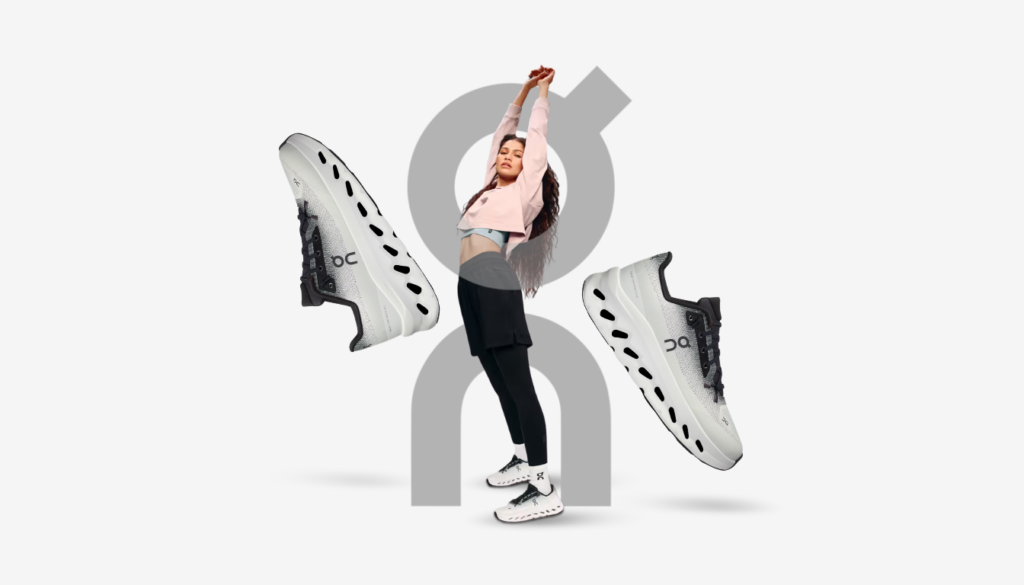
In an industry historically defined by polished outcomes and carefully constructed imagery, the latest campaign for On’s collaboration with Zendaya introduces a subtle yet significant recalibration, shifting attention away from the finished product and toward the far less visible, though infinitely more revealing, act of creation itself. Rather than presenting the collection as a resolved statement, the film unfolds as an exploration of ideas in motion, inviting viewers into a conceptual space where inspiration is still fluid, where forms are not yet fixed, and where the boundaries between thought and execution begin to dissolve.
In doing so, the campaign reflects a broader cultural shift in which audiences are no longer satisfied with surface-level storytelling, but are increasingly drawn to the processes, tensions, and decisions that shape what ultimately reaches them. It is within this context that the film finds its resonance, positioning creativity not as a hidden mechanism behind the brand, but as the very substance of its narrative.
Inside the Dream Lab
Set within a stark, almost clinical white room that operates simultaneously as a blank canvas and an internal landscape, the film constructs what it calls the “Dream Lab,” a space that exists somewhere between imagination and reality, where ideas are not merely conceived but physically enacted. Within this environment, Zendaya does not simply inhabit the scene as a model or figurehead but emerges as its central force, shaping, testing, and transforming the elements around her with an authority that suggests authorship rather than performance.
As the narrative progresses, her thoughts begin to materialize in increasingly surreal forms, most notably through the appearance of multiple arms that extend, twist, and gather behind her, evoking the multiplicity of ideas that coexist within any creative mind. What might initially appear as a visual flourish gradually reveals itself as a metaphor for the simultaneity and complexity of the design process, in which inspiration rarely unfolds in a linear sequence, but instead arrives in overlapping waves that must be navigated, refined, and ultimately resolved.
The result is a visual environment that feels at once abstract and deeply familiar, capturing the tension between control and unpredictability that defines creative work, while grounding it in a language that remains accessible and emotionally legible.
Spike Jonze and the Art of Controlled Surrealism
The campaign’s distinct tonal balance, which moves fluidly between clarity and abstraction, owes much to its direction, which embraces surrealism not as spectacle for its own sake, but as a deliberate strategy for rendering the intangible visible. Rather than simplifying creativity into a digestible sequence of steps, the film leans into its inherent contradictions, presenting it as at once chaotic and precise, instinctive and considered, elusive yet deeply structured.
This approach reflects an evolving understanding of how creativity is perceived and communicated within contemporary advertising, where audiences are increasingly attuned to authenticity and complexity, and where overly simplified narratives risk feeling disconnected from lived experience. By allowing the process to retain its ambiguity, the film does not diminish its clarity but instead enhances its credibility, offering a portrayal that feels both elevated and recognizably true.
Fashion in Motion
Central to this portrayal is the way in which the collection itself is brought to life, not as a series of static garments, but as forms in constant evolution, responding dynamically to Zendaya’s movements and interventions. Fabrics shift, silhouettes recalibrate, and materials appear to adapt in real time, as though guided not by external forces but by the internal logic of the creative process itself.
Through this lens, the clothing ceases to function merely as a product and instead assumes the role of outcome, the visible trace of an invisible sequence of decisions, experiments, and refinements. At the same time, this fluidity reinforces Zendaya’s position within the collaboration, not as a symbolic face of the campaign, but as an active participant in its construction, working alongside stylist Law Roach and the brand’s design team to shape a collection that reflects both personal perspective and collective expertise.
A New Role for Celebrity and Brand
In presenting Zendaya as both subject and creator, the campaign aligns itself with a broader transformation in the dynamics of celebrity partnerships, where the value of collaboration is increasingly measured not by visibility alone, but by the depth of creative involvement it represents. In this context, the distinction between endorsement and authorship becomes critical, particularly as audiences grow more discerning in their expectations of authenticity and intent.
For On, a brand that continues to extend its identity beyond performance into the more culturally nuanced territory of lifestyle, this positioning carries particular weight, allowing it to anchor its expansion in a narrative that feels both credible and contemporary. By foregrounding Zendaya’s creative agency, the campaign not only elevates the collection but also situates the brand within a broader conversation about who creates, who influences, and how meaning is constructed within modern fashion.
Selling Imagination in an Attention Economy
At a moment when visual saturation has rendered traditional product-centric storytelling increasingly interchangeable, the campaign offers a more layered proposition, suggesting that what truly captures attention is not the object itself, but the story of its becoming. By transforming the invisible mechanisms of creativity into a central narrative device, the film shifts the focus from ownership to understanding, inviting viewers to engage not only with what they see but also with the process that made it possible.
It is within this shift that the campaign finds its enduring relevance, as it moves beyond the immediate objective of promotion and enters a more reflective space, one in which fashion becomes a vehicle for exploring how ideas take shape, how they evolve, and why that evolution continues to resonate. In doing so, it does not merely present a collection, but offers a perspective on creativity itself, positioning it as both the origin and the outcome of the story being told.