
A Story Worth Wearing
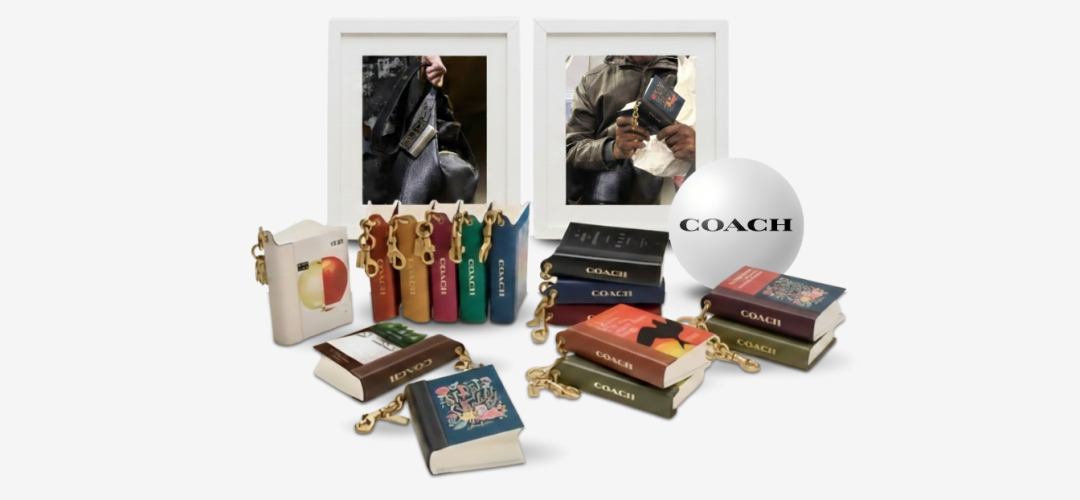
With its forthcoming collection of fully readable miniature book charms, Coach is not simply expanding its accessory line but articulating a broader thesis about identity, permanence, and the cultural value of narrative. These diminutive objects, meticulously crafted replicas of literary titles that hang from handbags, serve as more than embellishments; they are intimate declarations, subtle yet deliberate signals of taste and intellectual affinity.
At a time when fashion often competes for attention through spectacle, Coach appears to be pursuing resonance instead. The charm, in this context, becomes less a playful ornament and more a portable manifesto, suggesting that the story one chooses to carry can speak louder than any visible logo. In doing so, the brand elevates personalization beyond aesthetic customization and into the realm of self-definition, where the accessory becomes a curated extension of the wearer’s interior world.
The Strategy Behind “Coming Soon”
The deliberate framing of the collection as “coming soon” reveals a carefully paced marketing strategy that blends runway visibility with digital anticipation. By first allowing the charms to surface on the Spring 2026 runway, Coach generated intrigue within fashion circles before confirming availability through staggered online releases, effectively transforming curiosity into controlled demand.
Rather than saturating the market at once, the brand has opted for a chaptered rollout, pairing limited availability with waitlists and notification prompts that convert interest into measurable engagement. Scarcity here is not employed as an exclusionary tactic but as a narrative structure, inviting consumers to follow along as new titles emerge over time. The result is a launch sequence that mirrors the rhythm of publishing itself, where anticipation builds between releases and ownership feels earned rather than impulsive.
This calibrated pacing allows Coach to test demand signals while preserving the aura of exclusivity, ensuring that even a small leather charm can command attention out of proportion to its size.
Literature as Cultural Capital
The collection’s legitimacy is further reinforced through collaboration with Penguin Random House, a partnership that subtly reframes the charms as cultural artifacts rather than whimsical merchandise. By aligning with an established publishing authority, Coach positions the pieces within a lineage of literary credibility, ensuring that they feel anchored in tradition even as they circulate within contemporary fashion.
The choice of titles—spanning canonical classics and modern fiction—transforms each charm into a coded statement, allowing wearers to align themselves with particular values, moods, or intellectual affiliations without overt explanation. In a marketplace increasingly saturated with overt branding, this quieter form of signaling carries distinct power. To display a miniature novel is to participate in a shared cultural vocabulary, one that privileges narrative depth over immediate visual impact.
Through this synthesis of craft and culture, Coach effectively merges the aspirational language of luxury with the enduring authority of literature, suggesting that intellectual capital can serve as stylistic currency.
From Accessory to Attachment Strategy
Beyond its cultural symbolism, the collection operates strategically within Coach’s broader product ecosystem. Styled prominently alongside established icons such as the Tabby bag, the charms encourage layered personalization, transforming a single handbag into a platform for evolving expression. The base product provides the canvas, while the charm introduces narrative nuance, increasing both emotional attachment and incremental purchasing potential.
This approach resonates strongly with younger consumers who have embraced customization as a form of identity performance. The recent proliferation of bag adornments across social media—from plush tokens to metallic chains—has already recast handbags as storytelling surfaces. Coach’s intervention distinguishes itself through precision and authenticity: the charms are not abstract motifs but fully detailed, readable miniatures. This craftsmanship detail reinforces the brand’s heritage while justifying premium positioning.
In this sense, the book charm becomes both a cultural symbol and a commercial lever, strengthening product ecosystems while deepening emotional resonance.
Why It Resonates Now
The collection arrives at a moment marked by digital fatigue and a growing desire for objects that feel intentional rather than algorithmically generated. As consumers navigate feeds engineered for sameness, there is renewed appeal in artifacts that suggest reflection, permanence, and individuality. Literary aesthetics have quietly permeated contemporary culture, from online reading communities to curated “readcore” interiors, signaling a shift toward slower, more contemplative forms of self-expression.
Coach’s broader campaign narrative, centered on exploring one’s own story, aligns seamlessly with this sentiment. By proposing that identity is authored rather than assigned, the brand offers a counterpoint to the homogenizing forces of digital culture. The charm thus becomes a tactile reminder that narrative—personal, fictional, or aspirational—retains value in a landscape often defined by ephemerality.
The Bigger Implication
What may initially appear as a playful accessory launch ultimately reflects a deeper recalibration of luxury’s value system. Prestige today is no longer derived solely from material rarity or conspicuous branding; it increasingly emerges from meaning, context, and cultural fluency. By transforming literature into a wearable object, Coach positions itself at the intersection of fashion, publishing, and identity, suggesting that storytelling itself can function as a luxury good.
Whether the book charms become enduring collectibles or seasonal phenomena, their significance lies in what they represent: a recognition that consumers seek products that articulate who they are and what they believe, rather than merely what they can afford. In that shift, the smallest object may carry the greatest narrative weight.