
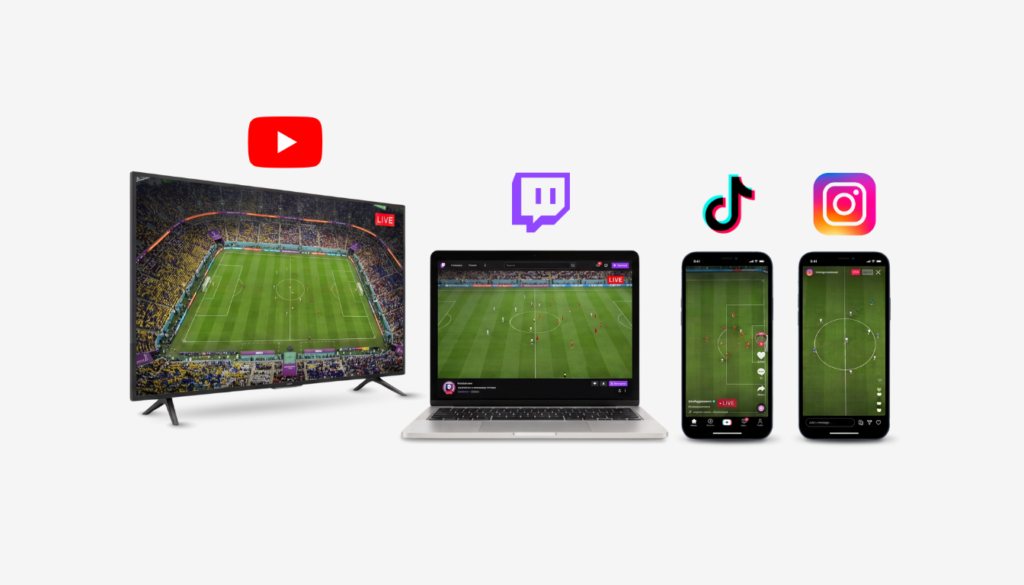
For six weeks, the 2026 World Cup produced a second tournament running alongside the matches. It played out on YouTube, Twitch, TikTok, and Instagram, and its broadcasters were creators rather than networks. The clearest sign of how far the shift has gone came at the final in East Rutherford, where IShowSpeed, a 21-year-old streamer from Cincinnati, became the first content creator to perform at a World Cup closing ceremony, leading drummers and dancers through his single World Cup (Champions) in front of more than 80,000 people. He arrived on that pitch with nearly 60 million YouTube subscribers and a following spread across seven platforms.
That moment is a useful marker for marketers, because it signals a change in who holds the audience during live sports and how brands should reach them.
The digital stadium
Live sports have always been compelling because of dynamic action and big plays, but traditional brand partnerships that take weeks to plan and execute are too slow to keep up with them. Creators solved that problem by turning their channels into what one observer called a digital stadium. Streamers ran watchalongs, stadium visits, and reaction sessions in real time, and clips from those streams circulated across platforms within minutes of the moments that produced them.
The appeal is not only speed. Fans feel an emotional connection to creators that turns them from passive viewers into participants. A streamer reacting to a Messi record or a last-minute goal gives the audience a perspective that a television broadcast cannot, and that intimacy deepens how invested viewers become in what they are watching. For a generation that consumes sports through second screens, the creator often is the broadcast.
Speed is the strategy
The tournament rewarded brands and businesses that could respond in real time. Smaller operators with a social presence captured the World Cup’s global appeal through a communal wave of user-generated content, and stories that would once have stayed local traveled worldwide because content was created around them as they happened. A neighborhood business could ride the same cultural wave as a global sponsor, provided it moved at the speed of the moment.
That immediacy is the capability traditional partnership models struggle to match. Creators can turn a match result into content while the emotion is still live, and prediction markets, out-of-home screens, and social feeds now act as a connected live feed for cultural relevance during major moments. The brands that treated the World Cup as a series of real-time opportunities, rather than a fixed set of pre-produced assets, stayed relevant throughout.
Authenticity is the product
The reason creators command this trust is that they have not softened their personas for sponsors. IShowSpeed’s brand partners structure deals around what he already does rather than asking him to become a spokesperson, which is why his commercial work performs. His Expedia partnership launched in late April 2026 with a 15-hour livestream across five Caribbean countries in a single day, reaching more than 400 million people across social platforms. The reach followed because the content stayed true to the creator.
That principle carries a warning for brands. When a company asks a creator to push its product within the first three seconds of a video, audiences recognize the ad and scroll past it. Trust in a creator does not transfer to a brand that overrides the creator’s voice. The brands that won gave creators the freedom to integrate a product in a way that felt native, and accepted that control is the price of authenticity.
What this means for brand planning
The World Cup accelerated a shift that was already underway, and it leaves marketers with concrete implications. Creator budgets can no longer sit at the edge of a media plan as a nice-to-have, because for younger audiences the creator is a primary channel, not a supplement to television. Reaching those communities effectively means spending with the voices they already choose to hear from.
The operational challenge is building the capacity to move fast. A brand that wants to capture live moments needs approval processes, creative partners, and social listening in place before the event, not assembled during it. The creators who defined this World Cup succeeded because responsiveness was built into how they work. Brands that want to borrow that relevance have to build the same muscle.
Traditional media did not disappear during the tournament, and it can still be authentic and effective. But a new wave of spending now has to be considered, one that treats creators as broadcasters and speed as a strategic asset. The final image of the tournament, a streamer performing before the world’s biggest football audience, is the clearest statement yet of where attention has moved. For marketers, the task is to meet it there.