
The Rule That Backfired
FIFA’s clean stadium policy is one of the most aggressive commercial controls in international sport. For the duration of the 2026 World Cup, every host venue across the United States, Canada, and Mexico was required to remove or cover any branding associated with companies that had not purchased official FIFA sponsorship rights, regardless of existing naming agreements, regardless of the cost of compliance, and regardless of the physical complexity of concealing a logo from a building’s exterior. The policy exists to protect the commercial ecosystem of official partners, many of whom paid up to $100 million for the right to be associated with the tournament. It is standard practice at major FIFA events and, in most cases, it works.
Levi’s Stadium in Santa Clara, California, officially rechristened the San Francisco Bay Area Stadium for the tournament’s duration, was not in most cases. The venue, which Levi’s has held naming rights to since 2014 through an arrangement the company extended just three years ago, posed a problem that FIFA’s clean stadium policy was not designed to handle. The brand’s signature logo, the red batwing shape that has been one of the most recognizable marks in American retail for more than a century, was printed at enormous scale across the stadium’s exterior facade. Covering the name was straightforward. Covering the shape was a different matter.
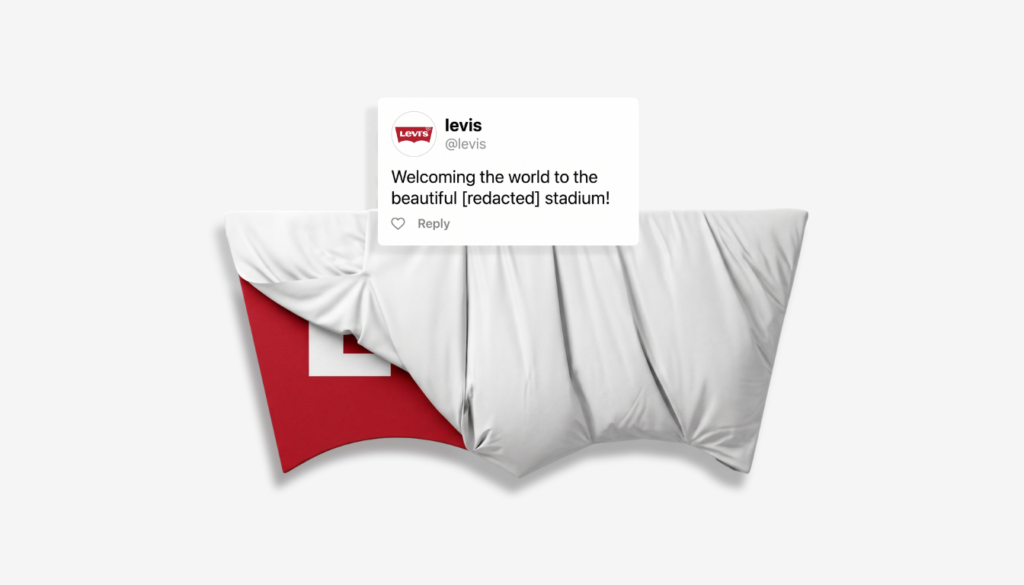
When the white tarp went up over the Levi’s logo ahead of the tournament’s opening matches, the letters disappeared entirely. The batwing shape, however, remained fully visible as a white silhouette against the facade. FIFA had covered the brand. The covering was shaped like the brand. The brand was still there.
The Internet Did the Rest
The images spread within hours of the first match at the venue. The covered logo, a giant white batwing pressed against the stadium wall, the name gone but the identity intact, became exactly the kind of absurdist visual that social media is designed to amplify: a rule followed so precisely that the spirit of it was entirely defeated, a brand erased so carefully that its erasure became its advertisement. The phrase “branding masterclass” appeared in comments across Twitter, Instagram, and TikTok almost simultaneously. BBC Sport posted the image. The Football Ground Guide called it a “cheeky tactic to bypass one of FIFA’s strictest rules.” The irony traveled globally and instantly.
Levi’s, for its part, understood the moment and did not overcomplicate it. The brand changed its Instagram profile picture to an image of the tarp-covered logo against a red background — the batwing silhouette in white, no name, instantly recognizable to anyone who has ever bought a pair of jeans. It posted a video set to the “nobody’s gonna know” TikTok audio, accompanied by the caption: “Welcoming the world to the beautiful [redacted] stadium!” The combination of the visual and the audio was precisely calibrated to the cultural language of the platform: self-aware, playful, and just cheeky enough to make the brand seem like it was in on the joke rather than the victim of it.
The content generated millions of views and earned media coverage that no paid campaign in the tournament matched in organic reach per dollar of investment — because the investment was zero.
What Levi’s Actually Did Right
The viral success of the covered logo was not entirely accidental, but it was not entirely planned either — and distinguishing between the two matters for understanding what the brand actually did well. The original decision to cover the logo with a tarp that preserved the batwing silhouette may or may not have been a deliberate creative choice. The structural reality is that the batwing shape on the stadium facade is physically what it is, and covering it with a rectangular tarp would have required either a much larger covering or a custom-shaped installation. The silhouette remained because it was the simplest solution to a practical problem.
What Levi’s did deliberately and well was recognize, in real time, that the solution to its practical problem had become a cultural moment — and to respond with exactly the right tone. The Instagram profile picture change is a detail that required a decision: someone at Levi’s saw the coverage spreading online and chose to lean into it rather than distance the brand from the compliance exercise. The “nobody’s gonna know” video and the “[redacted] stadium” caption required a creative team that understood the cultural context well enough to participate in the joke authentically. These were deliberate choices made quickly, and they were correct.
The deeper lesson is the one that the covered logo demonstrated without Levi’s doing anything at all: a brand so embedded in popular culture that its shape, stripped of its name and its colors, remains immediately recognizable to millions of people globally, does not need FIFA’s permission to be present at the World Cup. It was always going to be there. The white tarp just made that fact impossible to ignore.
The Broader Naming Rights Problem
The Levi’s moment is the most discussed expression of a commercial tension that runs through the entire 2026 World Cup’s relationship with its American host venues. Fifteen of the sixteen U.S. host stadiums carry commercial naming rights. FIFA’s policy requires all of them to disappear for the tournament’s duration. The scale of the compliance exercise — more than $1 million reportedly spent on signage removal at Houston’s NRG Stadium alone, temporary scaffolding structures erected at Gillette Stadium near Boston, the careful negotiation of a FIFA exemption for the Mercedes-Benz star mounted on Atlanta’s stadium roof that could not be removed without damaging the retractable roof structure — reveals the practical cost of staging a global sporting event in a commercial landscape built around permanent naming rights agreements.
For the brands affected, the situation creates an uncomfortable calculation: the naming rights investment that provides year-round visibility and local association is, during the World Cup, actively working against the brand by drawing attention to its absence. Houston spent $1 million to make NRG invisible. The effort generates its own news coverage. Levi’s spent nothing and generated more earned media than any naming rights brand at the tournament. The asymmetry does not suggest that compliance is wrong — FIFA’s clean stadium policy has clear commercial logic — but it does suggest that the brands most likely to emerge from the tournament with enhanced visibility are the ones with logos iconic enough that covering them only proves how recognizable they are.
That is a competitive advantage that cannot be purchased. It can only be earned, over decades, through the kind of brand equity that makes a white tarp over your name the most talked-about image at the biggest sporting event in the world.