
The Art of Elegant Failure
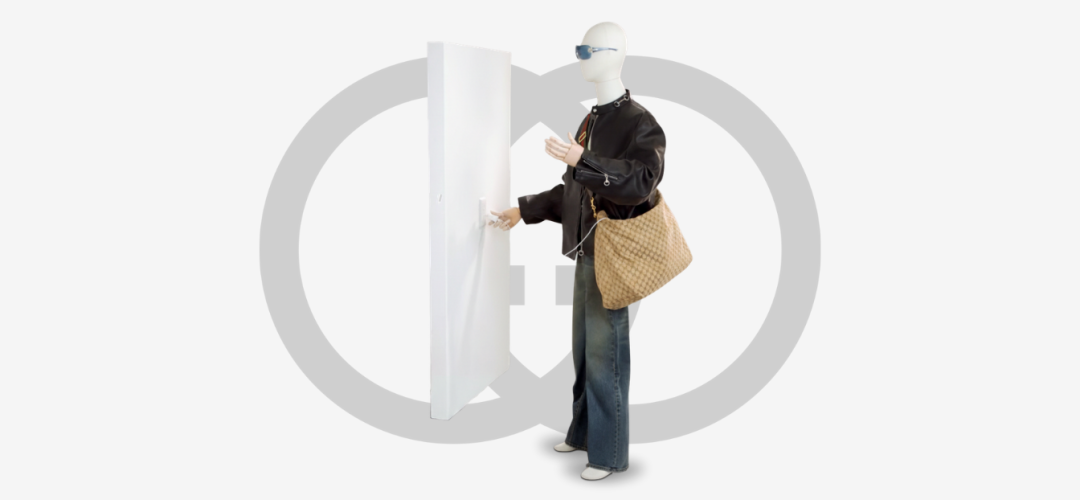
Luxury advertising has traditionally functioned as a theater of control, a carefully staged environment in which bodies move with certainty, objects behave obediently, and desire unfolds without resistance. Against that backdrop, Gucci’s campaign “Doing It Wrong”, launched in February 2026, feels almost disarmingly modest, centering on a mannequin that repeatedly attempts—and fails—to plug in a charging cable correctly. The action is simple, nearly banal, yet it unfolds with deliberate pacing, inviting viewers to linger in the hidden absurdity of a gesture everyone recognizes but rarely examines.
There is no dramatic arc, no sweeping romance, no overt declaration of product superiority. Instead, the narrative rests on repetition: the cable turned the wrong way, adjusted, reconsidered, and tried again. In that cycle of minor miscalculation, Gucci locates a shared experience that transcends geography and language, transforming a fleeting irritation into a cultural touchpoint. What might have been a throwaway joke becomes, in Gucci’s hands, a subtle exploration of how even the most polished surfaces are subject to friction.
When Perfection Meets Friction
The decision to cast a mannequin rather than a human model is central to the campaign’s resonance. Within fashion’s visual language, mannequins embody composure and authority; they are vessels of idealized form, untouched by doubt or clumsiness. By placing such a figure in a moment of technological incompetence, Gucci creates a striking contrast between aesthetic perfection and functional failure, allowing the humor to emerge not from exaggeration but from incongruity.
The mannequin’s struggle is restrained, almost clinical, avoiding slapstick in favor of repetition that feels eerily familiar. There is something quietly unsettling in watching a symbol of flawless presentation falter at a task so ordinary, and that tension lends the campaign its sophistication. Rather than dismantling luxury’s mystique, Gucci reframes it, suggesting that refinement need not exclude recognition of life’s minor glitches. In doing so, the brand narrows the emotional distance that has long defined high fashion, trading aloof aspiration for a more intimate form of cultural awareness.
A Meme Logic in a Couture Frame
The campaign’s structure mirrors the mechanics of contemporary digital humor, where a single, instantly legible scenario unfolds in rhythmic loops designed for short-form attention spans. The viewer requires no explanation; the act of fumbling with a cable is embedded in collective muscle memory. This structural simplicity, however, is executed within an unmistakably curated aesthetic, where composition, lighting, and pacing remain meticulously controlled.
Gucci is not borrowing meme culture superficially, nor diluting its identity to chase virality. Instead, it adopts the underlying logic of internet-native storytelling—clarity, repetition, recognizability—while preserving its visual authorship. The result is a campaign that feels culturally fluent without appearing reactive, as though the brand has absorbed the grammar of digital life and translated it into its own disciplined vocabulary.
In a media landscape governed by speed and fragmentation, such immediacy becomes an asset. A universally understood frustration travels farther and faster than a dense narrative, yet Gucci ensures that the concept retains the gravitas expected of a heritage house. The humor is subtle, the staging deliberate, and the absurdity contained within an art-directed frame.
Relatability as the New Luxury Code
Humor remains a precarious tool for luxury brands, which must balance accessibility with exclusivity. Too much levity risks eroding authority, while overt irony can slip into self-parody. “Doing It Wrong” navigates this terrain with precision by situating the joke within an abstracted, almost sculptural environment. The mannequin’s missteps are not chaotic; they are choreographed, controlled, and therefore elevated.
What emerges is a broader commentary on contemporary existence, where technological sophistication coexists with daily inefficiency. The charging cable, a minor object of modern dependency, becomes a symbol of our reliance on systems that promise seamlessness yet frequently demand patience. By dramatizing this friction, Gucci acknowledges the contradictions of digital life, positioning itself not above them but within them.
This subtle shift signals an evolution in brand storytelling. Luxury no longer relies solely on distance and unattainability to assert power; it increasingly demonstrates cultural literacy, showing that it understands the nuances of lived experience. Recognition, rather than pure aspiration, becomes the emotional anchor.
Why Getting It Wrong Feels Right
Ultimately, the campaign’s strength lies in its refusal to overstate its premise. By dedicating attention to a trivial inconvenience, Gucci elevates the ordinary into a site of aesthetic inquiry, proving that even the smallest gesture can carry symbolic weight when framed with intention. The mannequin’s inability to complete a mundane task does not diminish the brand’s authority; instead, it underscores a deeper confidence, one that allows for imperfection as part of a larger design.
In staging failure so carefully, Gucci demonstrates a paradox at the heart of modern luxury: control is most convincingly displayed when it accommodates vulnerability. The campaign suggests that sophistication today may lie not in projecting flawless distance, but in mastering the art of acknowledging friction. In turning a misaligned cable into a crafted narrative, Gucci shows that getting it wrong—when done deliberately—can feel unmistakably right.