
The Split That the Numbers Confirm
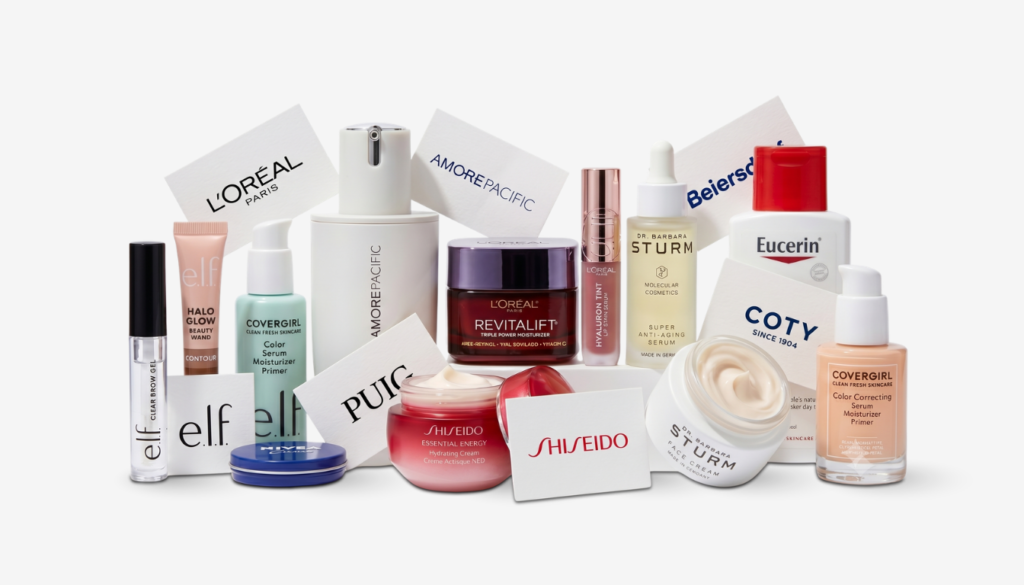
Beauty’s recent earnings season produced a chart that the industry will be studying for some time. Year-over-year sales growth for Q1 2026 showed L’Oréal at 6.7% and Amorepacific at 6.4% — both outperforming the broader market with meaningful momentum. Puig came in at 4.7%, Estée Lauder at 2.0%, Shiseido at 1.6%, and e.l.f. Beauty at 1.0%. Then the picture inverted: Beiersdorf contracted 4.6%, and Coty fell 7.0%. The industry’s consumer appetite is strong. The distribution of that appetite is anything but uniform.
The line separating the growers from the shrinkers is not primarily geography, scale, or brand heritage. It is the speed and quality of product innovation — specifically, the ability to deploy trending products when consumer demand is building rather than after it has peaked. L’Oréal and Amorepacific are launching products that connect with what consumers are actually talking about, searching for, and buying right now, and they are doing it frequently enough that their portfolio is consistently positioned at the front of the trend cycle rather than chasing it from behind. Coty and Beiersdorf, by contrast, are navigating the consequences of innovation pipelines that have fallen out of sync with the pace at which beauty culture now moves.
Why Speed Has Become the Primary Variable
Beauty has always been a trend-driven industry, but the mechanism that drives trends has changed fundamentally over the past five years, and the companies that have adapted their innovation models to the new mechanism are the ones growing. The shift from editorial beauty — where trends were set by magazines, runway shows, and professional makeup artists and took months to percolate into consumer behavior — to social beauty, where trends are set by creators on TikTok and Instagram and can move from niche discovery to mass demand in days, has compressed the window between trend identification and commercial opportunity to a point where traditional development cycles simply cannot capture it.
TikTok Shop processed over $3.4 billion in beauty-related transactions in Q1 2026 alone, a 41% year-over-year increase — a figure that represents not just a new distribution channel but a new trend engine operating at a speed that rewrites the assumptions underlying every beauty brand’s innovation calendar. The brands benefiting from this environment are those that have built organizational capabilities to move from trend signal to product launch in weeks rather than quarters, and that have invested in the creator relationships that position their products inside the content where trends are formed rather than marketing to audiences after the trend has already been discovered elsewhere.
L’Oréal’s consistent outperformance reflects exactly this capability. The company has invested heavily in both its direct creator partnerships and its digital innovation infrastructure, enabling it to identify emerging demand signals — through social listening, creator feedback, and real-time sales data — and translate them into products that arrive in market while the cultural moment is still building. Amorepacific benefits from a structural advantage: K-beauty as a global aesthetic movement has created sustained export demand for Korean beauty innovations, with brands like Aestura growing 9% in the Chinese market and international K-beauty momentum driving growth across multiple categories. Being at the origin point of a global aesthetic wave is, commercially, an enviable position.
The Gap Is Not Just About Products
What the Q1 2026 earnings make clear — and what Business of Fashion’s analysis emphasized — is that there is also a crucial distinction between companies that launch new products and companies that connect with customers through those products. The beauty consumer in 2026 is sophisticated, comparison-oriented, and acutely sensitive to whether a new product was designed for them specifically or developed by a brand that doesn’t quite understand who they are. Viral products fail when they are targeted imprecisely, when the creative execution misaligns with the community the product is reaching for, or when the product arrives without the creator ecosystem required to give it cultural context before it hits the shelf.
This is the subtler failure mode that the bottom half of the earnings chart represents. It is not simply that Coty and Beiersdorf aren’t launching new products — both companies have active development pipelines and significant retail footprints. It is that the products they are launching are not generating the kind of targeted, community-specific demand that translates into full-price sell-through. Coty’s challenges are compounded by structural issues — the loss of the Gucci license in 2028, an ongoing strategic review of its consumer beauty segment, and the prestige fragrance market’s move away from the double-digit growth rates that characterized 2023 and 2024 — but the underlying innovation alignment problem is real and separate from those structural factors.
The Innovation Imperative, Made Concrete
The practical implication of the Q1 2026 beauty earnings for brands across the category is a strategic imperative that admits very little nuance: the pace of innovation must match the pace of the culture, and the targeting of that innovation must be precise enough to generate community response rather than generic consumer awareness. These are not new ideas in beauty marketing, but the gap between brands that execute them well and those that execute them poorly has widened to the point where it is visible in quarterly earnings data.
For the companies at the top of the chart, the challenge is sustaining the operational capabilities that produced their results as their portfolios grow larger and their organizational complexity increases. L’Oréal’s acquisition of Kering Beauté in early 2026 — adding Gucci’s beauty license to a portfolio that already spans mass, prestige, luxury, and dermatological skincare — is both a growth opportunity and an integration challenge that will test whether the company’s innovation speed can be maintained across an expanded product architecture.
For the companies at the bottom, the path back to growth runs through the same capabilities that produced the divergence in the first place: faster development cycles, tighter creator relationships, more precise community targeting, and a willingness to launch products that are designed for specific audiences rather than optimized for the broadest possible market. In an industry where a single viral moment can move a brand from obscurity to waitlist status in a matter of weeks, the cost of moving slowly is not measured in missed opportunities. It is measured in market share that, once lost to a competitor embedded in the culture, is exceptionally difficult to recover.