
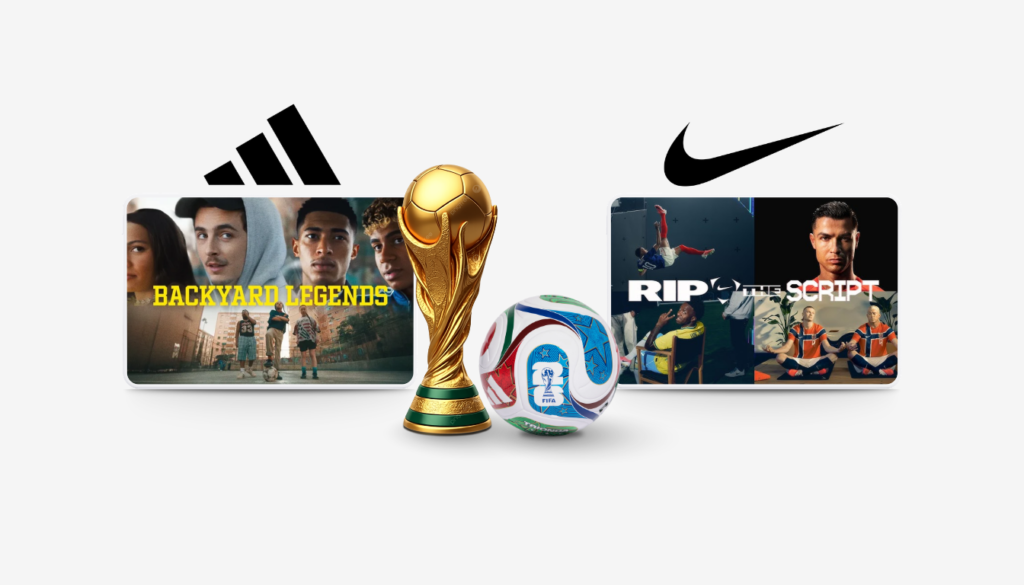
The Scoreoard That Tells One Story
In less than a week since its release, Nike’s “Rip The Script” has accumulated 66 million views on YouTube. Adidas’ “Backyard Legends,” which has been on the platform for more than a month, has not broken 7 million. In the immediate attention economy — where virality is currency and view counts are the only numbers most people discuss — the verdict looks definitive. Nike won.
The story is real and the numbers are not in dispute. “Rip The Script,” created by Wieden+Kennedy and directed by Dan Streit, became one of the fastest-accumulating sports advertising films in recent memory almost from the moment it dropped. Its 30-plus person cast, its self-aware Hollywood premise, its embedded Easter eggs and 185 follow-up shorts, its algorithmic versatility across K-pop, hip-hop, basketball, and football communities simultaneously — all of it combined to produce the kind of organic propagation that a brand cannot buy and rarely manufactures. The film is genuinely excellent, and the views reflect that.
But anyone who has spent time in the advertising industry knows that view counts and commercial effectiveness are related but not identical things, and that the gap between them is where the more interesting conversation lives.
Two Brands, Two Completely Different Briefs
To compare Nike and Adidas at the 2026 World Cup fairly, it is necessary to understand that the two brands entered the tournament from structurally different positions — not just strategically different ones. Adidas has been the official FIFA partner for decades. It has the official match ball. It supplied 14 federation kits for the 2026 tournament. Its commercial presence at every match is guaranteed regardless of what its advertising does or doesn’t achieve. The federation relationships, the match ball placement, the tournament infrastructure — these generate product visibility and revenue pipeline that the campaign is there to amplify, not to create from scratch.
Nike, which didn’t produce its first major World Cup campaign until 1994, has always been the disruptive interloper at a tournament it doesn’t officially sponsor. It has no guaranteed visibility. Every piece of attention it earns is earned purely through the quality and reach of its marketing. The asymmetry means that Adidas, for all of its creative ambition with “Backyard Legends,” is playing with a safety net. Nike is playing without one. A weaker Adidas campaign still generates enormous commercial return from infrastructure. A weak Nike campaign generates essentially nothing.
What “Backyard Legends” Got Right
The creative industry’s verdict on “Backyard Legends” has been warmer than the view count suggests. Adidas, working with agency Lola and director Mark Molloy, produced a narrative-centered film that uses nostalgia, time shifts, and cultural reference to build genuine emotional depth over five minutes. Timothée Chalamet plays a fast-talking football obsessive assembling his dream team from young underdogs — a premise that is rooted in the game’s culture rather than orbiting it from the outside. The cast, which includes Messi, Beckham, Lamine Yamal, Jude Bellingham, Zinedine Zidane, and Trinity Rodman, feels like a genuine football family rather than a celebrity roster assembled for maximum algorithmic reach.
The film’s deliberate 1990s visual register — urban pitches, analog aesthetics, the crossover of hip-hop and sportswear that defined that era’s street culture — is a calculated act of nostalgia aimed at the generation that last watched a World Cup on American soil in 1994. The timing is intentional and the emotional logic is coherent: Adidas is welcoming football home, in a language that the people who grew up with it will recognize. “By using celebrities as more of characters to propel the story, the storytelling stays anchored in the game,” noted one creative industry analyst. “The campaign strengthens fan connection through legacy, familiarity, and cultural memory.”
What “Backyard Legends” lacks is distribution velocity. A film that is emotionally resonant but travels slowly in the current social media environment is, in commercial terms, a film that reaches a smaller audience than it deserves — and the 7 million view comparison with Nike’s 66 million reflects something real about the structural difference between a campaign built for emotional depth and one built for algorithmic spread.
What Nike Got That Adidas Didn’t
“Rip The Script” was engineered to travel. Every casting decision, every embedded detail, every follow-up short, every Easter egg designed for second-watch discovery — all of it was constructed with the specific goal of generating organic propagation across multiple, distinct cultural communities simultaneously. LISA brings K-pop. Young Miko brings Latin trap. Central Cee brings UK street culture. LeBron and Kim Kardashian bring American entertainment audiences who are only now beginning to develop a football relationship as the World Cup arrives on home soil. Ted Lasso brings the streaming generation of new football converts. Ronaldinho and Cantona bring the football purists who grew up watching the legends.
The 185 follow-up shorts are not bonus content — they are the infrastructure of sustained engagement, ensuring that there is always something new to discover, share, or argue about across the full 12 weeks of the tournament. The film is Episode 1 of a serialized universe, not a single statement piece. It is designed to compound attention rather than peak and decay.
The approach has its own risk. Nike’s VP Helena Thornton was transparent about the challenge: the film was trying to win both “young, devoted fans and the soccer-curious” simultaneously — an audience so broad that any attempt to serve it completely risks serving no part of it well enough. A campaign that speaks to twenty communities at once could, in a less skillfully executed version, feel like it belongs to none of them. “Rip The Script” avoids that outcome, but only barely, and only because the underlying creative idea — instinctive football, the beauty of the unscripted moment — is strong enough to hold the sprawl together.
The Real Competition Starts Now
The view count battle is the opening act of a commercial competition that will not be decided until well after the final whistle on July 19. Adidas enters the tournament with the infrastructure guarantee — federation kits, official ball, FIFA partnership — that makes its baseline commercial return largely independent of whether “Backyard Legends” continues to accumulate views. Nike enters with a cultural ecosystem it has spent months constructing, a film that has outperformed every short-term metric, and a turnaround story that its CEO has explicitly tied to the commercial performance of football during this tournament.
The question that will define the real winner is not who had the more watched film. It is whose campaign drove product demand and brand preference in the categories that matter — football boots, federation kit replicas, lifestyle collections — across the weeks when attention is highest and purchase intent is live. Nike’s 66 million views mean nothing if they don’t move inventory. Adidas’ 7 million views are entirely adequate if the federation kits sell out and the Predator boot posts record numbers.
Both brands made significant, well-executed bets on a tournament that arrives at a pivotal moment for each of them. Both bets are still in play. The real scoreboard opens June 11 and closes July 19, and it measures something that YouTube’s counter can’t.