
The Number That Changes the Conversation
When On Holding reported its first quarter 2026 results, the company couldn’t help leading with its gross margin. At 64.2% — up from 59.9% the previous year — it was a new record for the Swiss brand and a figure that, when placed next to the industry’s most recognizable names, does something unusual: it removes On from the conventional sportswear competitive set and places it in a different category entirely.
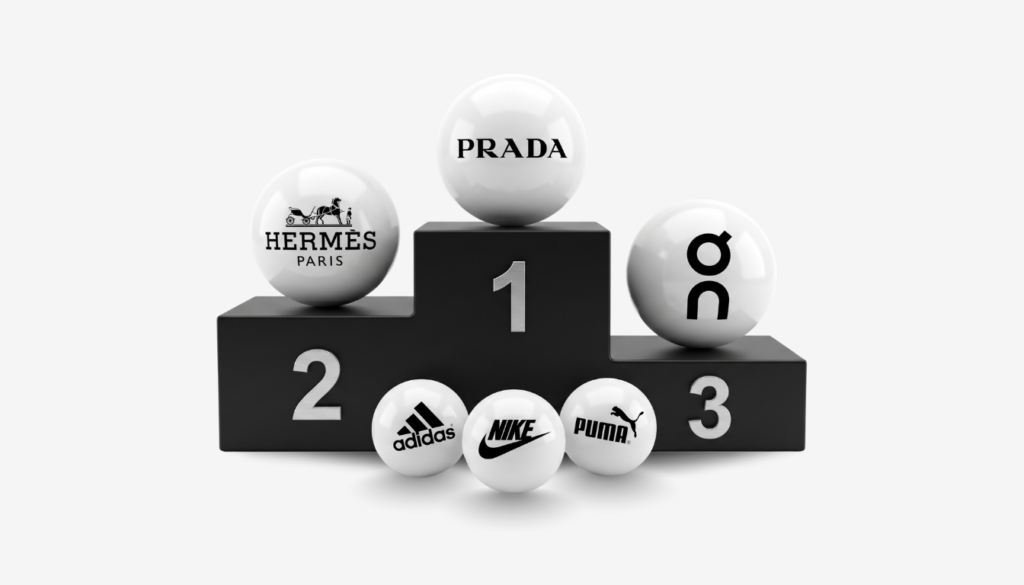
The Business of Fashion’s margin comparison makes the point with unusual clarity. Adidas, one of the two most powerful sportswear brands on earth, reported a gross margin of 51.1%. Puma came in at 47.7%. Nike, the sport’s most commercially dominant brand for decades and a company in the middle of a significant turnaround effort, reached 40.2% in its most recently reported quarter. On Running, at 64.2%, does not merely outperform its direct competitors. It sits between them and the luxury tier — closer to Hermès at 71.1% and above Prada Group at 80.3% in terms of market positioning logic, even if the absolute figure remains below those houses. The peers On is converging with are not running shoe companies. They are the most desirable brands in the world.
What a Gross Margin Actually Measures
The gross margin — the percentage of revenue that remains after subtracting the direct costs of producing goods — is useful precisely because it is difficult to manufacture through accounting or short-term financial engineering. It is, structurally, a measure of how much consumers are willing to pay above cost for what a brand offers them. A brand with a high gross margin is a brand whose products command a significant premium over their production cost — which means a brand that has persuaded consumers, at scale and with consistency, that what it offers is worth considerably more than what similar objects cost to make.
Nike’s 40.2% margin reflects a brand under pressure: aggressive inventory management, pricing competition, tariff headwinds, and a strategic recovery that requires margin sacrifice in the short term. Adidas at 51.1% reflects a brand in better position but still navigating the economics of mass-market sportswear, where distribution scale and price accessibility are structural constraints on how high margins can go. On at 64.2% reflects a brand that has achieved something structurally different — a full-price execution discipline that allows it to sell almost nothing at discount, in a product category where discounting has historically been the default mechanism for managing inventory and driving volume.
On’s co-founder David Allemann described the moment with the language of a structural thesis rather than a quarterly result: “We are witnessing a fundamental societal shift, as people globally replace traditional markers of status with a commitment to health, longevity, and performance.” The statement is a brand positioning argument embedded in an earnings call — a description of why On’s gross margin is not a temporary achievement but a structural consequence of a genuine change in what premium means to the consumer.
How On Built a Luxury Margin in a Sportswear Category
The margin On has achieved did not emerge from a single product innovation or a fortunate market window. It emerged from a consistent set of brand and business decisions made over several years that collectively positioned the company outside the price architecture that governs conventional sportswear competition.
The first decision was to resist the distribution logic of the mass market. On has grown its direct-to-consumer channel aggressively — with new store openings in Seoul, Shenzhen, and London in the most recent quarter — while maintaining selective wholesale distribution that avoids the markdown pressure of over-distributed sportswear. The brand’s presence in premium retail environments, its avoidance of the outlet channel, and its refusal to use promotional pricing as a demand lever have all protected its price integrity in ways that Nike and Adidas, with their enormous global distribution footprints, structurally cannot replicate at the same level.
The second decision was to invest in product innovation at a level that justifies premium pricing on functional grounds. The LightSpray technology, introduced in 2024 and expanded through the Cloudmonster Hyper in 2026, is a genuine technological differentiator — a manufacturing process that creates shoes using a robotic spray system, producing a structure that is both lighter and more structurally precise than conventional construction. When a running shoe has a verifiable performance reason to cost more, the premium is easier to sustain against the gravitational pull of competitive pricing.
The third decision was to align the brand with cultural figures whose association signals aspiration rather than accessibility. Roger Federer’s equity stake and brand partnership, Zendaya’s apparel collaboration — these are choices that position On adjacent to the luxury and entertainment world rather than squarely within the athletic performance category. The result is a brand that performance runners choose for technical reasons and lifestyle consumers choose for cultural ones, a dual appeal that is exceptionally rare in sportswear and commands a margin premium in both dimensions simultaneously.
What It Means for the Rest of the Industry
The competitive implications of On’s margin trajectory extend well beyond the brand itself. If a sportswear company can consistently achieve gross margins approaching the luxury tier — while growing net sales at 26% year-over-year, raising full-year guidance to at least 64.5% gross margin, and doing so against headwinds including U.S. tariffs — it changes the benchmark against which every other brand in the category is measured.
For Nike, whose gross margin contraction has been one of the most visible indicators of its current strategic challenges, the On comparison is uncomfortable. The gap between 40.2% and 64.2% is not a gap that can be closed through a single product launch or a year of improved execution. It represents a structural difference in how the two brands are positioned in the consumer’s mind — and changing that positioning, at Nike’s scale, is measured in years rather than quarters.
For the broader sportswear industry, On’s trajectory raises a question that has not previously needed to be asked with such urgency: is there a path for a performance footwear brand to operate at luxury economics, at global scale, without becoming a luxury brand in the conventional sense? On is attempting to answer that question in real time, in the market, with financial results that so far suggest the answer is yes. The industry is watching with the combination of admiration and unease that tends to accompany the emergence of a genuinely new competitive model.