
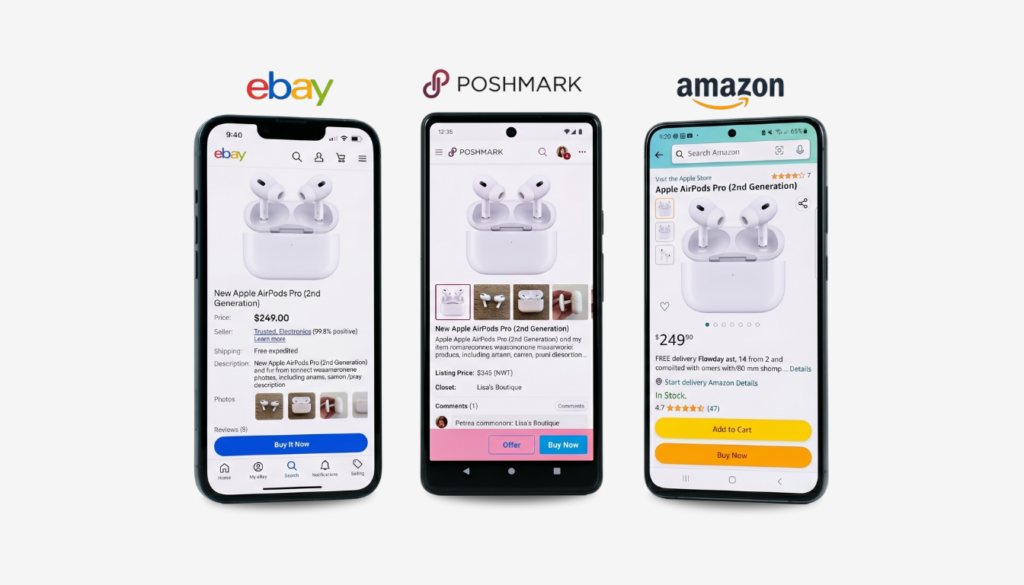
Resale used to be a simple, persuasive argument. It was cheaper than buying new, less wasteful than traditional retail, and often more interesting than walking into a store where the assortment had already been decided by someone else. That combination helped turn secondhand shopping from a niche habit into a mainstream consumer behavior, particularly among younger shoppers who have become fluent in mixing vintage finds, luxury pieces, fast-fashion staples, and peer-to-peer discoveries inside the same wardrobe.
But the market that once positioned itself as an alternative to retail is now becoming one of retail’s most crowded battlegrounds. Platforms such as eBay, Poshmark, Depop, Vinted, The RealReal, and ThredUp are no longer simply trying to persuade consumers that buying used is acceptable, because that argument has largely been absorbed into the culture. The more difficult task is now one of distinction: why should a shopper begin a search on one marketplace rather than another, trust one seller ecosystem over a competitor’s, or return to a particular app when the promise of secondhand value exists almost everywhere?
That is why the new resale marketing playbook looks more sophisticated than the old one. Sustainability still matters, and affordability remains a powerful motivator, especially in a consumer environment shaped by inflation, higher living costs, and more selective spending. Yet neither of those ideas is distinctive enough to carry a platform on its own anymore. Every resale company can talk about circularity, every marketplace can promise better prices, and every brand can describe secondhand as a smarter way to shop. The competitive edge now sits in the more specific territory of identity, convenience, trust, taste, community, and cultural relevance.
The End of Generic Secondhand
The growth of the secondhand market is driven by several consumer shifts. Shoppers are more cautious with money, fashion cycles are moving faster, social media has made discovery more fragmented, and younger consumers are increasingly comfortable building personal style from a mix of old and new rather than treating full-price retail as the default. That creates a major opportunity for resale platforms, but it also creates a branding problem: when everyone is selling pre-owned goods, the mere existence of inventory is no longer enough.
This is why resale marketplaces are increasingly behaving less like simple classified platforms and more like media brands, fashion editors, and lifestyle ecosystems. They are not only organizing supply and demand; they are shaping the meaning attached to what appears on their platforms. The same pre-owned jacket can be framed as a bargain, a collectible, a sustainable choice, a luxury investment, a personal style statement, or a symbol of belonging, depending on the marketplace in which it is presented.
For eBay, that means making resale feel credible, stylish, and culturally mainstream. For Poshmark, it means turning the closet into a social-commerce engine where personal networks and seller identity matter as much as the item itself. For Depop, it means positioning secondhand as a form of taste, self-expression, and economic participation. For The RealReal, it means selling luxury resale through the language of authentication, expertise, and value preservation. For Vinted, it means expanding resale beyond fashion and into the wider rhythm of life stages, where people buy and sell as their needs change.
The products may overlap, but the narratives around them are increasingly diverging. That divergence is the clearest sign that resale is no longer marketed as a single universal idea, but as a set of distinct consumer propositions built around different motivations, identities, and moments of need.
eBay Wants Resale to Look Like Fashion Authority
eBay’s resale strategy is one of the clearest examples of how much the category has evolved. The company already has what many younger marketplaces are still trying to build: scale, inventory, recognition, and a long history of marketplace trust. Yet scale alone does not automatically create fashion desire, especially among younger consumers who discover style through feeds, creators, archival references, celebrity wardrobes, and cultural moments rather than solely through search boxes.
That is why eBay has been working to make secondhand feel more aspirational. Its fashion-week initiatives, luxury authentication programs, and entertainment partnerships all point to a company trying to shift perception from a broad online marketplace to a legitimate style destination. The goal is not simply to remind consumers that eBay sells pre-owned fashion, but to make that inventory feel curated, credible, and culturally validated.
This distinction matters because fashion resale depends on both trust and imagination. A shopper needs to believe that a designer bag, archival jacket, or collectible sneaker is authentic, but also that it belongs in the current cultural conversation. A pre-loved piece becomes more desirable when presented not as leftover inventory but as a find with history, scarcity, and taste.
That is the role eBay is trying to claim as competition intensifies. It wants to make resale feel expansive and authoritative without losing the discovery-driven thrill that made marketplace shopping appealing in the first place. Its push into fashion partnerships and youth-facing cultural channels reflects a broader realization: to win the next generation of resale shoppers, a platform cannot simply have the item. It also has to provide the context that makes the item matter.
Poshmark Turns the Closet Into Infrastructure
If eBay’s strength has historically been scale, Poshmark’s has been social behavior. The platform built its identity around closets, sellers, sharing, and community, creating a version of resale that felt less like anonymous commerce and more like a network of personal storefronts. That model gave Poshmark a distinct emotional texture, because shopping there was not just about what was available, but about whose closet it came from and how people interacted around it.
As the market becomes more competitive, however, the community has to be paired with convenience. Resale’s biggest barrier is not necessarily consumer interest; in many cases, shoppers already like the idea of buying and selling secondhand. The harder part is participation. Listing an item takes time, pricing requires judgment, photos need to be taken, descriptions need to be written, and sellers have to believe that the potential return is worth the effort.
That is why Poshmark’s newer direction is strategically important. By making resale more closely connected to shopping histories, payment ecosystems, and AI-supported listing tools, the platform is moving toward a future in which selling is not treated as a separate chore, but as a natural extension of ownership. A consumer buys, wears, outgrows, reconsiders, and resells, all within a cycle that feels less manual and more integrated.
The marketing opportunity is therefore larger than the familiar idea of cleaning out a closet. Poshmark can frame the wardrobe as a form of personal commerce infrastructure, where items do not simply sit unused after purchase but retain social, financial, and emotional potential. In that world, resale becomes less about getting rid of things and more about managing value over time, with the platform acting as the bridge between personal style and personal economics.
Depop Sells Taste Before It Sells Clothes
Depop’s advantage is different because it is more cultural than operational. While many resale platforms compete on breadth, trust, or convenience, Depop’s strongest asset is its understanding of secondhand as a language of identity. On the platform, shopping used is not only a way to save money or reduce waste; it is a way to signal taste, participate in micro-trends, build an aesthetic, and find pieces that feel less predictable than what mainstream retail can offer.
That positioning has become increasingly valuable as fashion culture fragments. Younger shoppers are not necessarily looking for one dominant trend handed down from a runway, retailer, or magazine. They are moving through aesthetics, references, and subcultures at high speed, often using resale to assemble looks that feel personal, ironic, nostalgic, or hyper-specific. Depop fits naturally into that behavior because it turns secondhand discovery into self-expression.
More recently, the platform’s marketing has added an economic layer to that identity story. By presenting resale as a way to fund everyday expenses, Depop connects personal style to personal finance in a way that feels especially relevant to young consumers navigating higher costs and more uncertain economic conditions. The closet is not merely a place where taste is stored; it becomes a source of liquidity.
That gives Depop a more layered proposition than the standard resale pitch. It is not only arguing that secondhand is cool, but also that it is practical. It is presenting resale as a taste economy, where style, community, and income generation reinforce one another. The platform becomes less like a traditional store and more like a cultural exchange, where what people sell says almost as much as what they buy.
Luxury Resale Becomes a Value Argument
At the premium end of the market, The RealReal is operating under very different consumer expectations. Its central challenge is not to make resale feel playful, social, or trend-driven, but to make high-value secondhand purchases feel safe, informed, and worth the investment. In luxury, the stakes are higher, and so the emotional appeal of discovery must be supported by a stronger infrastructure of confidence.
That is why authentication, expertise, and resale value sit at the center of its positioning. A shopper buying a designer handbag, watch, piece of jewelry, or rare garment is not simply looking for a lower price; they are looking for reassurance that the item is genuine, that its condition has been properly assessed, and that its value makes sense in relation to both the primary luxury market and the broader resale ecosystem.
This is one of the most important shifts in luxury resale marketing. The category is no longer framed only as a way to access designer goods at a discount. Increasingly, it is being positioned as a more considered way to participate in luxury, especially as new-product prices continue to rise and shoppers become more selective about what deserves their money. Resale, in that context, becomes less of a compromise and more of an informed consumption.
The tone of the marketing has to reflect that. A luxury resale platform cannot behave exactly like a youth-fashion marketplace or a peer-to-peer closet app. It has to sell confidence as much as desire, because the product is not just a handbag or watch, but the assurance that the purchase has been authenticated, contextualized, and priced with expertise. The more luxury shoppers consider resale value before buying new, the more The RealReal’s proposition begins to resemble not just commerce but asset logic.
Vinted Expands the Resale Occasion
Vinted’s strategy points to another important evolution in the market: the expansion of resale beyond fashion. By positioning secondhand across different stages, transitions, and “eras” of life, the platform suggests that resale is not something consumers do only when they want clothing. It is something that can accompany them through moves, new hobbies, family changes, home updates, and shifting personal priorities.
That framing matters because resale platforms need to grow in frequency. Fashion can generate strong engagement, especially among style-conscious shoppers, but life itself creates repeated reasons to buy and sell. People change apartments, start new hobbies, have children, redecorate rooms, replace devices, abandon interests, and discover new ones. Each of those moments can produce both supply and demand, making resale less dependent on occasional wardrobe cleanouts and more embedded in everyday consumption.
The broader the resale occasion becomes, the more a platform can move from a shopping destination to a practical utility. That distinction is important because a fashion marketplace competes for attention, while a lifestyle resale marketplace competes for habit. If secondhand becomes the first place a consumer checks before buying something new, the platform has achieved something much more powerful than campaign awareness.
For Vinted, the opportunity is to normalize resale as part of how people move through life, rather than as a special category reserved for vintage lovers or sustainability-minded shoppers. The message becomes less about finding one exceptional piece and more about making secondhand feel like a practical, repeatable, and emotionally intuitive part of modern consumption.
Technology Becomes the New Brand Promise
Behind these increasingly distinct marketing narratives is a less visible but equally important source of competition: technology. Resale may be culturally compelling, but it remains operationally complicated. Unlike traditional retail, where products are standardized, professionally photographed, and stocked in predictable ways, secondhand commerce is built on millions of unique items, each with its own condition, size, history, seller behavior, and presentation.
That complexity can either create magic or friction. The same abundance that makes resale exciting can also make it exhausting. Search results can feel messy, product descriptions can be incomplete, photos can vary wildly in quality, and shoppers often have to work harder to determine whether an item is worth buying. Sellers face a different version of the same problem: they have to photograph, describe, price, and upload items with enough accuracy to attract buyers, but not so much effort that the process becomes discouraging.
This is why AI-powered listing tools, personalized feeds, smarter search, and automated product descriptions are becoming central to the resale playbook. They may sound like product features, but they carry real marketing weight because they address one of the category’s biggest weaknesses: the gap between the appeal of secondhand and the effort required to participate in it.
The platforms that narrow that gap will be in a stronger position to compete not only with other resale marketplaces but with traditional ecommerce. Consumers may like the idea of secondhand, but many still expect the convenience, personalization, and reliability of buying new. The company that makes resale feel just as easy while preserving the thrill of discovery will have a more durable advantage than the one that relies only on inventory volume or sustainability messaging.
In resale, better technology is not simply an operational upgrade. It becomes part of the brand promise, allowing a marketplace to say that it does not merely offer more things, but makes the entire secondhand experience easier to trust, easier to navigate, and easier to repeat.
The New Playbook Is About Meaning
The resale market’s next phase will not be won by the platform that repeats the broadest sustainability claim or shouts the loudest about low prices. Those messages remain important, but they no longer provide enough differentiation in a category that has become mainstream, competitive, and culturally complex. The next phase belongs to companies that understand what kind of resale behavior they own and can communicate that ownership with clarity.
eBay wants to own a trusted scale and fashion legitimacy. Poshmark wants to own social selling and closet monetization. Depop wants to own youth taste, self-expression, and the economics of personal style. The RealReal wants to own authenticated luxury value. Vinted wants to own resale as an everyday life tool. Each of these positions responds to a different consumer need, which is precisely why the market is becoming more sophisticated.
Together, these strategies show that secondhand is no longer being marketed as the opposite of retail. It is becoming a more flexible version of retail, shaped by culture, technology, financial pressure, identity, and changing expectations around ownership. That makes the category more competitive, but it also makes it more meaningful, because resale is no longer just about extending product life. It is about giving consumers new ways to assign value to what they buy, wear, sell, and keep.
The resale boom has therefore created a more interesting question for shoppers and marketers alike. Not simply, “Should I buy secondhand?” but “Which secondhand world do I want to belong to?”