
Zara’s New Drop Is Really a Cultural Strategy
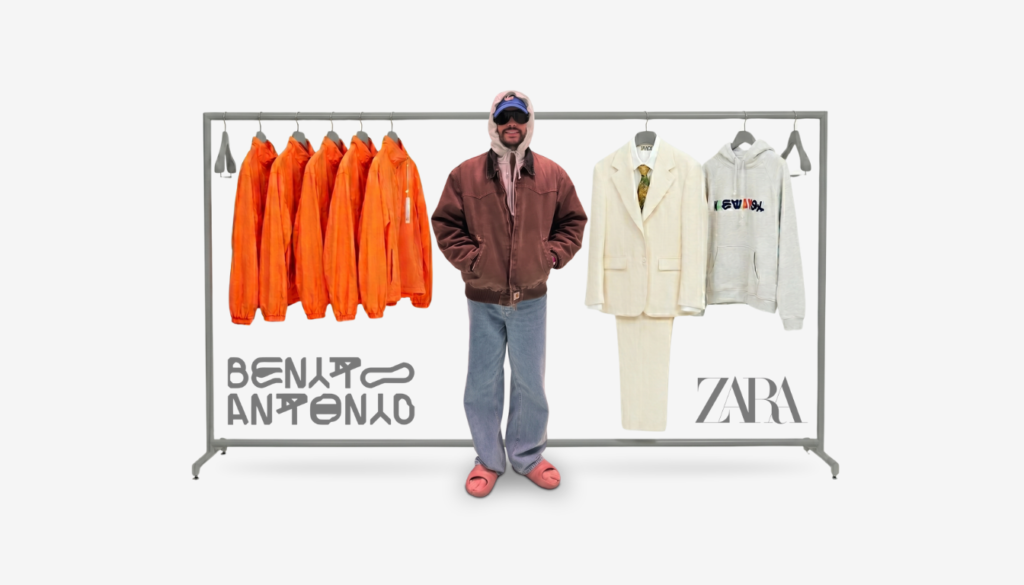
When Zara introduced its new collaboration with Bad Bunny under the name Benito Antonio, the decision immediately gave the project a more layered meaning than a conventional celebrity capsule. The brand could have leaned entirely on the performer’s global name recognition, plastered the collaboration with Bad Bunny’s stage identity, and treated the collection as another high-demand retail moment built around fame, fandom, and scarcity. Instead, Zara chose to foreground Benito Antonio Martínez Ocasio, the person behind one of the most influential cultural figures in the world, and in doing so repositioned the drop as something more intimate, more rooted, and more strategically useful.
That distinction is important because Bad Bunny is no longer simply a musician with a massive audience. He has become one of the clearest examples of how contemporary celebrity now operates across music, fashion, identity, and cultural politics simultaneously, especially among younger consumers who rarely separate what they listen to from what they wear, what they share, and what they believe says something about them. His style has long moved between streetwear, tailoring, gender-fluid silhouettes, Caribbean references, and luxury codes, not as a detached styling exercise, but as part of a broader artistic language that has made him feel both globally dominant and personally specific.
For Zara, that makes him more valuable than a famous ambassador. He becomes a shortcut into a cultural world the brand wants to enter with more credibility. At a time when fast fashion can no longer depend solely on speed, trend reproduction, and endless product rotation to feel relevant, Benito Antonio gives Zara something harder to manufacture: emotional meaning. The collection does not only ask consumers to buy into a look. It asks them to buy into a story that already carries music, memory, identity, and fan devotion.
Puerto Rico Was the Message
The most revealing part of the launch was not only what the collection looked like, but where Zara chose to introduce it. By presenting Benito Antonio first at Plaza Las Américas in San Juan, Puerto Rico, the brand avoided the predictable symbolism of a debut in New York, Madrid, Paris, or London, and instead placed the collaboration in the geography that gives Bad Bunny’s cultural influence much of its emotional force.
That choice turned Puerto Rico into more than a location. It became the message. For fans, the island-first reveal suggested that the collection was not imposed from the outside by a global fashion machine seeking relevance, but was introduced from within the world that shaped the artist. For Zara, the decision allowed the launch to feel less transactional and more culturally anchored, giving the collaboration a sense of origin that many celebrity partnerships struggle to create after the fact.
This is where the strategy becomes especially sharp. Zara borrowed the emotional infrastructure around Bad Bunny’s reach. The store became part of the campaign, the local crowd became part of the media plan, and the limited first-access in San Juan turned the launch into a moment the rest of the world had to watch before it could fully participate. In that sequence, geography became storytelling, scarcity became anticipation, and retail became a stage for cultural belonging.
Selling the Wardrobe, Not the Merch
The strongest celebrity collaborations are rarely the ones that look most like merchandise, because merchandise usually speaks first to fans and only secondarily to fashion. Benito Antonio appears to understand that difference. Rather than relying solely on obvious logos, slogans, or collectibles, the collection translates Bad Bunny’s personal style universe into a broader wardrobe language that can appeal to devoted fans without alienating Zara’s regular customers.
The capsule leans into relaxed tailoring, knitwear, denim, sweatshirts, stripes, colorful pieces, and casual silhouettes, creating a visual world that feels connected to Benito without becoming costume-like. It carries traces of Caribbean nostalgia, streetwear ease, summer dressing, and personal memory, while remaining commercially wearable enough to live beyond the initial frenzy of the drop. That balance is essential because the collaboration’s power depends not only on people wanting to own something associated with Bad Bunny but also on their ability to imagine those pieces inside their own lives.
In that sense, Zara is selling a wardrobe with emotional context. A Bad Bunny fan can approach the collection as a way into the artist’s world, while a Zara customer can read it as a culturally charged seasonal capsule, and a fashion consumer can see it as another sign that mass retail is learning to speak more fluently in the language of music-led style. The clothes matter, but the meaning around them is what gives the collection its strategic force.
Zara Learns From Drop Culture
Although Zara is one of the world’s most efficient fast-fashion machines, Benito Antonio shows the brand borrowing from a playbook that belongs more naturally to streetwear, sneakers, and limited-edition cultural releases. The collection did not simply appear everywhere at once, with the frictionless accessibility that usually defines mass retail. It was tied to a physical location, introduced through a culturally meaningful setting, and allowed to build momentum before broader availability, creating a controlled sense of scarcity around a brand more often associated with scale.
That sequencing changed the consumer psychology of the launch. Zara’s usual strength is immediacy: customers enter the store or open the app because something new is always available. With Benito Antonio, however, the brand created desire before access. Fans saw the collection through local footage, social media circulation, and the excitement of the Puerto Rico launch, while those outside San Juan were left to wait, speculate, and anticipate the moment when the product would become available more widely.
This is a subtle but important shift. A product becomes more valuable when it feels attached to a moment, and Zara used the collaboration to turn a retail release into something closer to an event. The capsule was not only placed on racks; it was staged, witnessed, and discussed before it was fully distributed. For a company built on the speed of getting fashion into stores, that ability to slow down access just enough to intensify desire is a sophisticated marketing move.
Why Bad Bunny Gives Zara What Price Cannot
The collaboration also speaks to Zara’s broader competitive challenge. In a market where ultra-fast-fashion platforms have made low prices, massive assortment, and constant newness feel almost limitless, Zara’s strongest defense is not to become cheaper or louder, but to become more desirable. Its advantage increasingly depends on curation, store experience, design perception, and cultural proximity, all areas where a figure like Bad Bunny can add value that price alone cannot.
Bad Bunny’s usefulness to Zara comes from the fact that his influence is not one-dimensional. He brings attention, certainly, but he also brings authorship. His fashion presence has become recognizable because it is connected to a larger artistic identity, one that can signal Puerto Rican pride, nostalgia, humor, gender fluidity, defiance, and glamour without feeling trapped by a single category. When Zara aligns with that world, it benefits from its complexity, allowing the brand to look less like a trend interpreter and more like a participant in a living cultural conversation.
At the same time, Zara gives Bad Bunny something luxury fashion cannot always provide with the same force: reach. A luxury partnership can reinforce prestige, but a Zara collaboration allows fans to enter the artist’s fashion universe at a more accessible level. That accessibility is central to the appeal, because Bad Bunny’s cultural power has always depended on the tension between global superstardom and a perceived closeness to everyday life. Benito Antonio extends his fashion influence without making it feel reserved for only those who can afford the rarest version.
The Real Product Belongs
What makes Benito Antonio strategically compelling is that the clothes are just one part of Zara’s offerings. The deeper product is proximity: proximity to Bad Bunny, to Puerto Rico, to a shared cultural memory, to the feeling of being early, and to an artist whose influence has expanded far beyond the boundaries of music.
That is the broader lesson for brands watching this collaboration. Celebrity partnerships are becoming less effective when they simply attach a famous person to a product and hope attention turns into sales. They become more powerful when the celebrity has a coherent world, when the brand can enter that world with some degree of credibility, and when the launch itself feels like a story consumers want to follow. Zara understood that Bad Bunny’s value is not only his audience size, but the emotional charge surrounding his identity.
By naming the collection Benito Antonio, launching it first in San Juan, and shaping it as a wearable wardrobe rather than simple fan merch, Zara created a collaboration that feels both intimate and scalable. It is fast fashion dressed in cultural specificity, and that may be precisely why it works.
The result is a collection that says less about the old logic of celebrity endorsement and more about the future of mass fashion. In a market overflowing with products, the brands that win will not always be the ones that move the fastest or sell the cheapest. Increasingly, they will be the ones who make consumers feel that buying the product also means entering the story behind it.