
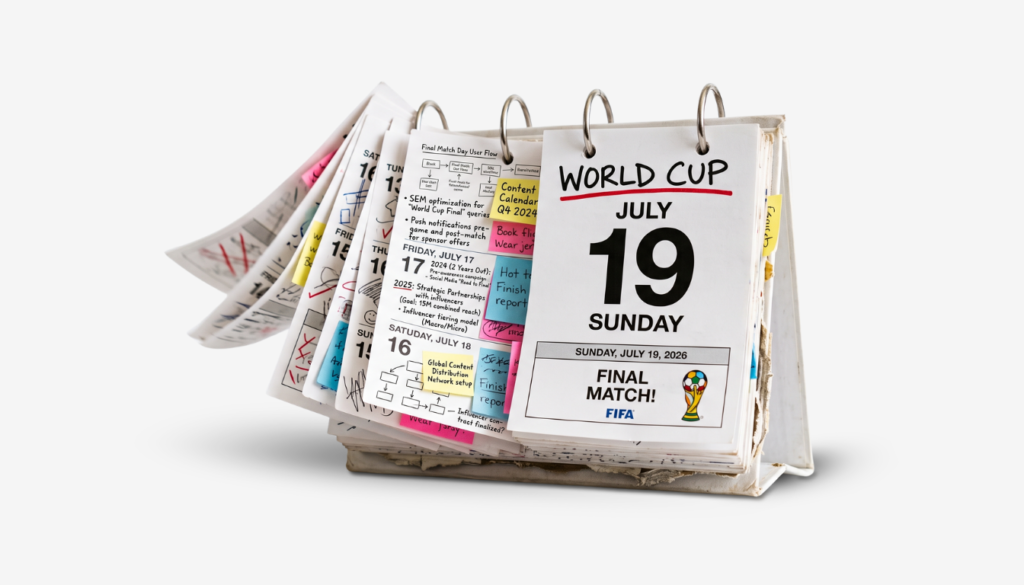
Spontaneity Is a Planning Output
At the ADWEEK House Sports Summit in New York, a session called Marketing at Match Speed, moderated by Adweek editor in chief Ryan Joe, made an argument that runs against prevailing wisdom about real-time marketing. Speed is not a creative capability. It is a preparation capability.
The panel included Chaucer Barnes, CMO at Translation; Amanda Calabrese, co-founder and CMO at Sequel; Radhika Duggal, SVP and CMO at Major League Soccer; Adam Lynn, co-founder and CEO at Breakaway; and Laura Petro, VP of brand and fan experience at Gotham FC.
Duggal framed the underlying principle. In live entertainment, most elements around a campaign are controllable if the team is thoughtful and methodical about them in advance. That control is what creates capacity later. Preparation, she argued, leaves mind space and the ability to think clearly about whatever arises in the moment.
The distinction matters because most organizations invest in the wrong side of this equation. They build approval workflows and rapid-response teams designed to move fast under pressure, when the more effective investment is reducing the number of decisions that have to be made under pressure at all.
Borrowing an Audience You Do Not Own
Two examples from the session show how preparation converts into access.
Major League Soccer had no live product during the World Cup. Its season paused while the tournament ran, which in conventional terms means a month of absence from the conversation. Duggal described working with FIFA and Fox Sports months in advance to set up World Cup viewing parties, which gave the league visibility during a period when it had nothing to broadcast.
Gotham FC did something structurally similar and more aggressive. Its home stadium was being used for World Cup viewing festivities, so the club moved a match to Citi Field, home of the New York Mets, and scheduled it on the same day as the second World Cup semifinal. Fans arrived for the semifinal in the afternoon and stayed for the NWSL match at night. The result was the highest-attended women’s sporting event in New York City history.
Neither organization bought World Cup sponsorship. Both extracted value from it. That is the most replicable idea in the session for marketers without tentpole budgets: the audience assembled by someone else’s event is available to anyone who plans far enough ahead to stand next to it.
The Beats Example
Barnes offered a case from outside football that illustrates how far ahead the planning has to happen.
During NBA All-Star Weekend in Toronto in 2016, conditions were poor. Temperatures were frigid, moving around the city was unappealing, and celebrity appearances were sporadic. Beats was not tied directly to the NBA, which meant no guaranteed access to the main event.
Rather than plan for a moment, Barnes and his team planned for a constraint. They built a 72-hour roundtable set close to the main activity, kept cameras running the entire time, and waited for celebrities to stop by when they happened to be free. They brought three identical sets of clothing for the host so that footage recorded across three days would cut together as one continuous conversation.
The output was not a weekend activation. It was a year of content, and the format later became The Shop, the roundtable show popularized by LeBron James and picked up by HBO.
“That level of preparedness put us in a position where we’ve got content for the year, because these are topics that are going to be popping across the year,” Barnes said. He added that he prefers to spend time in preparation rather than in response, describing preparation as the product of knowing the constraints and treating them as the ingredients of an execution.
What Preparation Actually Requires
The argument implies a specific set of operational choices, most of them unglamorous.
It requires deciding what could happen before it happens. The Beats team did not know which celebrities would appear, but it knew appearances would be unpredictable and that the weather would keep people indoors. Planning around known constraints is more useful than forecasting specific outcomes.
It requires building assets that work across multiple scenarios rather than one. A continuous roundtable produces usable footage whether one guest arrives or twenty. A viewing party works whether the home team advances or exits. Formats with wide tolerance for uncertainty are worth more than formats optimized for a single result.
It requires securing partnerships early. MLS did not negotiate viewing party access during the tournament. It negotiated months before, when FIFA and Fox Sports had the bandwidth to consider the request.
And it requires accepting that most of the work will happen before anyone sees anything. The visible output of these campaigns arrived in a moment. The cost was incurred over quarters.
The Broader Application
The 2026 World Cup will be studied for its sponsorship economics, but the operational lesson travels well beyond sport.
Any brand marketing around live cultural moments faces the same structure: a short window of concentrated attention, a long lead time, and limited ability to influence what actually happens. Awards shows, competitor product launches, election nights, sporting finals and platform announcements all follow this shape.
The organizations that appear fastest in those windows are rarely the ones with the best rapid-response process. They are the ones that did the thinking early enough that the moment required execution rather than decision-mak