
A World-First Law and What It Produced
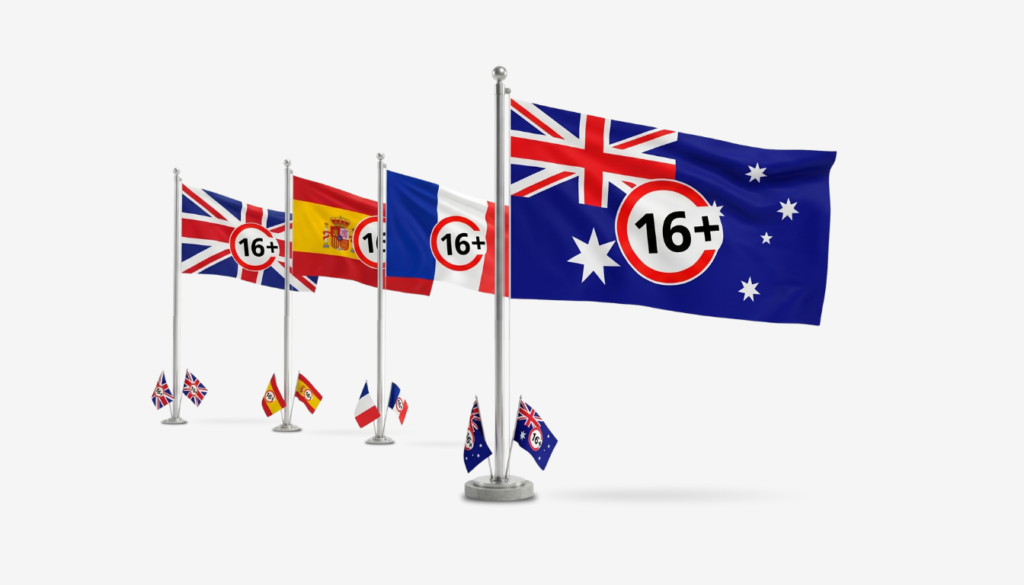
On December 10, 2025, Australia became the first country in the world to enforce a mandatory minimum age of 16 for social media access, requiring that YouTube, Instagram, TikTok, Snapchat, Facebook, X, Reddit, Twitch, Threads, and Kick prevent under-16s from creating or maintaining accounts, under threat of fines up to $50 million Australian dollars per platform for non-compliance. The law passed with bipartisan support. Parents cannot grant consent to override it. It applies to every platform whose primary function is social interaction or user-generated content, with messaging services, gaming platforms, and educational tools exempt.
By mid-January 2026, Australia’s eSafety regulator reported that more than 4.7 million accounts assessed to belong to under-16s had been removed, deactivated, or restricted. It also raised formal concerns about five major platforms — Facebook, Instagram, Snapchat, TikTok, and YouTube — for what it described as “poor practices” in age assurance compliance, flagging that many children still had their accounts or could create new ones under the existing verification systems. The compliance picture is, in other words, incomplete. But the direction of travel is not.
Australia is no longer alone. UK Prime Minister Keir Starmer has announced what he described as an “Australia-plus” policy — a ban preventing under-16s from accessing major social media platforms, expected to be debated in Parliament with potential enforcement by spring 2027. Spain’s Prime Minister Pedro Sánchez has moved toward similar legislation, calling social media “a failed state” in a speech at the World Government Summit. France’s National Assembly has approved an under-16 restriction bill that now moves to the Senate. Malaysia has implemented its own version. Ecuador has framed youth social media restrictions as a national security matter. The policy that began as a single country’s experiment has become a global regulatory movement, and the speed of that movement is accelerating.
What Marketers Are Actually Losing
The commercial implications for brands begin with a number: Harvard research found that Facebook, Instagram, Snapchat, TikTok, X, and YouTube collectively earned $11 billion in advertising revenues from users under 18 in 2022. That figure represents not only direct advertising spend targeted at minors, but the downstream commercial value of youth engagement in shaping brand discovery, trend formation, and purchase behavior that flows upward through family spending decisions. Teenagers are not just a direct target demographic. They are the cultural engine of what becomes desirable — the cohort whose adoption patterns on social platforms determine which trends reach millennials, parents, and eventually mainstream consumers.
Australian marketers have provided the industry’s first real-world data on what happens when that engine is restricted. The conclusions are arriving consistently across sources. The youngest reachable social media audience is now 16, and the brand discovery window that previously captured audiences at 12 to 15 — the age at which many fashion, beauty, gaming, and entertainment preferences are formed and brand loyalties begin to develop — has been permanently closed on the major platforms. Trend cycles are slowing among the restricted cohort. Content that once spread from teenage creators upward through older demographics is losing its origin point. And the brands most exposed are those whose entire youth acquisition model was built on organic and paid reach through TikTok and Instagram — platforms that are now, in Australia, legally prohibited from serving that audience.
For fast fashion specifically, the disruption is structural rather than marginal. Sharon Iles, senior apparel analyst at GlobalData, described the problem with precision: brands like Shein operate by releasing constant small batches of new products calibrated to trend signals that originate and amplify among precisely the teenage demographic now being removed from the system. Without the platform-based trend cycle that under-16s have historically driven, the speed of trend adoption slows, excess inventory accumulates, and the low-price discounting model that characterizes these brands faces additional pressure.
Where the Audience Actually Went
The critical marketing intelligence from Australia’s first months of enforcement is not that teenagers disappeared from the internet. It is that they moved. Sarah Keith, group managing director at Involved Media, described the observed shift with directness: “Anecdotally, we understand teens are using alternative platforms to communicate such as WhatsApp and Messenger and focusing on gaming platforms such as Roblox and Fortnite.” The demographic has not disengaged from digital life. It has relocated to environments that are either technically exempt from the ban — messaging services, gaming platforms — or simply harder to enforce against.
This relocation has immediate implications for media planning. Gaming platforms — Roblox, Fortnite, Minecraft — reach teen audiences at an enormous scale and with deep engagement, and their advertising environments are substantially less developed than the social media platforms that have just been restricted. Audio streaming through Spotify, which maintains a 13-plus limit for appropriate ad content, offers contextually relevant access to the demographic. Shared-viewing environments such as broadcast video on demand and streaming subscription services are predicted by media buyers to benefit from budget migration. Digital out-of-home placements in contextually relevant environments — near schools, cinemas, entertainment venues — represent another channel whose teen reach is not platform-dependent.
The brands navigating this transition most effectively are the ones doing exactly what Australian media buyers describe: building contextual advertising strategies calibrated to where the audience actually is rather than where it used to be, and investing in owned channels — email, loyalty programs, branded communities — that maintain direct consumer relationships independent of platform policy.
The Compliance Dimension That Isn’t Optional
Beyond the media planning challenge lies a legal compliance dimension that many brands have underestimated. The UK legislation, expected to be enforced by spring 2027, operates alongside rather than instead of existing regulatory frameworks: the CAP Code rules governing advertising to children, the ICO Age Appropriate Design Code, and the Online Safety Act requirements. Brands will face a new compliance layer requiring documented evidence that influencer campaigns are not designed to reach under-16s — including updated creator briefs, contract language, and platform targeting settings that demonstrate reasonable youth exposure controls.
The intersection of age verification data with existing UK GDPR, EU GDPR, and US state privacy laws creates compounded legal risk for brands running social commerce integrations alongside creator campaigns. Age verification produces data. That data carries its own retention, purpose limitation, and transfer restrictions that differ across jurisdictions. A brand running influencer campaigns across the UK, EU, and Australia simultaneously is navigating three different compliance frameworks that do not fully align, and the liability for miscalibration sits with the brand rather than the platform in most regulatory interpretations.
The categories facing the most compressed compliance timeline are the ones with the deepest historical reliance on teen audiences: gaming, fashion, beauty, and food. These are precisely the sectors that have built the most sophisticated youth social media marketing programs over the past decade — and that now face the most significant structural adjustment requirement.
The Longer Strategic Question
Underneath the immediate disruption lies a more fundamental question that brands have not yet fully confronted. The social media advertising model’s access to teenage audiences was never explicitly contracted or guaranteed. It was a consequence of platform policy, market structure, and regulatory absence that persisted long enough to become infrastructure. What governments around the world are now concluding — with Australia as the proof of concept and the UK, Spain, and France as the next wave — is that the model cannot continue in its current form.
Paul Greenwood, EMEA head of cultural strategy and insight at We Are Social, described what is actually happening underneath the policy debate: “The UK is entering a highly regulated, age-defined social media era, and youth-driven categories like gaming, fashion, and beauty will feel it first. But this ban accelerates an industry-wide transition where brands are judged as much on digital responsibility as creativity.” The phrase “digital responsibility” is doing significant work in that formulation. What Greenwood is describing is not just a compliance requirement but a change in the social contract between brands, platforms, and the audiences that both have historically taken for granted.
The brands best positioned for what comes next are not the ones that can most quickly find alternative channels to reach 14-year-olds. They are the ones that have invested in building genuine brand relationships with consumers across age groups — relationships founded on value, relevance, and trust rather than algorithmic placement in a social feed. Those relationships, built over time and across channels that governments cannot easily legislate away, are what survive a platform restriction. Everything built purely on social reach, without a deeper brand foundation underneath it, is at risk the next time a government decides the platform is doing more harm than good.
Australia decided last December. The UK is deciding now. The rest of the world is watching.