
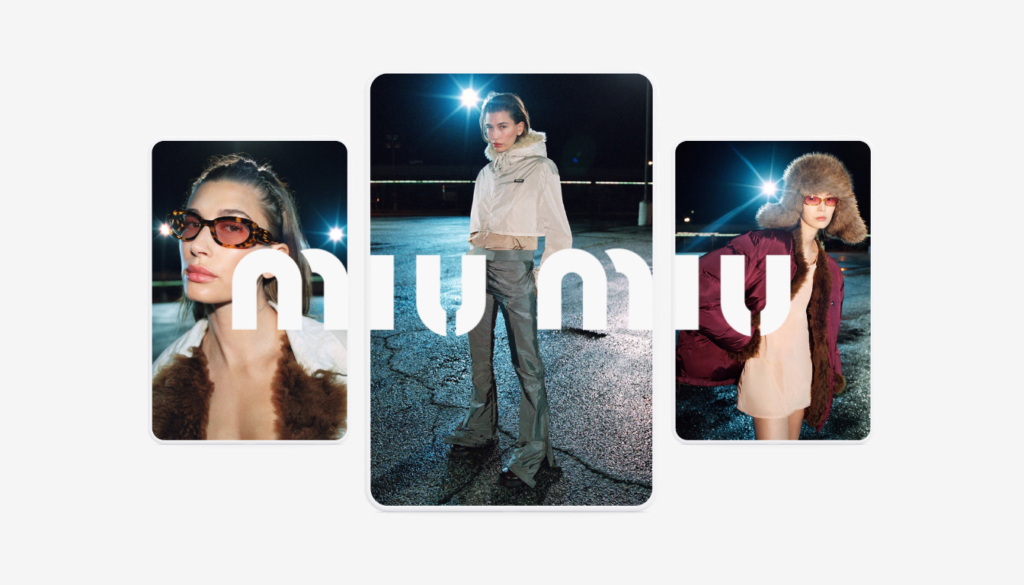
Miu Miu released its Fall/Winter 2026 campaign on July 24, casting Hailey Bieber alongside model Xiao Wen Ju against a nocturnal industrial backdrop washed in abstracted blues. Zoe Ghertner shot the stills, Renell Medrano directed the film, Christopher Simmonds art directed and Lotta Volkova styled, all under Miuccia Prada’s creative direction. The collection it advertises debuted at Paris Fashion Week in March under the theme Miuccia Prada described as mindful intimacy, and the campaign copy frames femininity as vulnerability and control at once, with clothing operating as armor and declaration together.
The fashion press received it warmly and uniformly. What almost none of that coverage placed beside the images was the financial context, which arrived days later and reframes the entire exercise.
The numbers the campaign landed into
Prada Group reported first-half 2026 net revenues of €3.05 billion, up 16% at constant currency, with retail sales of €2.63 billion. Beneath that headline, the group’s internal hierarchy inverted. Prada brand retail sales rose 3.3% in the half and accelerated to 6.3% in the second quarter. Miu Miu rose 2.5% in the half and 2.6% in the quarter.
For context on how large a shift that represents, Miu Miu grew 60% in the first quarter of 2025 and faced comparisons of roughly 40% in the second. The brand was the group’s engine for two straight years, the label that made Prada Group a growth story while most of luxury contracted. It is now growing at less than half the rate of its older sibling.
Group profitability moved in the same direction. Net income fell to €327 million from €386 million a year earlier, and operating profit declined to €523 million from €607 million, weighed down by the integration of Versace, which contributed €305 million in revenue during the half.
Deceleration is not decline, and the difference matters
A 2.5% increase on top of consecutive years of 40% and 60% growth is not a collapse. It is arithmetic. The base is now enormous, and the comparison quarters were the most demanding in the brand’s history. Prada Group also flagged a more pronounced impact from conflict in the Middle East and a European market that stayed subdued while the Americas, Asia-Pacific and Japan held up.
But the reading that matters for marketers is not whether Miu Miu is in trouble. It is that cultural heat and commercial conversion have separated. The brand’s standing in the culture has not moved. Its ability to convert that standing into incremental revenue has.
Why the casting escalated
This is where the Bieber decision becomes legible as strategy rather than aesthetics. Miu Miu built its run on casting that operated as editorial argument rather than reach. Intergenerational runway lineups, the Literary Club, actresses chosen for what they signified rather than how many followers they carried. The brand manufactured desire through curation and restraint, and it worked at a scale that spending could not have bought.
Hailey Bieber is a different instrument. She is a model with a long history at the house, having fronted campaigns as far back as 2019, but she is also the founder of the beauty brand rhode and one of the most commercially productive faces in fashion, having fronted Gap and Victoria’s Secret work in the same year. She brings an audience that buys, not merely an audience that watches.
The creative execution stayed disciplined. The imagery is restrained, moody and consistent with everything Miu Miu has made for five seasons. The casting, though, reaches for conversion. That is a reasonable move for a brand facing decelerating comparisons, and it carries a specific risk.
The trade every desire brand eventually faces
Miu Miu’s asset is scarcity of meaning, not breadth of reach. The brand grew because it felt like it was made for a particular reader rather than for everyone, and that feeling is what commanded full price. Casting for reach is the standard response to a growth problem, and it is also the mechanism by which brands built on specificity become generic.
Nothing in this campaign crosses that line. One commercially powerful face alongside a house model, shot in the brand’s established visual language, is a careful move rather than a lurch. The question is directional. If the next three seasons each reach for a larger name, the brand will have answered a comparison problem by spending the asset that created the comparison in the first place.
What this teaches beyond luxury
Three lessons travel out of this quarter. The first concerns momentum brands generally. Growth built on cultural heat produces comparison bases that eventually become impossible, and no campaign fixes arithmetic. Marketing teams inside fast-growing brands should be modeling that ceiling before it arrives, not reacting when it does.
The second is that casting is a conversion lever and should be evaluated as one. The industry discusses talent decisions in the language of image and fit, but the choice between a face that signifies and a face that sells is a media-mix decision with a measurable outcome. Naming it clearly makes the trade-off easier to manage.
The third is that the activities that build desire and the activities that harvest it run on different clocks. Miu Miu’s Literary Club and its runway casting were building exercises with multi-year payback. A Bieber campaign is a harvesting exercise with a seasonal one. Brands get into trouble when a soft quarter pushes them to convert the building budget into harvesting spend, because the harvest depends on a reservoir that only building refills.
Miu Miu has not made that mistake yet. Whether the pressure of a second slow quarter changes the calculation is the thing worth watching when the group reports again.