
The Paradox of the Trusted Brand
There is a particular kind of brand problem that only success creates. A company builds a product that genuinely works. Word spreads organically. A loyal community forms around it, not because of marketing but despite the absence of it. And then, eventually, someone asks the necessary question: how do we grow? The answer to that question, applied carelessly, is the fastest way to destroy exactly what produced the loyalty in the first place.
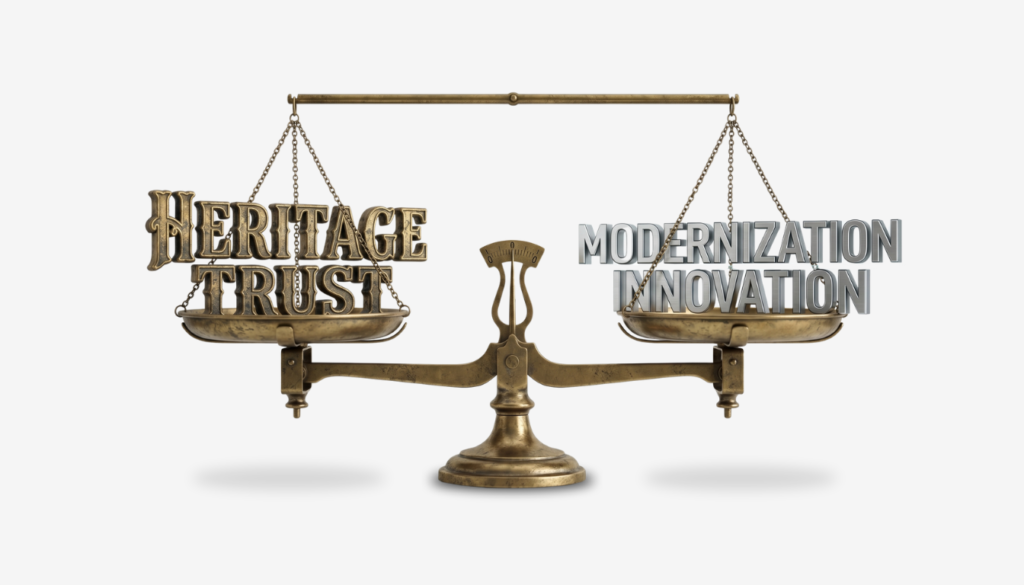
This is the central paradox of modernizing a trusted brand. The consumer’s relationship with a brand they genuinely believe in is built on consistency — on the reliable expectation that the product will perform the way it always has, that the values it represents are the same values it has always held, that choosing it again carries the same meaning it carried the last time. The moment a brand begins changing in ways that feel motivated by marketing rather than by genuine improvement, that expectation is disturbed. And once disturbed, trust is significantly harder to restore than it was to build.
Felicia Zhang, head of marketing at Bar Keeper’s Friend — a 144-year-old cleaning brand that grew for more than a century almost entirely through word of mouth, without advertising — has articulated the operating principle that navigates this paradox more clearly than most: launch, learn, and iterate rather than waiting for perfect conditions, while never changing the core thing that earned the trust. The application differs by brand. The principle is universal.
What Modernization Actually Means
The word “modernization” is frequently used as a euphemism for change without a clearly defined reason, and this is where most brand updates go wrong before they begin. True modernization is not a creative exercise. It is a diagnostic one: a systematic assessment of what has aged poorly, what has remained durable, and what the gap between those two categories reveals about how the brand should present itself to the current audience without abandoning the audience that already believes in it.
Bar Keeper’s Friend’s first visual identity refresh in a decade, developed with design agency Jones Knowles Ritchie, is a useful case study in what surgical modernization looks like in practice. The gold metallic can — the brand’s most immediately recognizable physical asset, the object that loyal consumers reach for on the shelf — was not changed. The fundamental brand color was not changed. The core product formula was not changed. What was updated was the typography, sharpened and smoothed into a more contemporary rendering. A new “sparkle apostrophe” star was introduced to reinforce efficacy. Before-and-after illustrations were added to communicate the product’s transformative effect in a way the previous packaging hadn’t made explicit. The result is a package that reads as contemporary without reading as unfamiliar — a package that the brand’s most loyal customers recognize as theirs, while new customers find it more accessible and legible than its predecessor.
The creative director at JKR described the brief’s organizing principle with precision: “Our goal was to modernize the identity without losing the character that made it iconic.” That sentence contains the entire discipline of brand modernization in seventeen words. The mistake most brands make is not updating too slowly or too conservatively — it is updating without first establishing clearly enough what the character is, and therefore not knowing what to protect when the creative process begins.
The Trust Audit Before the Creative Brief
The discipline that separates brands that modernize successfully from those that inadvertently dismantle themselves in the name of evolution is a rigorous understanding of why consumers trust them in the first place. That understanding is not always intuitive, and it is frequently different from what the brand’s own internal narrative assumes.
A brand’s functional trust — “this product does what it claims” — is relatively straightforward to identify and protect. A brand’s emotional trust — “this brand represents something I believe in” or “this brand has always been there for me” — is subtler, more powerful, and more easily damaged by changes that seem cosmetic but carry symbolic weight for the loyal consumer. When The Gap famously attempted to change its logo in 2010, the public reaction — so swift and so negative that the company reversed the decision within six days — was not about the logo. It was about the feeling that a brand, which represented a certain American simplicity, had decided to become something more corporate and less itself. The logo was the signal. The trust was what was actually at stake.
This is why the most effective brand modernization processes begin not with a creative brief but with what might be called a trust audit: a genuine investigation into what the brand’s most committed consumers believe about it, what symbols and signals carry the most weight in their relationship with it, and which of those symbols are non-negotiable versus which are genuinely available for evolution. The non-negotiables are the brief. Everything outside them is creative latitude.
Speed as a Strategic Discipline
One of the dimensions of brand modernization that receives less attention than it deserves is the question of pace — specifically, the advantage of moving quickly through small tests rather than slowly through large commitments. Brands that wait for certainty before making changes tend to make fewer changes and, paradoxically, to take larger risks when they do change, because the accumulated pressure of postponed evolution eventually produces a transformation brief rather than a refinement one.
The organization that tests and iterates continuously — that introduces small updates, reads consumer response honestly, and adjusts in real time — is the organization that never has to do the thing that terrifies brand managers most: the total overhaul of something that used to work. Zhang’s description of her operating philosophy at Bar Keeper’s Friend captures this directly: “We perform best when we’re willing to launch, learn, and iterate rather than waiting for perfect conditions.” The statement applies to packaging decisions, event sponsorships, product extensions, and communication strategies equally. Perfectionism in brand management is a risk management strategy masquerading as quality control, and it produces the same result as most risk avoidance — the gradual accumulation of a larger risk than the one being avoided.
The Community as Co-Creator
The final dimension of successful brand modernization that the current marketing environment has made newly accessible is the role of the brand’s community in the evolution process. Brands that listen to their most committed consumers — not as a focus group exercise but as an ongoing, authentic conversation — have access to a form of creative intelligence that no agency brief can fully replicate: the direct expression of what the community needs from the brand and what it fears losing.
When Reddit threads about Bar Keeper’s Friend began generating thousands of comments about creative solutions for the brand’s lidless can, the marketing team read that conversation as product feedback, not as complaint management. The result is a forthcoming lid, developed in direct response to community input, that functions simultaneously as a product improvement and as a demonstration of the relationship between the brand and the people who use it. “We’re here for you, we’re listening to you, and we’re here to help,” Zhang said of the decision.
That is, in the end, what trust-preserving modernization sounds like from the consumer’s side: not the feeling that a brand they rely on has changed to become something else, but the feeling that it changed because it understood them well enough to know exactly what they needed. The brands that achieve that are the ones whose evolution reads not as departure but as deepening, an ongoing confirmation that the relationship between brand and consumer is the thing being developed, and that the product, the packaging, and the communication are simply how that relationship is expressed.