
Adidas Turns World Cup Fever Into a Shared Ritual
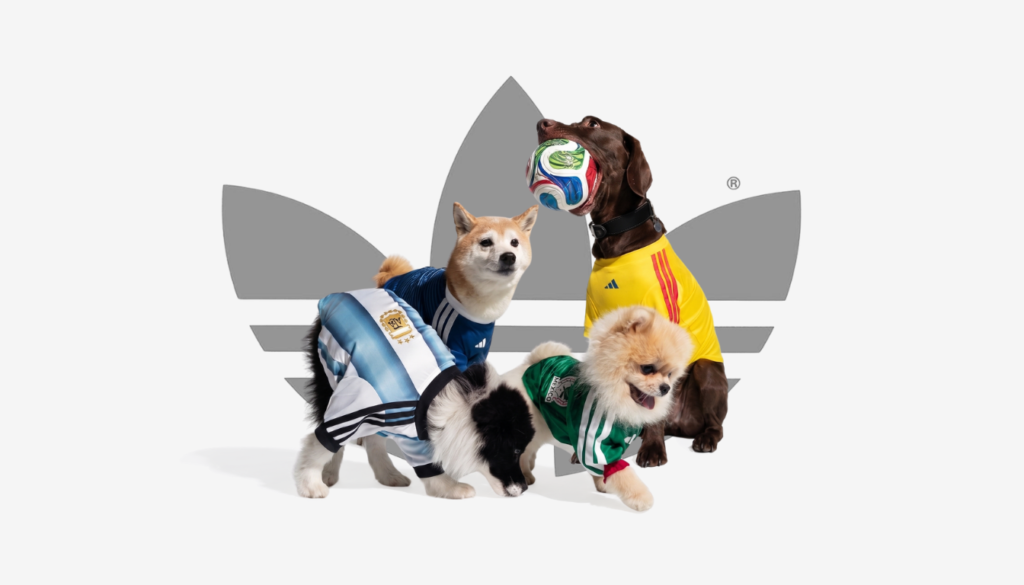
As anticipation steadily builds toward the FIFA World Cup 2026, adidas appears less interested in merely outfitting fans for the tournament and more focused on redefining how that fandom is expressed, experienced, and ultimately shared, unveiling a collection that extends beyond the expected boundaries of sports merchandising and into the rhythms of everyday life. Its latest drop, a line of dog jerseys modeled after national team kits, may initially register as a lighthearted gesture, yet it reveals, upon closer examination, a deliberate response to the evolving intersection of identity, culture, and digital behavior.
The collection faithfully translates the visual codes of official jerseys from Argentina, Mexico, Colombia, and Japan, preserving the integrity of crests, colors, and design language while adapting them to a new, unconventional wearer. However, the importance of this launch lies not in the garments themselves but in what they quietly propose: that football identity is no longer confined to the individual fan, but instead diffuses into the spaces, relationships, and environments that surround them, becoming a more expansive and integrated expression of belonging.
When Fandom Leaves the Stadium
For much of its history, football merchandising has adhered to a relatively stable formula, centered on garments and accessories worn in stadiums, public viewings, or celebratory gatherings, where collective presence reinforced a sense of shared allegiance. Yet, as the consumption of sport has increasingly migrated into digital environments, where visibility is continuous, and participation is mediated through screens, the very nature of fandom has undergone a transformation that extends far beyond physical attendance.
Within this shifting landscape, adidas’ decision to introduce pet jerseys signals a nuanced but meaningful evolution, suggesting that fandom is no longer defined solely by who wears the jersey, but by how and where that identity is displayed. By incorporating pets into this equation, the brand effectively multiplies the points of expression through which allegiance can be communicated, turning domestic spaces into extensions of the stadium and everyday routines into opportunities for cultural signaling. In this sense, the jersey evolves from a static symbol into a dynamic element of storytelling, capable of appearing across a wide range of contexts that collectively sustain the tournament’s narrative.
Designed for Circulation, Not Just Consumption
What ultimately distinguishes this drop is the recognition that, in the contemporary media ecosystem, products are not simply purchased and worn, but continuously circulated, documented, and reinterpreted across platforms that reward familiarity, emotion, and relatability. Pets, in this context, occupy a uniquely powerful position, consistently generating high engagement and serving as focal points for content that resonates across demographics and geographies.
By combining the universal appeal of animals with the symbolic weight of national teams, adidas has effectively engineered a product that exists as much within the logic of content as it does within that of commerce, allowing each jersey to function as a self-contained unit of media capable of traveling far beyond its point of sale. The implication is clear: visibility is no longer driven solely by campaigns or paid placements, but by the organic multiplication of moments in which the product appears, often in ways that feel spontaneous, personal, and therefore more compelling.
Expanding the Economics of Loyalty
Beneath its cultural resonance, however, the move also reflects a calculated effort to deepen the economic relationship between brands and their audiences, shifting the focus from acquiring new consumers to expanding the ways in which existing fans engage with and invest in a shared identity. Rather than treating merchandising as a singular transaction, adidas is building a layered ecosystem in which each additional product extends the narrative, encouraging supporters to participate in multiple dimensions of the same cultural moment.
In this framework, the jersey ceases to be an isolated purchase and instead becomes part of a broader continuum that includes lifestyle apparel, accessories, and now pet-focused adaptations, each reinforcing the others while collectively increasing both emotional attachment and commercial value. It is a strategy that reflects a more mature understanding of loyalty, one that recognizes depth of engagement as a more sustainable driver of growth than sheer scale.
The Power of Playfulness
Perhaps the most effective aspect of the collection lies in its tone, which presents itself not as a strategic recalibration but as a natural, almost inevitable extension of fandom, integrating seamlessly into consumer behavior without appearing forced or overly calculated. This sense of playfulness, far from diminishing its significance, enhances it by aligning with a broader cultural preference for brand interactions that feel intuitive, participatory, and embedded in everyday life.
In the end, the introduction of pet jerseys serves as a subtle yet revealing indicator of where the industry is heading, pointing toward a future in which the boundaries of fandom continue to expand, and where the most successful products are those capable of existing simultaneously as objects, symbols, and carriers of cultural meaning across an ever-growing range of contexts.