
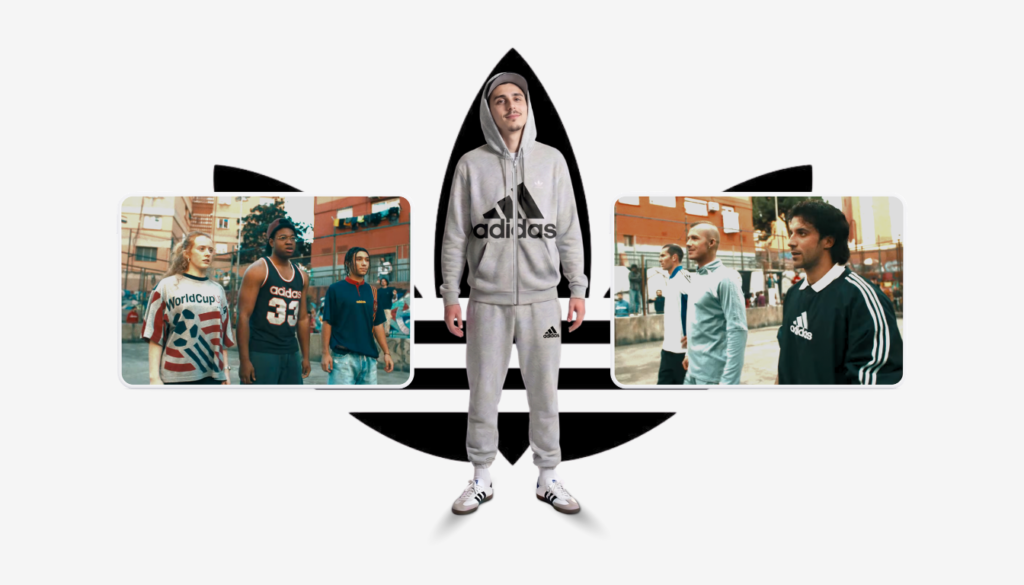
When Adidas unveiled its five-minute World Cup short starring Timothée Chalamet this week, the sportswear giant did far more than introduce a campaign timed to football’s biggest stage. In many ways, it offered a revealing glimpse into how global brands increasingly want audiences to experience advertising itself—not as an interruption, but as entertainment; not as a polished sales pitch, but as a cultural experience audiences might willingly choose to spend time with.
At the center of the film is a deceptively playful premise. Chalamet, portraying an exaggerated version of himself as an obsessive football fan, sets out to assemble his dream soccer team to challenge an undefeated neighborhood squad that has seemingly ruled local mythology for decades. Around him orbit football royalty, cultural icons, and rising stars, all stitched together through humor, cinematic pacing, and nostalgic references designed to feel less like branded content and more like the opening chapter of a larger story.
Yet beneath the celebrity cameos and carefully choreographed charm lies something considerably more strategic. As a reported Tier-1 sponsor of the 2026 FIFA World Cup—an investment estimated at $150-$200 million—Adidas already possesses one of the most valuable sponsorship packages available, granting the brand expansive visibility across stadiums, broadcast coverage, digital activations, and tournament branding. The real question, however, is no longer whether audiences will see Adidas during the World Cup, but whether they will care.
When Sponsorship Stops Feeling Like Advertising
For decades, the formula for major sports sponsorships remained relatively unchanged. Brands secured visibility, attached themselves to elite athletes, and packaged triumphs into emotionally charged commercials that celebrated excellence and inspired aspiration. But in an era increasingly defined by fragmented attention and endless content options, visibility alone no longer guarantees engagement. Adidas seems acutely aware of this reality, which helps explain why its World Cup centerpiece does not resemble a conventional sports commercial.
Rather than compressing emotion into a tightly edited 30-second advertisement, the brand chose to build a five-minute short film, complete with narrative tension, humor, character arcs, celebrity surprises, and enough visual texture to reward repeat viewing. The pacing feels cinematic, the storytelling intentionally immersive, and the creative ambition unmistakably closer to entertainment than to traditional marketing.
This distinction matters because the competition for attention has fundamentally changed. Brands are no longer simply competing against rival advertisers for share of voice; increasingly, they are competing against streaming platforms, creators, YouTube recommendations, and the endless gravitational pull of social feeds. Consumers may instinctively skip advertisements, but they willingly invest time in content that feels emotionally rewarding, culturally resonant, or entertaining enough to deserve their attention.
In that sense, Adidas is not merely activating a sponsorship. It is attempting to transform one of sport’s largest commercial stages into something people might actively seek out, discuss, and share. The ambition is clear: if audiences no longer tolerate interruption, perhaps the smartest strategy is to become something worth watching.
Why Timothée Chalamet Makes More Sense Than It First Appears
At first glance, Timothée Chalamet may seem like an unconventional choice for a football campaign, particularly one tied to an event as globally significant as the World Cup. He is not an athlete, nor does he carry the immediate sporting credibility traditionally associated with major tournament ambassadors. Yet that apparent mismatch may, in fact, be precisely what makes the decision so strategically compelling.
Over the past several years, Chalamet has evolved into a uniquely modern form of celebrity, moving fluidly between Hollywood prestige, luxury fashion, internet fandom, and Gen Z cultural obsession. His appeal extends beyond any single category, allowing him to occupy a rare cultural space where film enthusiasts, fashion audiences, younger consumers, and online communities overlap.
The 2026 World Cup, hosted across the United States, Canada, and Mexico, represents a particularly consequential moment for football’s continued expansion in North America, where the sport is gaining momentum but still faces deeply entrenched loyalties to American football, basketball, and baseball. Rather than speaking exclusively to devoted football fans, Adidas appears intent on expanding the tournament’s emotional and cultural reach.
By placing Chalamet at the center of the narrative, the brand subtly reframes football not simply as a sport, but as a cultural language—something aspirational, communal, and emotionally relevant even to audiences who may not traditionally follow the game.
Increasingly, celebrity in marketing is becoming less about endorsement and more about translation. Chalamet does not merely lend star power to Adidas; he acts as a bridge between worlds, helping football feel more culturally central within audiences who might otherwise remain outside the conversation.
Rebuilding the Romance of Street Football
If Chalamet broadens the campaign’s cultural reach, nostalgia provides its emotional backbone. At the heart of the story sits a familiar fantasy: the legendary neighborhood team that no one can beat, a group seemingly frozen in time and protected by local mythology. It is a premise that instantly evokes the romanticized spirit of street football, where greatness emerges not from billion-dollar academies or commercial machinery, but from improvised pitches, neighborhood rivalries, and afternoons stretched endlessly between friends.
For audiences who came of age during football advertising’s creative peak in the late 1990s and early 2000s, the atmosphere feels strikingly familiar. There is an unmistakable echo of an era when football campaigns felt playful, communal, and emotionally oversized.
Yet Adidas avoids the trap that often undermines nostalgia marketing: becoming trapped in the past. Alongside legacy figures such as David Beckham and Zinedine Zidane stand emerging names including Jude Bellingham, Trinity Rodman, and Lamine Yamal, while cultural figures like Bad Bunny expand the campaign’s emotional geography well beyond the boundaries of sport itself. The effect is carefully balanced, allowing Adidas to evoke memory and project possibility simultaneously.
Rather than simply revisiting football culture’s golden era, the brand appears determined to reinterpret it for a generation shaped by fragmented attention, internet communities, and increasingly fluid cultural identities.
Selling the Feeling Before Selling the Product
Perhaps one of the campaign’s most revealing qualities is what it chooses not to emphasize. For a film centered around one of the world’s largest sportswear brands, the products themselves remain surprisingly understated. Shoes appear, naturally, but rarely become the focal point. There are no aggressive product demonstrations, no heavy-handed performance claims, and little of the transactional urgency that once defined sports advertising.
Instead, Adidas focuses on something far less tangible but arguably far more valuable: emotional ownership. The campaign positions the brand not merely as a maker of sportswear, but as a custodian of football culture itself, associating Adidas with friendship, rivalry, obsession, local pride, and the impossible optimism that football has long inspired. In doing so, the company follows an increasingly influential marketing principle that prioritizes emotional connection before commercial conversion.
The assumption underlying this approach is relatively simple: if audiences emotionally associate Adidas with the feeling of the World Cup itself—with belonging, excitement, nostalgia, and anticipation—then purchasing behavior becomes a downstream effect rather than the opening objective. Around tentpole cultural moments, selling the emotion increasingly matters more than selling the product.
The Future of Sports Marketing May Look More Like Cinema
Ultimately, Adidas’ World Cup campaign feels significant not simply because of its celebrity cast or production scale, but because of what it quietly reveals about the future of sponsorship itself.
Owning logos, stadium placements, and broadcast integrations may still carry immense value, yet such visibility increasingly struggles to break through in a media environment defined by overwhelming abundance. The brands that succeed are no longer simply the most visible, but the most culturally magnetic, capable of building stories audiences willingly choose to enter.
Adidas appears to understand this shift with unusual clarity. Rather than treating the World Cup as a sponsorship property to activate through predictable advertising, it is treating the tournament as an expansive cultural universe—one where football, fashion, music, film, nostalgia, and fandom intersect in ways designed to feel immersive rather than promotional.
The larger question, however, remains whether cultural attention can ultimately translate into long-term brand preference, particularly in North America, where Nike continues to dominate the broader conversation. Yet even before those results emerge, Adidas may already have accomplished something important: reframing what a modern sports sponsorship can look like in an age when brands increasingly compete not for impressions, but for genuine attention.
Because if this campaign succeeds, the future of sports marketing may begin to resemble something far closer to Hollywood than Madison Avenue.