
When Images Stop Behaving Like Reality
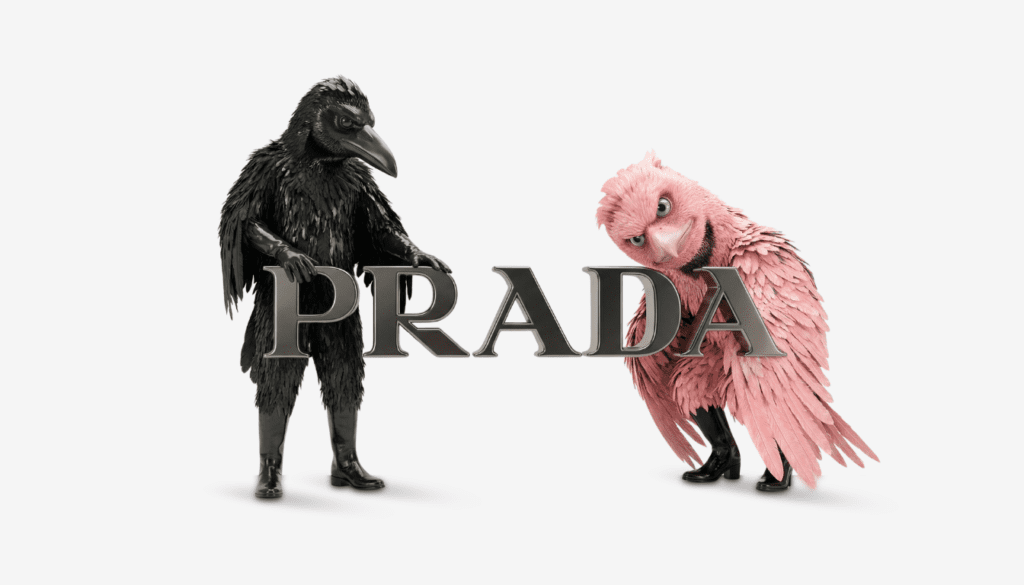
For years, luxury advertising has relied on meticulous control to create a believable yet aspirational image, using technology to enhance this effect. Prada’s campaign notably rejects this tradition. It intentionally distorts reality rather than perfecting it, inviting viewers to reconsider their expectations of what luxury images represent.
In collaboration with artist Jordan Wolfson, the campaign introduces AI-generated figures that blur the line between human and synthetic, disrupting familiarity through subtle deviations. These figures are not just digital embellishments; they act as agents in the image, engaging human models in ways that feel both intimate and disquieting, dissolving the line between subject and simulation.
The campaign’s style intentionally appears unstable: faces look real but somewhat artificial, and bodies and surfaces signal their digital origins. Prada does not want viewers to accept the images as real. Instead, it asks them to notice the artificiality and to actively question what they see, shifting the experience from passive viewing to active interpretation.
The Rise of Ambiguity as a Creative Strategy
Where traditional campaigns aim to communicate a single, controlled message, Prada’s campaign deliberately avoids a definitive assertion, using the repeated phrase “I, I, I, I am…” to foreground ambiguity. This intentional incompleteness creates structural openness: instead of presenting a resolved narrative, it encourages the audience to interpret meaning for themselves, keeping the idea of identity flexible rather than prescriptive.
Such ambiguity is not merely aesthetic but strategic. Prada intentionally uses ambiguity to recalibrate how brands engage with attention in an environment full of instantly digestible content. By resisting clarity, Prada creates narrative friction that encourages deeper engagement: viewers must balance recognition with uncertainty and project their own meanings onto images that refuse to dictate one interpretation.
With this approach, the campaign is less about direct messaging and more about offering many possible meanings. Instead of creating confusion, the lack of clear answers invites audiences to engage and find their own interpretations, showing that complexity can be more powerful than simplicity in luxury marketing today.
From Production Tool to Creative Authorship
Most discussions of AI in marketing focus on efficiency—how it speeds up work and reduces costs. Prada takes a different approach, treating AI as a means to rethink creative authorship rather than just a tool for faster production.
The collaboration with Jordan Wolfson is particularly telling in this regard, underscoring the importance of artistic intent in shaping how technology is deployed. The campaign’s distinctive visual language—defined by its uncanny figures, exaggerated smoothness, and deliberate rejection of naturalism—does not feel like the byproduct of an automated system, but rather the result of a carefully constructed vision in which AI serves as an expressive tool.
This change in approach shifts focus from what AI can make on its own to what artists and brands can express through it. Prada shows that the real value of AI lies in its guidance by human creativity, using it to explore ideas and concepts—not just to produce more content faster.
Luxury Shifts from Craftsmanship to Meaning
Beyond the campaign’s striking visuals, Prada’s strategy recognizes that as AI makes high-quality images widely accessible, classic luxury traits such as precision and technical perfection are becoming less distinctive. Brands, therefore, must differentiate themselves in new ways.
Prada’s answer is to prioritize meaning over craftsmanship. The brand places greater emphasis on creative ideas than on flawless execution, making interpretation and cultural resonance its true markers of luxury in a world where images are easily replicated.
This shift reflects a broader transformation in which luxury brands are no longer simply purveyors of objects, but participants in cultural discourse, using their platforms to explore themes that extend beyond the product itself. In this context, the campaign’s exploration of identity as fluid, constructed, and continuously negotiated aligns with a broader societal conversation, reinforcing Prada’s role not just as a brand but also as a cultural interlocutor.
Beyond The AI Debate
The campaign’s most notable achievement is shifting the conversation about AI in luxury. Rather than focusing on whether AI is good or bad, Prada integrates it into its creative vision, showing what is possible when technology is used purposefully and thoughtfully.
By doing so, the campaign reframes AI not as a replacement for creativity but as a collaborator within it, capable of introducing new forms of tension, ambiguity, and depth when guided by a clear artistic perspective. It suggests that the future of creative work will not be defined by the presence or absence of machines, but by how they are directed, contextualized, and ultimately made meaningful.
In this emerging landscape, the brands that will distinguish themselves are unlikely to be those that adopt AI most aggressively, but those that engage with it most thoughtfully, using it not to simplify their narratives, but to expand them—and, in the process, to redefine what creativity itself can look like.