
The Supermarket Where Beauty Logic Suddenly Looks Ridiculous
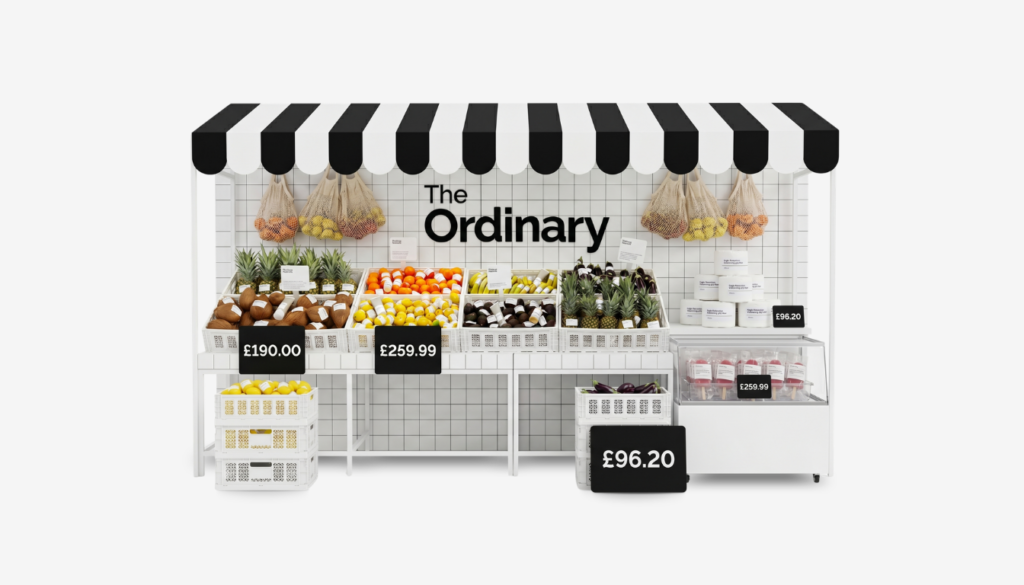
At first, The Ordinary’s latest pop-up appears to be another carefully staged retail experience, the kind of concept store built for curiosity, foot traffic, and social media. There are baskets, produce-style displays, ordinary household essentials, and the clean visual language consumers have come to expect from contemporary beauty and wellness brands. But the longer one looks, the more the joke begins to reveal itself, because this is not a market designed to sell groceries. It is a market designed to expose the logic that often sells beauty.
Inside The Markup Marché, a banana is no longer simply a banana. It becomes an “All-Natural Magical Energy-Boosting Bar.” A coconut is reframed as an “Exotic Thirst-Defying Hydration Vessel.” Toilet paper becomes a “High-Retention Cleansing Cylinder.” The language is deliberately overblown, the presentation is knowingly polished, and the prices are inflated to a level that feels almost theatrical. Yet that theatricality is precisely the point. By taking familiar supermarket products and dressing them in the codes of premium skincare, The Ordinary turns an industry habit into something consumers can instantly see, photograph, and understand.
What makes the campaign effective is that it does not ask consumers to decode a complex argument about formulation, supply chains, or pricing architecture. Instead, it places the beauty industry’s marketing language in a context where its exaggerations become impossible to miss. A banana priced like a prestige serum is funny because everyone knows what a banana should cost. But it is also revealing, because the same mechanisms that feel ridiculous in a grocery aisle can often feel persuasive in beauty, where scientific terminology, minimalist packaging, wellness claims, and emotional promises are routinely used to make products feel more valuable than their ingredients alone might suggest.
The result is a campaign that functions less like a traditional pop-up and more like a physical editorial. If consumers would reject this pricing logic when applied to lemons, apples, or toilet paper, the campaign asks, why do they accept it so easily when it is packaged as skincare?
A Brand Built on Skepticism Finds Its Perfect Stage
The Ordinary has always been most compelling when it behaves not like a conventional beauty brand, but like a corrective force within the category. Its early disruption came from stripping skincare down to ingredients, concentrations, and accessible prices at a time when much of the industry still relied on opacity, aspiration, and the emotional power of luxury. While many brands sold transformation through mood, mystique, and status, The Ordinary built its identity around a more practical promise: consumers should know what they are buying and why they are paying for it.
That is why The Markup Marché feels so aligned with the brand’s DNA. It is not a random act of retail theater, nor is it simply a clever visual joke about expensive beauty. It is an extension of the same anti-hype philosophy that made the brand stand out in the first place, translated from product shelves into an immersive environment. Rather than telling consumers that some beauty prices are inflated, The Ordinary creates a setting where the inflation becomes visible, absurd, and easy to question.
The campaign’s sharpness lies in its use of category translation. It takes the elevated naming conventions, scientific-sounding descriptors, and wellness-coded promises that frequently shape beauty marketing, then applies them to objects whose value consumers already understand. In doing so, it reveals how much of perceived value can be created not only by what a product contains, but by the language and atmosphere surrounding it.
That distinction matters because beauty has always existed in the space between substance and desire. Sometimes a premium price reflects genuine research, advanced formulation, performance, or sensory quality. But often, the category also depends on a more ambiguous equation in which packaging, scarcity, celebrity association, and evocative language help turn ordinary ingredients into extraordinary promises. The Markup Marché does not deny that beauty can have value; instead, it asks consumers to be more attentive to where that value actually comes from.
Why the Joke Travels So Well
Part of the campaign’s strength is that its central idea is understandable almost immediately, even to someone with no particular interest in skincare. The absurdity of an overpriced banana or coconut does not require explanation, and that simplicity gives the campaign a rare advantage in a crowded media environment. A single image can carry the concept because the contrast between the object and its inflated presentation tells the story on its own.
That makes The Markup Marché especially well-suited to the mechanics of social distribution. The physical pop-up gives the campaign a sense of presence and credibility, but its real reach depends on how easily the experience can be translated into posts, videos, headlines, and conversations. The exaggerated product names invite screenshots. The impossible prices invite reaction. The familiar grocery setting makes the critique accessible. And underneath the humor, there is a larger cultural tension that gives the campaign more weight than a simple visual stunt.
This balance is difficult to achieve. Educational beauty campaigns often become too technical, while experiential campaigns can easily become decorative spaces with little strategic substance. The Ordinary manages to avoid both traps by making the education entertaining and the entertainment purposeful. Consumers are not being lectured about ingredient transparency; they are being invited into a world where the consequences of hype are exaggerated just enough to become undeniable.
In that sense, the campaign’s humor is not a distraction from the message, but the delivery system for it. The joke works because it compresses a complicated critique into a familiar retail experience. It gives consumers the pleasure of getting the punchline while also leaving them with a more serious question about how they evaluate beauty products, claims, and price.
The Anti-Hype Campaign That Is Also Brilliant Marketing
There is an obvious irony at the center of The Markup Marché, and it is one that The Ordinary appears to embrace rather than avoid. This is an anti-hype campaign that is itself designed to generate hype. It uses spectacle to criticize spectacle, retail theater to question retail persuasion, and marketing to expose the mechanics of marketing. In less careful hands, that contradiction might feel cynical. Here, it feels more like a knowing acknowledgment of how modern brand communication works.
The Ordinary is not pretending to operate outside the attention economy. The brand understands that consumers are unlikely to engage deeply with a straightforward pricing explainer, no matter how rational the argument may be. It also understands that, in today’s fragmented media landscape, an idea must be visually immediate and culturally legible to travel beyond those who encounter it in person. The Markup Marché succeeds because it uses modern marketing tools without letting them overwhelm the brand’s message.
That is what separates the campaign from a typical experiential activation. Many pop-ups are built around atmosphere first and meaning second, designed to produce social content without necessarily deepening the brand’s position in the consumer’s mind. The Ordinary’s market, by contrast, is valuable because it is argumentative. Every object in the space points back to the same strategic idea: consumers deserve to understand whether they are paying for ingredients, efficacy, and formulation, or for the story built around them.
The campaign, therefore, reinforces The Ordinary’s positioning without having to make a hard sell. It does not need to place its products at the center of every frame, because the entire experience exists to reinforce the brand’s logic. The message is not simply that The Ordinary is cheaper. It is that The Ordinary is more rational, and in a category where affordability can sometimes be mistaken for lower desirability, that distinction is strategically powerful.
The Bigger Shift in Beauty Consumption
The campaign also lands because it reflects a broader shift in how consumers, particularly younger consumers, relate to beauty. Skincare buyers are no longer dependent solely on brand narratives to understand what a product might do. They have access to ingredient explainers, dermatologist content, dupe comparisons, Reddit threads, TikTok reviews, and side-by-side breakdowns that make the category more transparent than it once was. As a result, the old assumption that a higher price automatically signals better performance is becoming increasingly difficult to defend.
This does not mean consumers are abandoning premium beauty. In many cases, they are still willing to pay for luxury, sensoriality, packaging, brand identity, and emotional pleasure. But they are increasingly asking brands to clarify the relationship between price and value. The market is becoming less tolerant of vague claims that rely solely on prestige, especially when lower-priced products can appear more direct, more functional, and more honest about their contents.
The Ordinary’s campaign speaks directly to that shift. It does not present affordability as a compromise, nor does it frame the consumer as forced to choose cheaper options due to limited spending power. Instead, it positions rational purchasing as a form of intelligence. The implied message is that paying less is not the same as wanting less; sometimes it means refusing to pay for inflated language, unnecessary mystique, or a premium that has more to do with perception than performance.
That is why The Markup Marché feels especially timely. Beauty is still a category driven by desire, but desire is now filtered through a more informed, skeptical consumer mindset. The brands that win in this environment may not be those that abandon aspiration altogether, but those that can explain, with greater precision, what consumers are actually paying for.
The Lesson for Marketers
The smartest lesson from The Markup Marché is that a strong campaign should make a brand’s strategic tension visible. The Ordinary did not choose a supermarket because groceries are amusing props. It chose that setting because groceries make the absurdity of inflated beauty logic easier to understand.
That is what effective experiential marketing can do when it is built around a real point of view. It can turn a brand argument into a place, transform a positioning statement into an experience, and give consumers a story they can repeat without needing to recite the campaign strategy behind it. The best version of this kind of marketing does not simply create attention; it clarifies why the brand exists.
In The Ordinary’s case, the story is unusually clear. Beauty has become highly skilled at making ordinary things feel extraordinary, and consumers have often been asked to pay for the illusion. By placing a luxury price tag on a banana, the brand made that illusion look ridiculous. More importantly, it reminded the industry that transparency is no longer just a product attribute or a claim on a package. It is becoming a form of cultural relevance, a pricing argument, and, increasingly, a competitive advantage.