
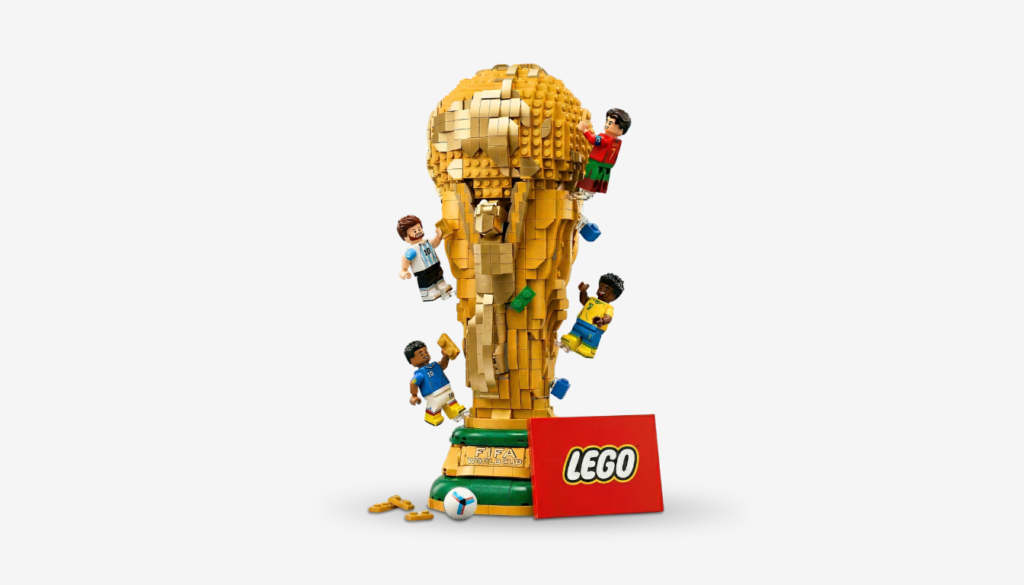
As the 2026 FIFA World Cup approaches, LEGO has chosen to anchor its campaign not simply in the scale of the tournament, but in the cultural weight of the players who define it, transforming figures like Lionel Messi, Cristiano Ronaldo, Kylian Mbappé, and Vinícius Júnior into something far more fluid than traditional celebrity endorsements. Rather than presenting them as distant icons captured in cinematic storytelling, the campaign reframes these athletes as modular, reinterpretative figures—translated into LEGO form and inserted into a narrative where their identities are no longer fixed, but open to manipulation, play, and reinvention.
This shift represents a significant departure from how sports marketing typically leverages star power: players are no longer positioned solely as aspirational figures to be admired, but as creative raw material that audiences can engage with, reshape, and redistribute across digital environments. In doing so, LEGO effectively dissolves the distance between celebrity and consumer, allowing fans not only to watch their heroes but to rebuild them, reinterpret them, and, ultimately, integrate them into their own forms of expression.
A Campaign Designed for the Social Feed
The approach is particularly potent because it is engineered with social media behavior at its core, not as an afterthought to a traditional campaign. The visual language of LEGO minifigures—instantly recognizable, playful, and adaptable—fits platforms like Instagram, TikTok, and Threads, where content thrives on clarity, immediacy, and remixability.
Within this ecosystem, the presence of globally recognized players acts as a catalyst for attention, yet it is the creative treatment of these figures that sustains engagement, as each reinterpretation invites further variation, parody, and personalization. A moment featuring Messi or Mbappé in LEGO form does not function as a static piece of branded content, but as an open invitation for users to create their own versions, whether through physical builds, digital edits, or narrative reinterpretations that extend the campaign far beyond its original execution.
From Endorsement to Participation
In traditional sports advertising, the role of the athlete has long been defined by endorsement, serving as a symbol of performance, excellence, and aspiration that brands attach themselves to in order to borrow credibility and reach. LEGO, however, redefines this dynamic by shifting from endorsement to participation, embedding players within a system that encourages interaction rather than passive admiration.
By doing so, the campaign aligns more closely with the logic of contemporary digital culture, where relevance is driven less by polished messaging and more by the capacity to be reinterpreted, remixed, and circulated within communities. The players become not just faces of the campaign, but functional elements within it—characters in a broader creative system that thrives on user input and collective storytelling.
The Creative Loop That Fuels Itself
At the heart of the campaign lies a self-reinforcing creative loop: official content featuring these players sparks initial attention, user-generated reinterpretations expand the narrative, and each new iteration feeds back into the broader cultural conversation surrounding the World Cup. The modularity of LEGO, combined with the recognizability of the athletes, creates a framework in which content is not consumed in isolation but continuously evolves as it moves across platforms and audiences.
Meanwhile, the dynamic transforms social media from a distribution channel into an active layer of the campaign itself, where the boundaries between brand-created and user-created content become increasingly blurred. Each build shared, each variation posted, and each reinterpretation circulated contributes to a growing archive of collective creativity, effectively turning the campaign into a living, participatory ecosystem rather than a finite sequence of advertisements.
The Power of Play in a Performance-Driven Culture
There is also a deeper cultural tension at play in LEGO’s approach, as it introduces playfulness into a space traditionally defined by performance, competition, and seriousness. By reimagining elite athletes—figures often associated with discipline and achievement—as playful, buildable characters, the campaign softens the rigidity of sports culture and opens it up to new forms of engagement that are less about outcome and more about expression.
This repositioning resonates particularly strongly with younger audiences, for whom the boundaries between entertainment, creativity, and identity are increasingly fluid, and participation often takes precedence over observation. In this context, LEGO’s interpretation of football feels less like a reinterpretation of the sport and more like a natural extension of how culture is already being experienced and reshaped online.
A New Role for Celebrity in Social Media
Ultimately, LEGO’s World Cup campaign points toward a broader evolution in the role of celebrity within marketing, suggesting that the future of influence may lie not in visibility alone, but in adaptability. By transforming players into creative building blocks rather than fixed symbols, the brand demonstrates how star power can be extended, multiplied, and sustained through user interaction, rather than exhausted through repeated exposure.
In this emerging model, the most valuable celebrities are not those who command attention in a single moment, but those who can exist across multiple interpretations, formats, and narratives, enabling audiences to engage with them in ways that feel personal, participatory, and continuously evolving.
Rebuilding Football Culture for the Social Era
LEGO’s campaign redefines football culture on social media. It shifts the culture from a spectacle that is watched and commented on to a system constructed by engaged users. The brand puts top players at the center and frames them as pieces to be played with, not just observed. This model of engagement feels both culturally relevant and strategically forward-looking.
LEGO reshaped how that moment is expressed, shared, and remembered. In the era of social media, the most powerful campaigns are not those that tell the best stories, but those that give people the tools to tell their own.