
The industry is historically defined by visibility. Brand partnerships often rely on surface-level integrations, such as product placement or logo exposure. McDonald’s has taken a much more ambitious approach. It moves beyond presence and into authorship, redefining what it means for a brand to participate in culture. The collaboration with Netflix and Wieden+Kennedy, linked to the global success of K-pop Demon Hunters, does not just attach the brand to an existing phenomenon. Instead, it weaves it into the story’s narrative fabric. This positions McDonald’s not as a sponsor, but as a contributor to the universe.
The campaign, titled “Battle of the Fans,” extends the storyline beyond the screen. It continues the rivalry between Huntr/x and the Saja Boys, letting audiences engage in real time. This transformation turns a passive viewing experience into something far more immersive and participatory.
A Story That Spills Into Real Life
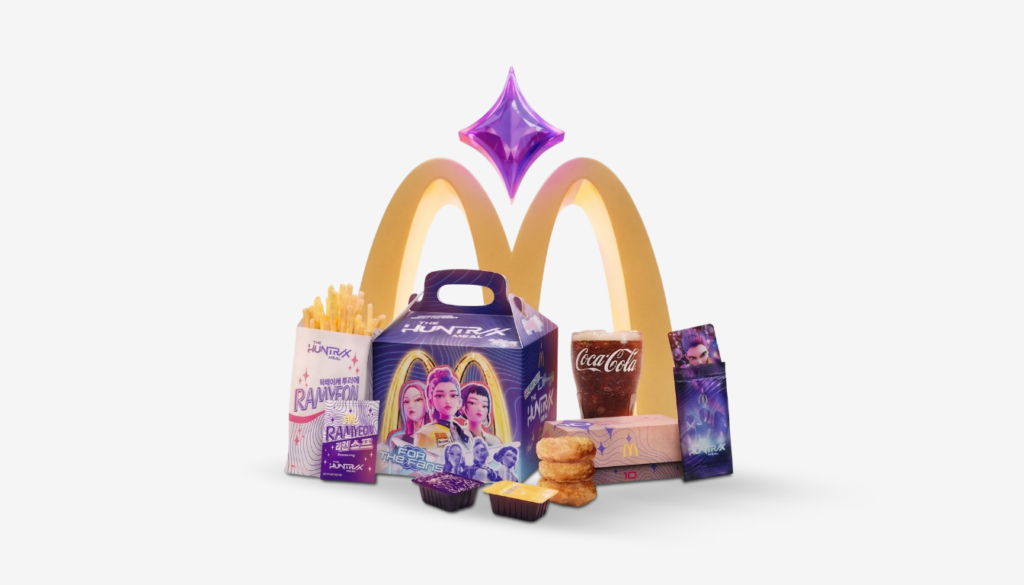
What gives the campaign its particular resonance is how it transforms a familiar marketing mechanic into a narrative device that feels both organic and culturally attuned, drawing inspiration from McDonald’s “Famous Orders” platform while reimagining it through the lens of fandom and storytelling. By introducing themed meals associated with each fictional band, the campaign invites consumers not merely to make a purchase, but to declare an allegiance, subtly reframing consumption as an act of identity.
In this context, choosing between Huntr/x and the Saja Boys goes beyond the menu options. It becomes a symbolic gesture. This echoes the dynamics of contemporary fan cultures, where people express affiliation publicly, and participation carries emotional weight. A routine transaction now carries a performative aspect, allowing individuals to align with a narrative that extends beyond the product.
From Celebrity Endorsement to Fictional Influence
For years, McDonald’s has successfully leveraged its “Famous Orders” platform to tap into the cultural capital of globally recognized figures, aligning its brand with artists whose influence extends across music, fashion, and digital culture. Yet this latest campaign marks a significant evolution of that strategy, shifting away from real-world celebrities toward fictional characters whose influence is defined entirely within their narrative universe.
This transition offers a distinct advantage, as it allows for a level of creative integration and narrative consistency that is difficult to achieve with human talent, whose public personas are shaped by factors beyond the brand’s control. By collaborating with characters rather than individuals, McDonald’s can embed itself more deeply in the story, transforming the relationship from one of endorsement to one of co-creation and, in doing so, signaling a broader shift toward intellectual property as a central driver of cultural relevance.
The Power of Participation and Ritual
The campaign centers on a fansign event, reflecting a nuanced understanding of K-pop culture. Such gatherings are not just promotional tools; they are rituals reinforcing the bond between artists and fans. By recreating this format, McDonald’s taps into an existing cultural framework. This lets the experience feel authentic and familiar, not artificially constructed.
This sense of continuity is further enhanced by integrating QR code cards, which extend the interaction beyond the point of purchase into a broader digital ecosystem where fans can access exclusive content, merchandise, and social experiences that deepen their engagement with both the story and the brand. In this way, the campaign establishes a layered journey in which physical and digital elements converge, creating a sustained relationship that evolves over time rather than concluding at the transaction.
Marketing as a Narrative Experience
At a time when audiences are increasingly resistant to traditional advertising formats, the campaign reflects a growing recognition that storytelling is one of the most effective ways to capture attention and foster engagement. Yet what distinguishes this effort is not simply its narrative ambition, but its ability to position the audience as an active participant within that narrative, inviting them to step into the story rather than observe it from a distance.
By linking consumption to choosing a side, the campaign redefines the role of the consumer, transforming it from a passive recipient of messaging into an active collaborator in the storytelling process. This shift suggests that the future of marketing will not be defined solely by the stories brands tell, but by the roles they create for audiences to inhabit within those stories.
A Glimpse Into the Future of Brand Building
In embedding itself within the KPop Demon Hunters universe, McDonald’s offers a compelling glimpse into the evolving nature of brand building, where success is increasingly tied to a brand’s ability to operate within cultural ecosystems rather than alongside them. As entertainment properties continue to expand into interconnected worlds with deeply engaged fan bases, the opportunity for brands lies not in maximizing exposure but in enhancing immersion.
This approach carries broader implications for the industry, suggesting that the most effective campaigns will prioritize participation over visibility and depth over reach, leveraging fandom not simply as an audience but as an active force in the distribution and amplification of cultural moments. In this sense, McDonald’s has not only executed a successful campaign but has also articulated a model for how brands can remain relevant in a landscape where culture is no longer something to be observed but something to be entered, shaped, and shared.