
When The Devil Wears Prada 2 premieres this May, reuniting Meryl Streep and Anne Hathaway, it does so within an entertainment landscape that has quietly evolved into something far more expansive than the industry that first introduced audiences to Runway in 2006. What was once a contained cultural product now operates as a connective layer across media, retail, and brand ecosystems, where the boundaries between storytelling and commerce are increasingly difficult to separate.
The original film, defined by its sharp portrayal of fashion culture, integrated designers such as Chanel and Valentino with a subtlety that reflected the conventions of its time, embedding them into the narrative as markers of status and aspiration. Yet those appearances, while impactful, remained largely confined to the film’s visual language, functioning as contextual details rather than strategic extensions.
Today, the sequel enters a market where visibility alone no longer holds the same value, and where the ability to extend a narrative into real-world interaction has become central to how cultural impact is built and measured.
From Wardrobe to World-Building
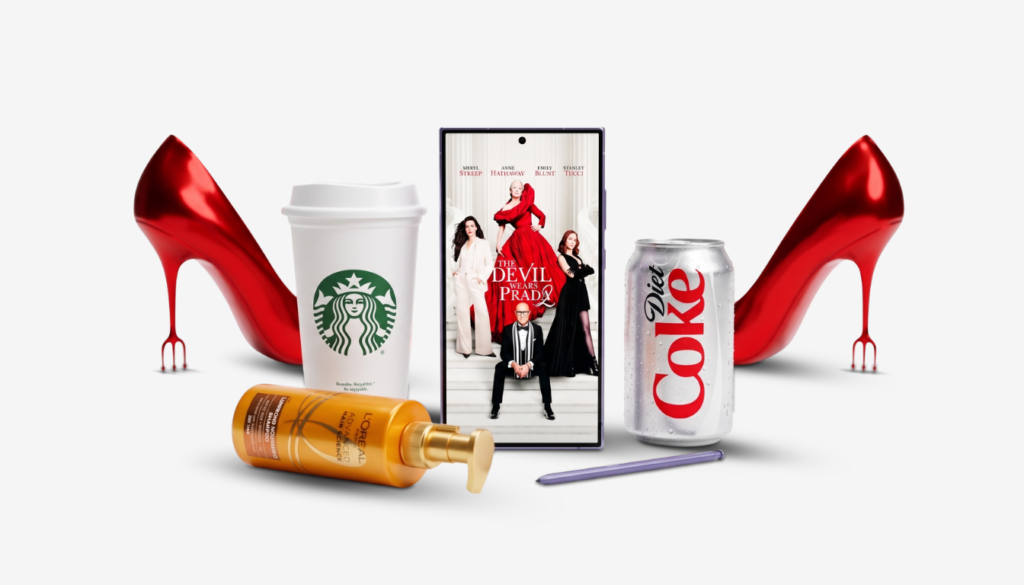
In the lead-up to its release, a growing constellation of brands—including Diet Coke, L’Oréal, Samsung, and Starbucks—has begun to position itself within the Runway universe in ways that move decisively beyond traditional product placement, signaling a broader shift toward narrative participation and experiential integration.
Rather than appearing as background elements within a scene, these brands are constructing parallel layers of engagement that allow audiences to encounter the world of Runway through tangible interactions, whether by consuming a themed product, engaging with a campaign, or experiencing an environment inspired by the film’s aesthetic and cultural codes. In this model, products no longer sit adjacent to storytelling but operate within it, transforming fictional cues into real-world touchpoints that extend the narrative beyond the screen.
This evolution reflects a deeper strategic transformation, where storytelling itself becomes the infrastructure through which commercial activity flows, enabling brands to embed themselves within the cultural fabric of the moment rather than simply attaching to it.
Nostalgia Meets Purchasing Power
The return of The Devil Wears Prada after nearly two decades arrives at a moment when its original audience has matured into a demographic defined not only by emotional attachment to the story, but also by increased purchasing power, effectively turning nostalgia into a functional distribution layer for brands seeking both attention and conversion.
By reactivating a shared cultural memory, companies can tap into an existing emotional framework, using familiarity as an entry point for engagement. Yet this strategy unfolds within a delicate balance, as nostalgia alone is not sufficient to sustain relevance in a rapidly evolving cultural landscape. Early responses to some activations suggest that while recognition may capture initial attention, it is contemporary alignment that ultimately determines whether that attention translates into meaningful interaction.
In this sense, nostalgia operates less as a guarantee and more as a gateway, one that must be supported by a clear understanding of current cultural expectations.
Hollywood Becomes a Distribution System
What ultimately distinguishes The Devil Wears Prada 2 is not simply the presence of brand partnerships but the evolving role of the film itself, which increasingly functions as a distribution system through which narratives, products, and cultural signals circulate simultaneously.
Audiences are no longer introduced to the story solely within the confines of the cinema; instead, they encounter elements of the Runway universe in advance, engaging with branded experiences that act as entry points into the narrative. By the time the film reaches theaters, the relationship between the audience and the story has already been partially established, effectively collapsing the traditional sequence of awareness, engagement, and consumption into a more immediate, interconnected loop.
Within this framework, box office performance remains relevant, yet it is only one dimension of success, as cultural reach, brand integration, and cross-platform visibility collectively redefine how impact is measured.
The Runway as Marketplace
The evolution of The Devil Wears Prada 2 reveals a broader transformation in how intellectual property is activated, shifting from a closed narrative into an open system designed for collaboration, expansion, and commercial integration.
Brands are no longer purchasing isolated moments of visibility; they are securing positions within a shared cultural ecosystem that spans multiple touchpoints, allowing them to participate in the construction of meaning rather than merely align with it. Runway, once a fictional symbol of taste and authority, now mirrors the mechanics of the market itself, operating as a space where identity, aspiration, and commerce converge.
In an era defined by fragmented attention, this model suggests that the most valuable asset is no longer the story alone, but the ecosystem it enables—one in which culture is not only consumed, but actively inhabited.