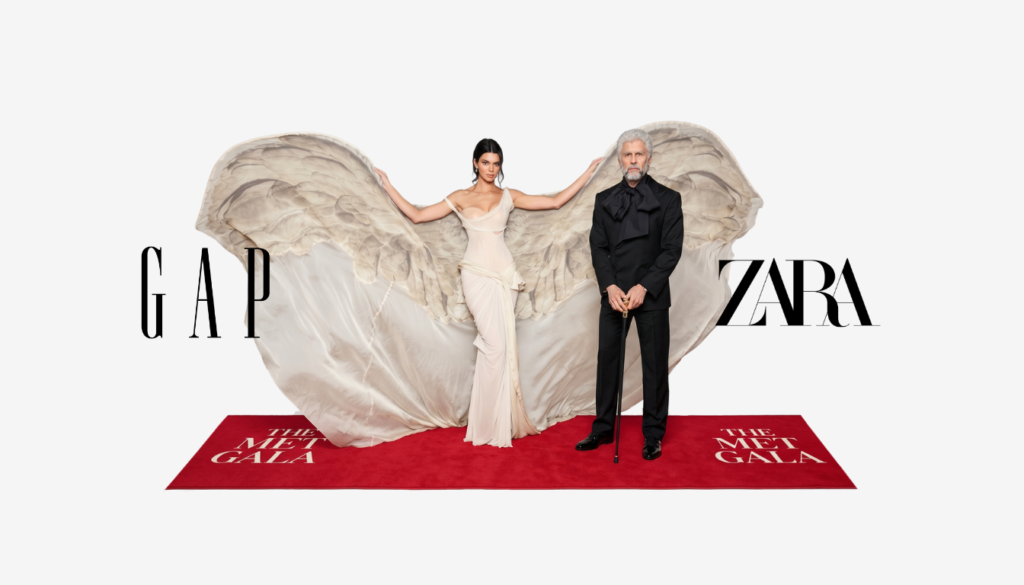
The Met Gala represented one of the last truly untouchable spaces in fashion, a carefully guarded spectacle where the world’s most prestigious luxury houses reinforced their dominance through celebrity, craftsmanship, and exclusivity, transforming the museum steps into a global theater of aspiration where every gown, tuxedo, and jewel served as an extension of a brand’s cultural authority. That is precisely why the arrival of Gap and Zara on this year’s red carpet felt so unexpectedly significant, not simply because the brands themselves appeared out of place beside the traditional titans of couture, but because their presence exposed how dramatically the balance of influence inside fashion has begun to shift.
Among the archival silhouettes, custom tailoring, and legacy maisons that traditionally define the evening, Kendall Jenner appeared in a flowing white GapStudio gown designed by Zac Posen, while Bad Bunny wore a custom black Zara tuxedo, and Stevie Nicks arrived in a blue Zara gown connected to the retailer’s newly announced collaboration with John Galliano. On the surface, the moment carried an element of novelty, almost as though two familiar mall brands had accidentally wandered into fashion’s most elite gathering. Yet beneath the surprise was something far more consequential unfolding, because these appearances did not represent isolated celebrity styling decisions, but rather the visible outcome of a broader transformation reshaping the economics, symbolism, and cultural mechanics of the fashion industry itself.
The Met Gala Is No Longer Just About Luxury
The Met Gala has never been solely about fashion. More than anything, it functions as a marketplace of cultural legitimacy, where brands compete to position themselves at the center of the global conversation surrounding aspiration, relevance, and identity. In previous eras, luxury houses controlled that conversation almost entirely because they monopolized both scarcity and visibility, dictating trends from the top down while mass retailers diluted those ideas months later for wider audiences. Today, however, the structure of influence has become far less centralized, fractured across social platforms, creator ecosystems, fandom culture, and algorithmic attention cycles that reward visibility and conversation as much as heritage itself.
In that environment, companies like Gap and Zara possess advantages that would once have seemed almost irrelevant in high fashion, particularly their immense scale, cultural familiarity, marketing budgets, and ability to generate widespread public conversation at extraordinary speed. What happened on the Met Gala carpet this year was, in fact, the mass fashion openly asserting its place within the same cultural arena.
Gap and Zara Are Selling Cultural Relevance
Gap’s transformation under Zac Posen illustrates this evolution especially clearly, because the company’s strategy extends far beyond aesthetics alone. When Gap hired Posen in 2024, it was acquiring decades of fashion-world credibility, red-carpet history, and couture association that could fundamentally reshape how consumers perceive the brand itself. Kendall Jenner’s gown, inspired by classical Greek sculpture while subtly evoking the simplicity of an everyday white T-shirt, embodied that ambition perfectly, balancing accessibility and aspiration in a way that felt carefully engineered for the modern attention economy, where symbolism often travels further than craftsmanship alone.
That balance matters because younger consumers increasingly navigate fashion without the rigid hierarchy that once so definitively separated luxury from mass retail. The modern wardrobe is shaped less by traditional status codes and more by cultural fluency, with consumers effortlessly mixing vintage pieces, fast fashion, designer accessories, sportswear, and independent labels within the same personal aesthetic. In many ways, fashion has become simultaneously more democratic and more performative, driven not only by ownership but by participation in broader cultural conversations. In that case, what consumers increasingly seek is not simply exclusivity, but relevance — the feeling that a brand exists inside the moments, communities, and narratives shaping contemporary culture.
Fast Fashion Wants Authorship, Not Just Imitation
Zara’s strategy reveals another dimension of this shift, one rooted not only in accessibility but in authorship. For years, the retailer built its empire on speed and interpretation, transforming runway trends into affordable products faster than almost anyone else in the industry. Yet its partnership with John Galliano signals a far more ambitious direction, suggesting that Zara no longer wants to merely react to luxury culture, but to actively shape it, positioning itself not as a follower of fashion narratives, but as a creator of them.
That ambition reflects the changing economics of the luxury industry itself. Many heritage fashion houses are currently navigating slowing growth, reduced consumer appetite, and increasing pressure to rationalize extravagant spending, conditions that have quietly reshaped how brands allocate resources toward events like the Met Gala. At the same time, global giants like Inditex, Zara’s parent company, continue to generate enormous revenues and maintain extraordinary operational scale, giving them the financial flexibility to invest aggressively in celebrity partnerships, creative collaborations, and high-visibility cultural moments that elevate perception far beyond the retail floor.
Visibility Has Become the New Luxury Currency
As a result, the Met Gala increasingly resembles a broader contest for cultural dominance that extends well beyond traditional fashion. The growing presence of technology companies, creator platforms, entertainment firms, and non-traditional brands at events once reserved primarily for couture houses reflects a broader transformation across industries, in which influence no longer belongs exclusively to established incumbents but to whoever can command sustained attention in an overcrowded media landscape.
Perhaps the most revealing aspect of Gap and Zara’s appearance was that neither brand attempted to disguise its identity or pretend to be something else. There was no effort to conceal their accessibility beneath a veneer of exclusivity. Instead, the tension between the setting and the brands themselves became the source of fascination, generating exactly the kind of internet conversation, social media circulation, and cultural debate that increasingly defines modern prestige. In today’s media environment, where visibility often functions as a form of currency in its own right, provoking conversation can be more powerful than preserving distance.
Fashion’s Power Structure Is Changing
The irony, of course, is that luxury fashion helped create the conditions for this moment. For years, major fashion houses aggressively expanded into streetwear, celebrity culture, influencer ecosystems, and mass collaborations in pursuit of relevance and scale, gradually dissolving the boundaries that once separated exclusivity from accessibility. In doing so, they opened the door for mass-market brands to learn the same cultural strategies, operate within the same entertainment-driven systems, and compete for the same attention.
The Met Gala did not suddenly become a celebration of affordable fashion overnight, nor did luxury lose its symbolic power in a single evening. Heritage, craftsmanship, and exclusivity still hold enormous value within the fashion ecosystem. Yet the appearance of Gap and Zara on one of the world’s most prestigious carpets revealed something increasingly difficult to ignore: cultural power is no longer controlled solely by the old guard of luxury fashion. More and more, it belongs to the brands that understand how celebrity, entertainment, internet culture, commerce, and aspiration now merge into a single global conversation.
And in a fashion industry increasingly shaped by visibility rather than distance, being culturally unavoidable may ultimately prove more valuable than being traditionally exclusive.