
Digital advertising used to rely on speed and adaptability, while social media rewarded immediacy, and algorithms favored momentum, and Marketers prioritized visibility, engagement, and viral moments, often measuring success by how well they fit into the constant scroll.
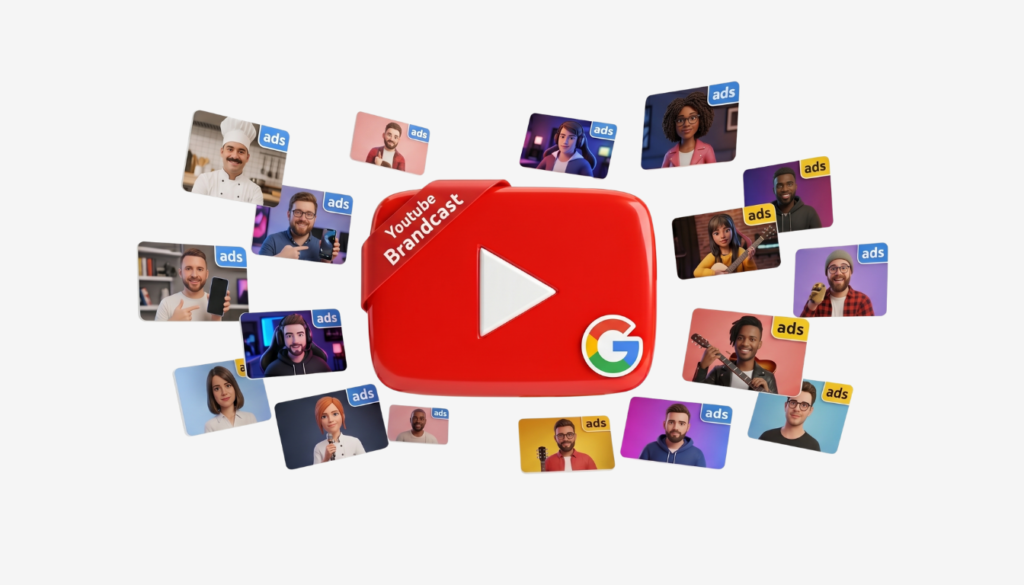
However, at Brandcast, YouTube introduced a new vision for advertising, challenging established beliefs about platform marketing. Instead of pursuing trends or quick content, YouTube contends that future brand growth will depend on lasting trust.
Sean Downey, president of the Americas at Google, told advertisers that while branding used to be about social media, the real advantage now lies in building genuine connections among brands, creators, and communities. While this might sound like typical event talk, it actually marks a real strategic change for both YouTube and the creator economy.
Beyond its presentations, YouTube says creators are no longer just supporting players. They are now the main way audiences find, trust, and connect with brands.
From Video Platform to the Future of Media
Perhaps the clearest signal from Brandcast was YouTube’s desire to escape the confines of traditional platform categories altogether.
For years, media channels occupied relatively defined roles within the advertising ecosystem. Television built awareness, paid social generated engagement, creator partnerships injected cultural relevance, and performance media focused on measurable outcomes. As consumer attention fragmented across devices and formats, marketers learned to spread budgets across increasingly specialized channels, balancing storytelling against efficiency while attempting to reconcile long-term brand equity with short-term business pressure.
YouTube now says this scattered approach no longer aligns with how people watch media or how brands should invest. Repeatedly, Downey emphasized YouTube as “the future of media,” a phrase that reveals ambitions far larger than video advertising alone. The platform increasingly wants advertisers to see YouTube not simply as a streamer, a social destination, or a creator marketplace, but as a fully integrated ecosystem that combines entertainment, creator influence, commerce, and measurable performance within a single environment.
There’s a reason YouTube is making this argument now; since connected television continues reshaping viewing habits, younger audiences move fluidly between long-form content and short-form video, and creators increasingly replace institutions as trusted voices in culture, YouTube occupies an unusually powerful position. It remains dominant in streaming viewership, commands massive scale through Shorts, and simultaneously functions as one of the internet’s largest destinations for discovery, education, entertainment, and creator-led communities. In many ways, the platform is positioning itself not as an alternative to traditional media but as its successor.
The Institutionalization of Creator Marketing
The biggest change at Brandcast is YouTube’s new approach to creator partnerships. They are moving from one-off deals to making creators a key part of media planning.
Creator marketing was long inefficient. Partnerships were negotiated one by one. Agencies or talent managers often acted as middlemen. Deals depended on personal relationships. Measurement frameworks were inconsistent, making large investments tough to standardize. Even as influencer spending rose, many marketers treated creator budgets as experiments instead of integrating them into wider media plans.
YouTube is trying to completely change this situation. In the past year, YouTube has grown its tools for working with creators. They’ve added creator takeovers, where brands can sponsor big creator events; channel slates to preview upcoming shows; and YouTube Creator Partnerships, which use algorithms to match advertisers with creators on a large scale.
YouTube is creating a system that makes working with creators more predictable, measurable, and similar to traditional media. Instead of having marketers find the right creators themselves, YouTube wants to match brands with creators whose audiences and content are most likely to deliver results.
In doing so, YouTube is redefining creators not as influencers, but as programmable media properties, reflecting a broader evolution already underway in the creator economy. Increasingly, creators resemble mini entertainment companies with recurring formats, highly loyal audiences, and predictable content ecosystems, rather than individuals posting sporadic sponsored integrations. The introduction of channel slates reinforces this transformation, borrowing directly from the logic of television upfronts by allowing advertisers to preview future content and secure premium placements around anticipated creator moments before they happen.
The creator economy, once celebrated for its spontaneity and unpredictability, is gradually becoming institutionalized.
Why Trust Is Replacing Reach
At the heart of YouTube’s broader argument lies a growing discomfort many brands have developed toward the economics of social media itself.
After years of chasing engagement metrics, marketers increasingly face diminishing returns from audiences exhausted by over-commercialized feeds, declining organic visibility, and creator partnerships that often generate visibility without necessarily building credibility. Massive follower counts, once viewed as proxies for influence, no longer guarantee meaningful business impact, while viral moments frequently disappear before they have time to translate into long-term brand memory.
This is precisely where YouTube believes its creator ecosystem differs from other platforms. Unlike environments optimized primarily for fleeting interactions, YouTube creators tend to cultivate relationships over much longer periods, often through recurring formats, educational programming, podcasts, serialized storytelling, or entertainment ecosystems that audiences return to consistently. Viewers are not simply consuming isolated moments; they are building habits.
That habit formation matters because trust compounds. Watching a weekly creator for years is different from briefly encountering an influencer while scrolling. Recommendations from these creators feel earned, not inserted. Audiences see creators less as advertisers and more as trusted personalities. Their opinions carry emotional weight.
YouTube’s internal data appears designed to reinforce that claim. According to Downey, brands using Creator Partnerships within Shorts experience roughly a 30% lift in conversion, a statistic that speaks directly to one of the industry’s central tensions: whether authenticity can be measured by performance.
Increasingly, platforms believe the answer is yes. And once trust begins producing measurable business outcomes, it ceases to be merely a branding aspiration and becomes an investable media strategy.
The End of the Branding-versus-Performance Divide
One of the more revealing tensions addressed during Brandcast centered on a debate that has shaped marketing conversations for years: whether brands must choose between long-term storytelling and short-term efficiency.
Economic pressures push budgets toward performance channels, rewarding quick results and sidelining branding. Marketers try to balance storytelling with accountability, seeing awareness and conversion as competing rather than complementary priorities. It argues that the distinction between brand-building and performance marketing is outdated, asserting that both priorities can be met within a single integrated strategy.
Through creators, the platform argues, brands can establish trust and cultural relevance; through Shorts, they can drive action and commerce; through connected television, they can achieve scale; and through AI-powered advertising systems, they can optimize creative execution and measurement simultaneously. Rather than separating brand and performance into distinct budget categories, YouTube is effectively pitching itself as a single ecosystem that can deliver both.
Whether advertisers fully embrace that proposition remains uncertain, yet the logic behind it reflects the pressures modern marketers increasingly face. Fragmented budgets, rising accountability demands, and proliferating media environments have made simplification attractive, and YouTube’s larger message is impossible to ignore: if creators, entertainment, measurement, and commerce already exist in one place, why continue dividing attention elsewhere?
A Creator-Led Media Future
Even podcasting, while notably understated during Brandcast, subtly reinforces the platform’s larger ambitions.
YouTube increasingly positions itself as the default home for creator-led media regardless of format, whether video podcasts, long-form conversations, educational series, or entertainment franchises. As audiences spend more time in creator ecosystems that blur the lines between television, streaming, and social content, the boundaries separating media categories continue to collapse.
That collapse is creating an entirely new competitive reality. Creator marketing is no longer experimental or confined to influencer teams operating outside mainstream media planning. It is steadily becoming infrastructure, moving closer to how advertisers traditionally purchased television inventory, entertainment sponsorships, or premium programming integrations. Creators are becoming channels, audiences are evolving into communities, and trust is increasingly emerging as one of advertising’s most valuable forms of currency.
Still, YouTube’s vision raises an unavoidable question, one likely to become more urgent as creator partnerships scale. If authenticity becomes increasingly automated, systematized, and optimized through platforms designed to maximize efficiency, can it retain the very qualities that made audiences trust creators in the first place? That paradox may ultimately define the next chapter of creator marketing. Because while trust may indeed become the future of branding, trust has always proven most fragile precisely when the systems surrounding it become too calculated.