
The Boot That Earns Its Technology
Stone Island has been putting its material obsession on football pitches since Raheem Sterling debuted a special-edition Furon at the 2022 World Cup — the first time the brand’s design language appeared at a major tournament, worn on the feet of a professional footballer during competitive play. Bukayo Saka continued that lineage in 2025, lacing up in the next Furon iteration at the Santan Cup, giving the collaboration its second chapter of on-pitch credibility. The 2026 World Cup, arriving with Saka as one of England’s most prominent players, presented the natural stage for a third.
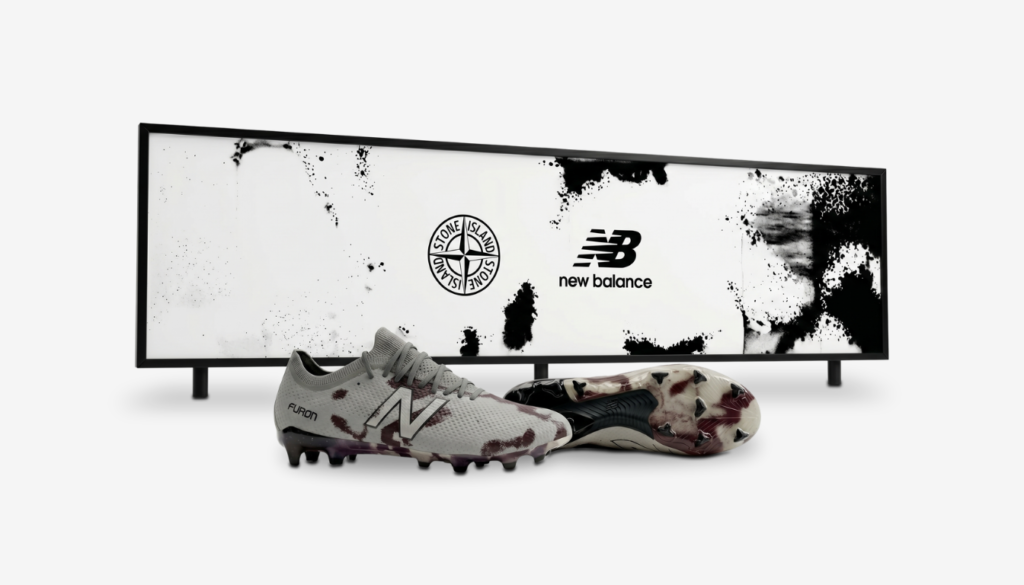
The Stone Island x New Balance Furon Elite FG v9 is the collaboration’s most technically realized football product. The boot is built around a one-piece mesh upper and a lightweight outsole designed for speed — the performance brief of the Furon line — but its defining detail has nothing to do with weight or traction. The upper features a heat-reactive thermochromic pattern: a paint-splattered camo mix of tan, black, and earthy tones that physically changes color and appearance in response to temperature. On a cold morning, the boot looks one way. Warmed up by body heat or sunlight or the friction of the pitch, it transforms. The effect is not simulated or printed. It is a material property. The boot responds to the environment it is in.
This is the most Stone Island thing that Stone Island has ever done on a football pitch, and SoccerBible described it in precisely those terms — “Very Stone Island, and very unnecessary in the best way.” The “unnecessary” is the point. Stone Island’s entire design philosophy is built on the idea that material innovation is worth pursuing for its own sake, not merely for functional justification. The compass badge has meant garment-dyed, technically obsessive clothing for decades. The Furon v9 extends that philosophy to a boot, on a pitch, at the World Cup.
Alongside it, the Tekela Elite Low FG v5 takes a contrasting approach: pale neon green with steel blue hits, semi-transparent studs, chrome-finished heel detailing, and a textured upper engineered for touch and control. Where the Furon is dark, experimental, and shape-shifting, the Tekela is bright, clean, and precise. Both Saka and Brazilian wonderkid Endrick front the campaign, representing a new generation of football talent whose aesthetic sensibility is as considered as their technical ability.
The Billboard That Lives the Same Life as the Boot
The campaign’s most creative element is not the boot. It is the billboard. Stone Island unveiled a heat-reactive outdoor advertisement in London — the spiritual home of its terrace culture identity — that does something no conventional out-of-home advertisement can do: it changes color based on how long the viewer’s gaze rests on it. The heat generated by concentrated attention, represented as the warmth of the human eye and the ambient temperature of extended focus, triggers the same thermochromic response that animates the boot. The longer you look, the more the billboard transforms.
The concept is elegant in a way that the best advertising is — it is not a trick or a stunt, but an extension of the product’s core idea into a medium that would not normally support it. The boot changes color with temperature. The billboard changes color with attention. Both are expressions of the same underlying thesis: that the most interesting materials are the ones that respond to the conditions they are in, rather than remaining static regardless of their environment. Stone Island has been making this argument in clothing for 40 years. The campaign makes it simultaneously in a football boot and a London street poster.
The creative specificity of the execution — making the campaign medium demonstrate the product’s defining technology, rather than merely describing it — is the kind of idea that separates genuine creative problem-solving from the competent execution of a brief. Most product campaigns tell you what the product does. This one makes you experience what the product does, standing on a street, staring at a wall.
Why the Collaboration Works When Others Don’t
The fashion-meets-football collaboration space has become crowded enough in 2026 that the question of why any individual partnership works requires more than pointing at the name recognition of the brands involved. Stone Island x New Balance has worked, across multiple iterations since its launch, for reasons that have less to do with the brands’ individual cachet and more to do with what they actually share.
Stone Island’s connection to football is not manufactured. It is organic, decades-old, and embedded in the terrace culture of British and European football in a way that no amount of collaboration planning could replicate. Anyone who has attended a match in England knows that the compass badge is as common in the stands as the colors of the teams playing. Stone Island is not a brand that decided to be associated with football. It is a brand that football supporters already wore, for their own reasons, long before any official partnership existed. That pre-existing authenticity is what gives the New Balance collaboration its legitimacy — it is Stone Island going back to a world it already belonged to, rather than entering one it needed permission to access.
New Balance, for its part, brings a combination of performance football credibility — its athletes include Saka, Endrick, and a growing roster of Premier League players — and a brand identity that has earned genuine streetwear relevance without abandoning its sporting core. The 1890 sneaker, included in the Summer 2026 collection alongside the boots, demonstrates both dimensions simultaneously: technically considered, aesthetically deliberate, and positioned comfortably between the pitch and the terrace.
The heat-reactive Furon v9 and the billboard that mirrors it are the fullest expression yet of what happens when those two things — a brand with genuine material obsession and a sport with genuine terrace culture — produce something together with genuine intent. Football at the World Cup is the largest canvas in sport. Stone Island put something worth looking at on it. Then it put a billboard in London that rewarded you for looking.