
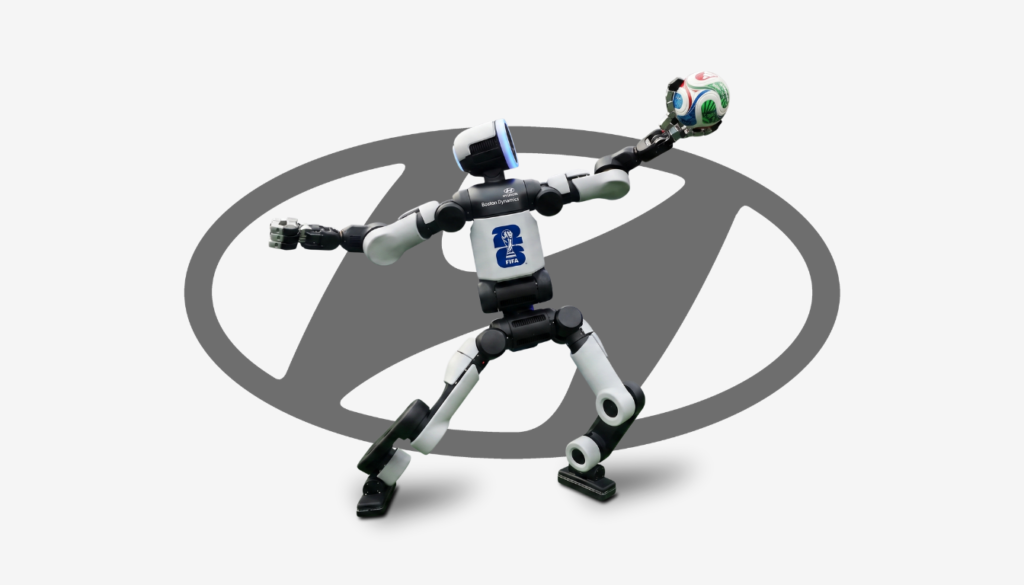
A Sponsorship That Doubled as a Product Demo
At the Round of 16 match between Brazil and Norway at MetLife Stadium in New Jersey, Hyundai staged what it describes as the World Cup’s first robotics-powered halftime activation. Atlas, the humanoid robot built by Boston Dynamics, delivered the match ball and performed goal celebrations associated with stars including Brazil’s Matheus Cunha and Norway’s Erling Haaland. Hyundai says it marked the first public demonstration of the robot’s real-world movement and the first time a humanoid has been integrated into a live World Cup match environment.
The choice to lead with a working machine rather than a filmed spot is the point. Most sponsors buy attention with polished video. Hyundai spent its moment proving something on the field, in front of a global broadcast audience, in real time. The activation builds on the company’s “Next Starts Now” platform and its role as FIFA’s official robotics partner for the 2026 tournament.
Competing With the Feed, Not Just Other Sponsors
Hyundai’s marketing leadership framed the stunt as a fight for attention against everything on a viewer’s screen, not only against rival sponsors on the pitch. In that reading, incremental creativity is not enough to break through the constant churn of reels and short-form video. The company wanted a moment real enough to interrupt the scroll, and a robot delivering the ball at the world’s most-watched sporting event is engineered for exactly that.
The calculation reflects a broader shift in how brands approach tentpole events. Reach is abundant and cheap; salience is scarce. A sponsor logo on a board earns impressions, but a spectacle that people stop to watch, screenshot, and share earns something closer to memory. Hyundai is betting that a live demonstration travels further than any produced ad it could have run in the same slot.
From Carmaker to Mobility Company
Beneath the theater sits a positioning argument. Hyundai used the tournament to present itself as a future-focused mobility company rather than an automaker, and Atlas is the emblem of that claim. The company also deployed its dog-inspired Spot robots for security and asset protection at select venues, pairing an emotional showcase with a functional one. The message the company wants to land is that its robotics are already operating in the real world, not merely appearing in highlight reels.
That dual display, one robot delivering spectacle and another handling logistics, is a compact statement of strategy. It tells consumers and investors that Hyundai’s robotics ambitions extend beyond a marketing gimmick into infrastructure and operations. For a brand trying to expand how the public defines it, the World Cup offered a stage where a single moment could reframe the whole company.
The Playbook Behind the Stunt
The execution was less spontaneous than it looked. Atlas went through pre-training, testing, and rehearsal, and while an operator initiates its actions, its balance, movement, and recovery are driven by its own systems. The activation showcased capabilities such as retargeting, which lets the robot translate human movements into its own, along with reinforcement learning across thousands of simulations and whole-body coordination.
The company also planned for the moment to live well past the final whistle. Behind-the-scenes footage and additional storytelling are set to roll out across broadcast, digital, and social in the weeks ahead, extending a single halftime beat into a sustained campaign. That is the discipline behind the spectacle. The ball delivery was the visible climax, but the surrounding content strategy is what converts a fleeting stunt into weeks of conversation. For marketers, the takeaway is less about robots than about structure: the boldest live moment still needs a plan for what happens after everyone stops watching.