
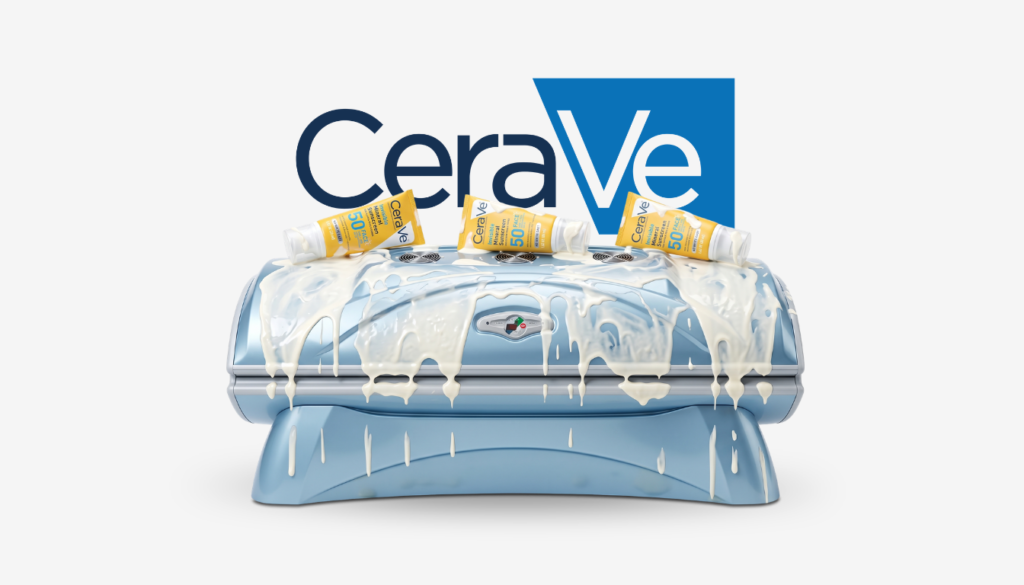
CeraVe has spent nearly a decade persuading Americans that dermatologist-designed basics belong in every bathroom. Its newest obstacle is not a rival moisturizer. It is a generation that has decided a tan matters more than the skin underneath it. On August 11 the L’Oréal-owned brand answered that problem with a four-episode social series built around tanmaxxing, the internet shorthand for maximizing a tan, and it did so without a single finger-wag.
The premise is a renovation. Television personality and licensed contractor Tyler Cameron teams with board-certified dermatologist Dr. Chloe Goldman to remake the backyard of the Alpha Eta chapter of Delta Delta Delta at Florida State University into what CeraVe calls a sun-safe social space. Across the series they add a pergola that turns an exposed lawn into shade, landscaping that builds natural cover, and UV meters that signal when the rays peak and it is time to reapply. At the center of it sits CeraVe’s Invisible Mineral Sunscreen SPF 50.
Selling Prevention to a Generation That Wants a Tan
The behavior CeraVe is confronting is documented and stubborn. Roughly one in five Gen Z adults say getting a tan is more important to them than preventing skin cancer, and about 71 percent report being unaware of the risks tied to sunburn, according to survey figures cited across dermatology coverage. One in seven adults under 35 believe daily sunscreen does more harm than direct sun. Young people increasingly treat the UV index not as a warning but as a timetable for when a tan will develop fastest, a habit dermatologists have spent the year sounding alarms about. Measured against melanoma research showing that indoor tanning roughly triples the odds of the disease, the distance between what this cohort knows and what it does is the whole marketing problem, and it is one no volume of clinical copy has closed.
Renovation as a Content Format
CeraVe’s answer borrows a genre Gen Z already watches, the makeover. Rather than a public-service announcement, the brand produced episodic, documentary-style content that behaves like the home and lifestyle videos already filling TikTok and YouTube. The casting does double duty. Tyler Cameron brings reach and lifestyle credibility from reality television along with a real contracting background, while Dr. Goldman supplies the clinical authority any skincare claim needs. The sorority setting drops the message inside the exact environment where a tan is social currency, not in a clinic or a thirty-second spot. The sunscreen appears throughout, yet the story is the space, and that is what keeps the series from reading as an advertisement rather than a show its audience might choose to watch.
Why Suncare Is Worth L’Oréal’s Attention
The series doubles as a demand engine for a product line L’Oréal has been building deliberately. CeraVe crossed two billion dollars in global sales in 2024 and sits within L’Oréal’s dermatological beauty division, which posted 7.20 billion euros in revenue in 2025 at a 26.1 percent operating margin, the richest of any division in the group. Alongside La Roche-Posay and SkinCeuticals, CeraVe helped push dermocosmetics past the billion-dollar threshold and made the division L’Oréal’s fastest-growing. The company extended into ceramide suncare with CeraVe Sun in May 2026, and suncare is exactly the category the tanmaxxing cohort under-consumes. A campaign that makes SPF feel native to Gen Z culture is less a corporate-responsibility gesture than a growth lever for a range that needs this audience to convert.
Culture as the New Front in Skincare
The launch signals where mass skincare marketing is heading. Prevention brands used to compete on ingredients and dermatologist endorsements; increasingly they compete on cultural fluency, on whether a message can survive inside a feed built for entertainment. CeraVe is effectively operating as a content studio, producing a series with characters, a setting and a narrative arc it can sequel. Rivals across the aisle, from legacy suncare labels to newer SPF challengers, now face the same test, because the audience most at risk is also the one least moved by warnings. If the format works, expect prevention to keep migrating from the clinic to the creator economy, dressed as home renovation, comedy or reality television rather than health advice.
The Play Marketers Should Study
Three moves make the effort worth studying. CeraVe trend-jacked a risky behavior without moralizing, which is the difference between joining a conversation and scolding it. It bought cultural permission by building something physical and real, a renovated space, instead of publishing another warning. And it turned a health message into ownable, episodic intellectual property it can extend, rather than a disposable film. The risks are equally plain. Amplifying a dangerous trend, even to counter it, hands the term more oxygen, and reach among a skeptical audience does not automatically become behavior change or sales. The number that matters will not be views. It will be whether a generation that ranks a tan above its own skin can be sold, through entertainment, on the very thing designed to protect it.