
The excitement of attending a 2026 FIFA World Cup match is hard to match, and brands are along for the ride as much as fans. At the New York-New Jersey Stadium on June 16, France beat Senegal 3-1 in a Group of Death fixture, with supporters of both nations filling the stands. They were not the only ones present. Verizon hosted Golden Ticket members, and the surfaces surrounding the match, from the arrivals hall of the airport to the merchandise stand, formed a continuous advertising environment that extended far past the pitch.
Inside the Venue, FIFA Holds the Keys
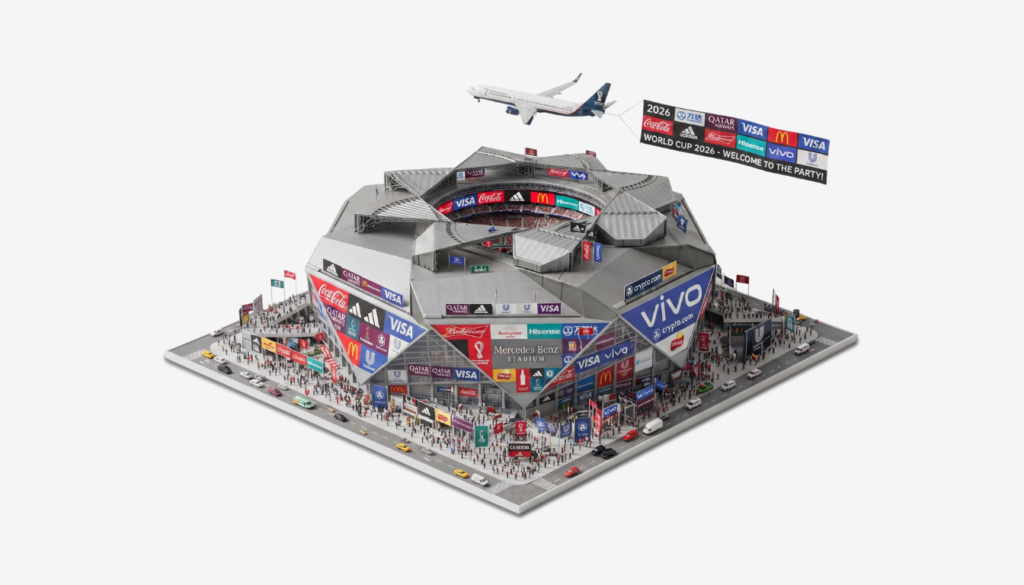
Advertising inside a World Cup stadium is tightly controlled. FIFA manages in-venue branding through its official partner and sponsor program, and host cities enforce clean zones that restrict commercial activity in a radius around each venue. That leaves most brands to reach fans through what the industry calls stadium-adjacent out-of-home: billboards, digital screens, and wallscapes within one to three miles of the venue, plus airport, transit, and fan-zone placements that capture supporters on their way in.
The result is a layered system. Sponsors buy proximity and association inside the perimeter, while everyone else engineers presence around it. Verizon’s hospitality activation illustrates the sponsor play, converting access into a branded experience that fans photograph and share. Non-sponsors, meanwhile, treat the surrounding city as inventory, tuning messaging to national pride and fan emotion without touching FIFA trademarks.
The Hydration Break Rewrites the Broadcast
The most consequential change this tournament is not on any billboard. FIFA introduced structured mid-match hydration breaks, confirmed across all 104 games, opening the first scheduled in-match commercial windows in World Cup history. When play pauses, broadcasters are not obligated to cut away, but a full cutaway opens a window of roughly two minutes and ten seconds to any advertiser willing to pay a premium. Fox and Telemundo are expected to take it.
That window commands top-of-market pricing. Streaming CPMs for World Cup coverage are forecast in the range of 60 to 120 dollars, with hydration-break placements sitting at the high end. For advertisers, the break creates something soccer never reliably offered American media buyers: a predictable, high-attention ad slot inside a sport built around continuous play. It imports the interruptive rhythm of the Super Bowl into a tournament of 104 matches.
The Largest Stadium Is Everywhere Else
For every fan inside a venue, thousands more watch from elsewhere, and that is where the economics get extraordinary. In the United States, Fox is broadcasting all 104 matches across its networks, with Tubi positioned as a free, ad-supported fan hub. Host cities are running official FIFA Fan Festivals with large screens, live entertainment, and sponsor activations, turning public squares into media destinations.
The scale is difficult to overstate. Roughly 100 million Americans plan to follow the tournament, about four times the audience for the 2022 final. Brands are pouring an estimated 10.5 billion dollars in additional global ad spend around the event, and one survey found 89 percent of viewers plan to make a purchase tied to their watch experience, with projected consumer spending near 7.5 billion dollars. Every screen becomes inventory, every gathering place a venue, and the match itself becomes the center of an attention marketplace that runs for 39 days.
The Measurement Puzzle Nobody Has Solved
All that reach creates a problem that sits at the heart of the tournament for marketers. A single fan might see an airport billboard, a geofenced mobile push, a social spot, and a stadium merch stand across a few days, paying cash at the final touchpoint. No single platform’s dashboard sees the whole journey. The physical-digital boundary remains one of the least-solved problems in modern measurement, and at World Cup scale it stops being an edge case and becomes the main event.
The brands that will know what they bought are the ones investing in identity resolution that follows a fan across surfaces, matching physical movement through a fan zone to a known digital profile and treating an untraceable cash purchase as a conversion to work backward from. Research around the tournament suggests fans are meaningfully more likely to buy when they encounter a brand consistently across connected TV, social, and mobile, which rewards coordinated cross-surface buys over isolated placements. The advertisers guessing in August will be the ones who treated each surface as a separate campaign rather than one continuous path to a purchase.
The takeaway for marketers is that the World Cup is no longer a media buy. It is a distributed system of attention, and the winners are the brands that plan for the whole journey and can prove where it led.