
A Different Kind of Spotlight
The 2026 FIFA World Cup, opening June 11 across the United States, Canada, and Mexico, has already generated one of the most competitive marketing environments in sports history. Nike has assembled a 42-person cast. Adidas released a five-minute cinematic epic. Visa signed Jason Sudeikis. The instinct among brands with World Cup exposure has been, almost universally, to reach for scale, celebrity, and spectacle. Chobani, the Greek yogurt company that became U.S. Soccer’s official nutrition partner, chose something entirely different.
Rather than leading with the tournament’s biggest names, Chobani asked a question that most sports marketing never stops long enough to consider: what about the people who made those stars possible? The brand’s World Cup campaign, developed with agency Uncommon New York, turns the spotlight onto the coaches, parents, and communities behind three U.S. Soccer players — Weston McKennie, Christian Pulisic, and Antonee Robinson — tracing their journeys from childhood to the World Cup pitch through the eyes and hands of three distinct artists. As Sam Shepherd, chief creative officer at Uncommon New York, described it: the campaign is a deliberate counterpunch to the way most brands try to show off the flashy stars.
Art as the Medium, Not the Decoration
What distinguishes the Chobani campaign is not just its thematic choice but its formal ambition. The brand did not commission a conventional advertising campaign and dress it up with artistic language. It commissioned original works of art and built a campaign around them — a meaningful distinction that changes what the work can mean and how far it can travel.
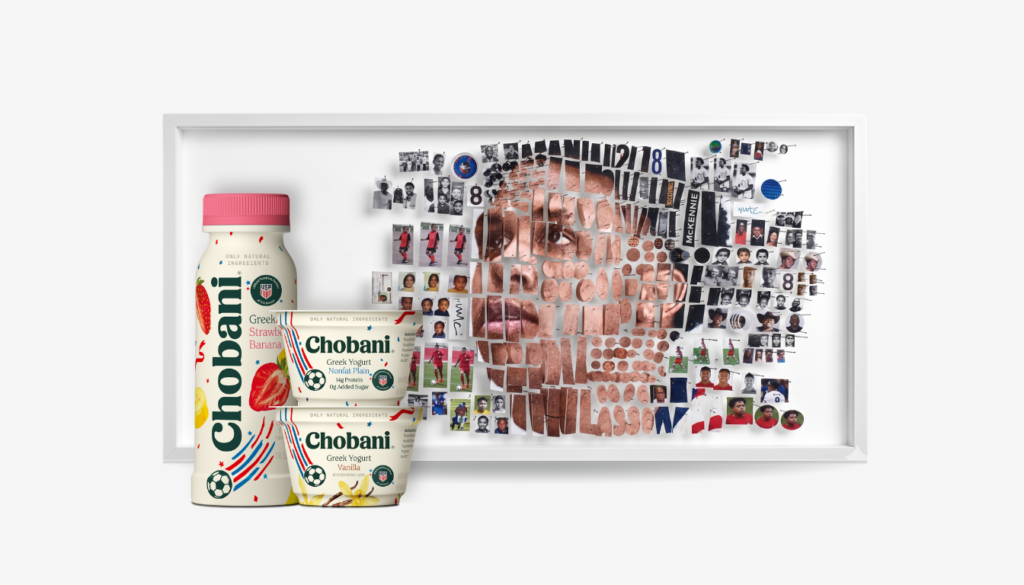
Fashion designer Heron Preston created three bespoke jerseys for the three players, each one built from fabrics carrying personal significance: former club jerseys, national flags, childhood kits. The garments function as wearable biographies, with every textile choice serving as a reference point in a life story. Portraitist Michael Mapes constructed three deconstructed portraits assembled from fragments of what he calls “biographical DNA” — photographs, personal documents, and objects of private meaning — which will be exhibited at the U.S. Soccer House in Los Angeles and reproduced as out-of-home displays in New York City and in each player’s hometown. Director Hector Dockrill produced a series of biographical short films that will run as television spots throughout the tournament, each one examining what unconditional support looks like in practice: a youth soccer coach who stayed, a mother who never left.
David Isaac, Chobani’s VP of brand operations and creative production, described the project as a deliberate exploration of multiplicity — the same story told differently by three artists working in three forms. “It’s not just the star or the celebrity,” he said. “It’s about their journey and all the people who came around to support them.” What the campaign understands, and what most sports advertising does not, is that the story of how a world-class athlete is made is almost always more emotionally resonant than the story of what they achieve. The achievement is visible to everyone. The making is invisible to almost everyone.
Feed the Dream, Not Just the Moment
The campaign sits within a broader initiative, giving it structural weight beyond any single piece of content. Chobani’s “Feed the Dream” program, launched in October 2025, represents a $5 million commitment to sponsor 500 youth soccer clubs across the United States, providing each club with $10,000 to improve access to fields, training, and equipment. That level of investment in grassroots infrastructure is, in fact, a brand strategy expressed through funding, and the campaign is its public face.
The framing Isaac uses to describe the initiative is worth attending to: food and soccer as forces for community and accessibility, two things that should be available to everyone regardless of background. That alignment between Chobani’s product category and its community investment is coherent in a way that many brand purpose plays are not. A nutrition company investing in youth athletic development is not a stretch. It is, in fact, the most natural thing a brand in that category could do, which is perhaps why it carries more credibility than the generic social responsibility gestures that most World Cup sponsors produce.
The campaign began in April with soccer-inspired packaging and will extend across hundreds of U.S. youth soccer clubs and more than 17,000 stores, stadiums, and fan zones. It is, in scale and duration, a commitment rather than an activation.
The Bet Behind the Brief
There is a strategic insight embedded in the Chobani approach that has implications well beyond this particular campaign. In a media environment where brands are competing for a finite amount of emotional real estate during the World Cup, the instinct to go bigger — more stars, more production value, more spectacle — is understandable but increasingly self-defeating. Every brand that tries to own the tournament moment by featuring the tournament’s biggest names is, by definition, competing in the same register against the same opponents with the same audience.
Chobani’s move to redirect attention to the unacknowledged support systems behind those athletes is not only emotionally differentiated—it is commercially differentiated. The coaches, parents, and community figures at the center of its campaign are not just compelling characters; they are also compelling figures. They are the people whom the largest, most engaged community in American soccer, including youth players and their families, most closely identify with. A campaign that honors the youth coach speaks directly to the families of the 30 million children who play youth soccer in the United States, most of whom will never play at a World Cup but all of whom understand exactly what it means to be coached, supported, and believed in.
That is not a small audience. And no other major World Cup sponsor is talking to them.