

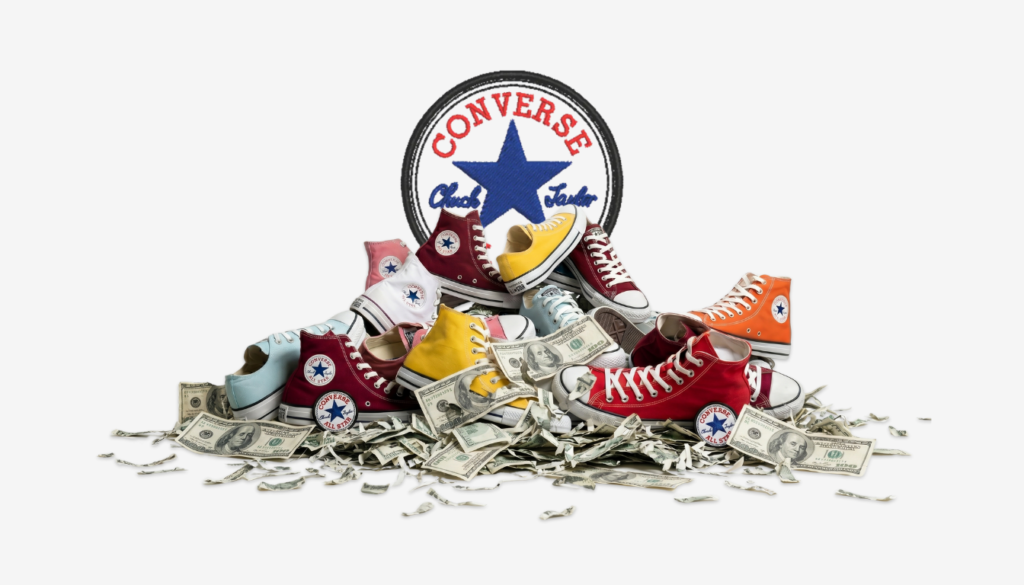
The Decline That Can’t Be Explained Away
The numbers are difficult to contextualize charitably. Converse revenues fell 28% in Nike’s fiscal Q1 2026, then another 31% in Q2, then 35% in Q3 — hitting $264 million against $405 million at the same time the previous year. EBIT turned negative in Q2. The brand hired Aaron Cain as its new CEO in July 2025 and, in February 2026, conducted layoffs. BNP Paribas senior equity analyst Laurent Vasilescu raised the question in a January client note that had been present in industry conversations for months: was Nike quietly preparing to exit Converse? The note described the brand’s underlying health as “more precarious than it may seem” and pointed to Nike’s stated $2 billion cost-saving target as a structural pressure that could make a Converse divestiture attractive.
Nike CEO Elliott Hill shut down the speculation on the Q3 earnings call with language that was simultaneously reassuring and revealing: “Converse will remain an important part of the Nike, Inc. family, and we are excited about its long-term prospects.” The qualifier that accompanied it — “the pace of progress is different across the portfolio” — was a frank acknowledgment that Converse’s recovery is running behind Nike’s. Hill had already said in December that Converse’s turnaround would take longer than Nike’s own. For a company that has described itself as being in “the middle innings” of its comeback, the suggestion that Converse is in the early innings is a meaningful admission.
What Went Wrong
Converse’s decline is not a product failure in the conventional sense. The Chuck Taylor has not been displaced by a superior product. It has been displaced by the accumulated fatigue that follows overexposure, combined with the absence of the kind of consistent brand investment that might have refreshed its cultural relevance before the fatigue set in. The brand’s market presence became so omnipresent across the decade following Nike’s 2003 acquisition — in every retail channel, at every price tier, in every colorway — that the Chuck Taylor’s meaning was diluted at exactly the pace at which its distribution expanded.
The result is a brand that has maximum awareness and diminishing desire — the most dangerous combination in consumer goods, because it forecloses the easy marketing solutions. A brand with low awareness and strong desire needs to be introduced to more people. A brand with high awareness and low desire needs to convince people who already know it that it is worth wanting again. That is a harder problem, and it does not have a campaign solution. It requires a sustained period of scarcity, curation, and deliberate cultivation of cultural relevance that is fundamentally at odds with the mass distribution model that produced the problem in the first place.
The Brand’s Structural Tension
The specific strategic difficulty of Converse’s position within Nike is the tension between what the brand needs to recover and what the corporation needs from the brand. Converse’s recovery requires the kind of discipline that luxury brands apply when they want to rebuild desire: reduce distribution, increase curation, invest in fewer but more culturally significant product moments, and accept lower volume in exchange for higher price points and stronger brand equity. That approach generates declining revenue in the short term before it generates growth — a timeline that is very difficult to sustain inside a publicly traded parent company that is itself in the middle of a turnaround and under pressure from investors to show improvement every quarter.
The demand creation spend that Nike allocated to Converse in its most recent half — $24 million — is, relative to the scale of the challenge, modest. It reflects either a deliberate decision to let the brand find its footing before investing heavily in marketing or an uncertainty about what marketing message would actually move the needle. Possibly both. The Shai 001 — a collaboration with NBA star Shai Gilgeous-Alexander that represented one of the brand’s more creatively coherent recent drops — generated genuine energy but not at the scale required to arrest the revenue decline.
The cultural territory Converse has historically owned — youth subculture, art, music, the particular kind of anti-establishment cool that the Chuck Taylor has accumulated across seven decades of association with punk, grunge, hip-hop, and independent filmmaking — is still available. The brand’s identity is intact in the way that the most durable brand identities survive even severe commercial difficulty: the Chuck Taylor still means something. It means creative independence, downtown New York, the girl in the band, the art school kid, the kid who doesn’t belong anywhere else and belongs exactly there. That meaning is not transferable to any other product. It is Converse’s alone.
What Recovery Actually Requires
The brands that have successfully rebuilt desire after a period of overexposure and commercial decline have done so through a consistent set of moves that are available to Converse in principle, even if execution requires patience that corporate timelines make difficult. Distribution tightening — reducing the number of retail doors, prioritizing premium and independent channels over mass market — removes the ubiquity that diluted the brand’s meaning while making each remaining placement feel more considered and more significant. Product curation — fewer releases, more intentional, each one with a clear creative rationale — replaces the volume strategy with a quality signal that gives the brand’s most engaged audience a reason to pay attention and pay more. Cultural investment — in music, art, sport, and the specific subcultures where the Chuck Taylor’s identity was originally formed — reminds the audience that the brand belongs to those worlds rather than simply selling products to them.
These are not new strategies. They are the strategies that every major footwear brand has applied, at one point or another, to rebuild a silhouette that was once relevant and became a commodity. Nike applied them to the Air Force 1. Adidas applied them to the Stan Smith. New Balance applied them to the 990. The common thread is patience, specificity, and a willingness to accept smaller short-term numbers in exchange for a stronger long-term position.
Hill has committed to keeping Converse. The question that the next several quarters will answer is whether the parent company’s own turnaround pressure gives the brand the time and freedom it needs to rebuild properly, or whether the performance clock runs faster than the brand recovery can. The Chuck Taylor has survived 108 years. Whether it can survive its current owner’s timeline is the more pressing question.