
From Shoes to Speakers
Justin Bieber launched SKYLRK in July 2025, co-founding the lifestyle brand with creative partner Neima Khaila. The origin, as he described it on one of his Twitch streams at the time, was disarmingly simple: “It started off as just us wanting to, like, make shoes.” What happened next was less simple. Within months, SKYLRK had become one of the most talked-about brand launches in the streetwear space — not because of its distribution scale or its marketing budget, but because of the coherence between the brand’s visual identity, its founder’s artistic evolution, and the cultural moment it arrived into.
By April 2026, SKYLRK had taken over Coachella. Not peripherally — the brand built an immersive SKYLRK Oasis and a dedicated SKYLRK Shop on the festival grounds, creating a physical brand world for consumers days before Bieber took the stage to headline. When he finally performed, he wore nothing but blue silk SKYLRK boxers and black SKYLRK socks — a choice that made every camera at Coachella a brand placement without any of the transactional awkwardness that conventional product placement carries. It was branding as autobiography, and it generated coverage that no paid partnership could have replicated.
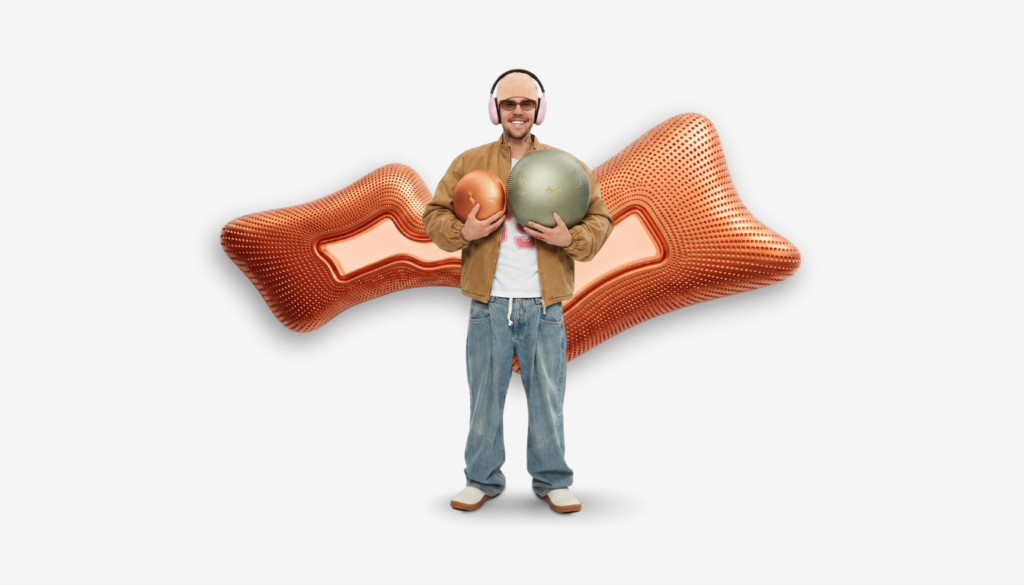
On June 7, 2026, Bieber posted teaser images to Instagram that confirmed what he had begun hinting at months earlier: SKYLRK Audio. The images showed flying saucer-shaped portable speakers in three sizes, a pair of chunky over-ear headphones, and what appeared to be wired earbuds — all rendered in bold, eye-catching colorways including olive green, copper, burnt orange, lilac, and deep teal, with translucent finishes and prominent SKYLRK branding. No release date, no price, no spec sheet. Just images close enough to final form that the message was clear: this is not a concept. It is coming.
The Architecture of the Expansion
The move into audio is not arbitrary, and understanding why it makes sense requires looking at the logic of what SKYLRK has been building rather than simply what it has been releasing. Bieber described the evolution in his own terms: “Now, it has turned into something where we’re working on headphones and tech and stuff, and it has evolved into this different space.” The phrase “different space” understates what is actually happening. SKYLRK is not diversifying into adjacent product categories in the way that a fashion brand might add a fragrance line. It is constructing an ecosystem — a brand presence across every dimension of how its target consumer lives, moves, listens, and expresses themselves.
The product architecture already spans apparel, footwear, accessories, experiential activations, and now audio hardware. Each category reflects the same visual and cultural DNA: bright colorways, recognizable branding, design-forward construction, and a refusal of the conservative neutrals that dominate most of the premium consumer electronics market. The SKYLRK speaker is not designed to blend into a shelf. It is designed to be seen, discussed, and photographed — to function simultaneously as a functional audio device and a design object that signals something about the person who owns it.
This dual function — product as tool and product as identity statement — is precisely what has made streetwear brands commercially powerful over the past two decades, and it is exactly what most consumer electronics companies have failed to deliver. The premium audio market has produced technically sophisticated products in a visual language so conservative that it has become effectively invisible. SKYLRK’s entry into the category is, in that sense, a competitive opportunity as much as a brand extension.
The Ecosystem Logic That Changes Everything
The most significant thing about SKYLRK Audio is not the products themselves — which have not yet been fully detailed — but the strategic logic they represent. Bieber and his team are building what the brand’s observers have begun calling a “lifestyle ecosystem”: a brand presence so comprehensively distributed across the daily experience of its target consumer that brand engagement becomes ambient rather than transactional. You wear SKYLRK. You listen through SKYLRK. You encountered SKYLRK at Coachella. You follow Bieber performing in SKYLRK on social media. The brand is not a product you choose. It becomes part of the texture of how you move through the world.
This is the model that Apple perfected in consumer electronics, that Supreme built in streetwear, and that a small number of artist-led brands have begun attempting with varying degrees of commitment. What separates SKYLRK from most celebrity brand efforts is that the ecosystem logic was apparently embedded from the beginning — the Coachella Oasis, the audio expansion, the tech and fashion hybrid positioning — rather than being bolted on after an initial fashion success. Bieber is not adding audio to a clothing brand. He is revealing the next layer of something that was always intended to be larger than clothing.
The premium audio market’s renewed appetite for aesthetically differentiated products creates a moment of genuine commercial opportunity. Consumers who value design as highly as performance — and who are increasingly treating their audio equipment as lifestyle statements in the same way they treat their footwear and outerwear — have been underserved by a category that has prioritized technical specification over visual identity. SKYLRK’s entry into that gap is timed well. Whether the products can deliver the audio quality required to justify premium pricing — expected to range from around $200 for headphones to potentially above $1,000 for the largest speakers — will determine whether the expansion creates lasting commercial credibility or remains primarily a cultural statement.
The answer to that question is still ahead. What is already clear is that Bieber is building something with a coherence and ambition that most celebrity brands never approach — and that the space between streetwear and technology, which SKYLRK is claiming, is one of the most valuable intersections in the consumer economy right now.