
The Shift That Took Too Long
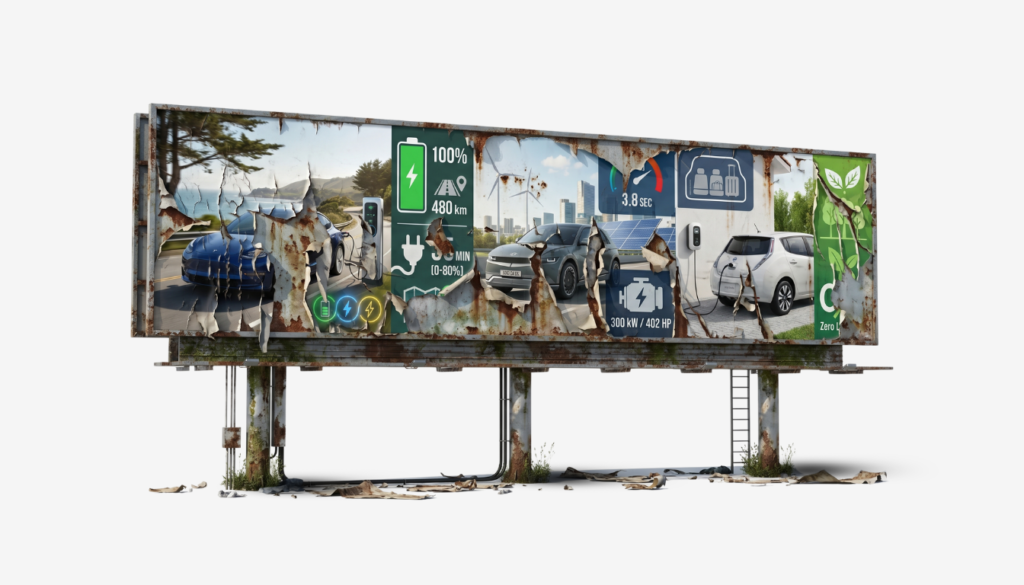
For most of the past decade, automotive advertising was organized around a set of propositions that felt urgent when they were new and increasingly generic as they proliferated across the entire category. Range anxiety was addressed. Charging speed was dramatized. Autonomous features were demonstrated with the particular combination of excitement and reassurance that the regulatory environment required. Every major brand communicated roughly the same story about the same capabilities in the same approximate register — forward-looking, technology-centered, aspirationally designed — and the cumulative effect was a category in which brands sounded indistinguishable from each other at exactly the moment when differentiation mattered most.
The insight that has been restructuring auto marketing’s most effective work in 2025 and 2026 is simple and, in retrospect, obvious: the technology is now the floor, not the ceiling. Consumers have largely accepted that electric vehicles work, that connected features add convenience, that autonomous capabilities improve safety. The baseline has shifted. What remains as a genuine differentiator — what still generates emotional response and brand preference and ultimately purchase behavior — is everything the technology is in service of: the trip, the relationship, the freedom, the belonging, the ordinary moments that become meaningful in the specific context of a car.
What Human Connection Means in Practice
The practical translation of this strategic insight varies by brand, category, and audience in ways that resist a single formula, but the structural move is consistent across the auto brands generating the strongest brand equity metrics in the current environment: the story moves from the vehicle to what the vehicle enables. This is not merely a creative direction. It is a brief-level decision that changes what the research agenda looks for, what the creative executes, and what the media plan is designed to deliver.
Subaru has been executing this approach for decades through its “Love” platform, which anchors every brand communication in the human relationships that Subaru vehicles appear in rather than the vehicles themselves. The platform has survived multiple vehicle technology generations, multiple competitive disruptions, and multiple cultural moments because it is not about what Subaru’s cars do. It is about what Subaru owners are like and what they value. The technology changes; the people stay recognizable.
The brand platforms gaining the most attention in 2026 are those making a similar move with contemporary resonance. Ram’s “Built to Serve” repositioning centers not on payload capacity or towing specification but on the identity and dignity of the people who work with their hands — a creative territory that resonates emotionally with an audience that has historically felt underrepresented in advertising that fetishizes luxury and lifestyle at the expense of labor. Jeep’s “Freedom” platform, maintained across decades of model changes and ownership transitions, generates brand love that surveys consistently show is impossible to explain through product specification alone. It is the story of what Jeep enables — the access, the self-reliance, the places you can go — that creates the emotional attachment, and the attachment is what produces the loyalty.
The Data Layer That Makes Human Connection Scalable
The evolution in auto marketing’s creative philosophy is running in parallel with a structural shift in how auto brands reach and understand their audiences — and the two developments are more connected than they appear. The first-party data revolution that has reshaped digital advertising broadly has had a specific and consequential application in automotive: the connected vehicle generates behavioral data about its driver’s daily life that no other consumer product approaches in depth or continuity.
A driver’s daily commute pattern, preferred routes, music listening behavior, frequency of specific types of trips, response to navigation suggestions, in-vehicle purchase behavior — all of this generates a behavioral dataset that auto brands can use to personalize communications and service interactions at a level of specificity previously unavailable. The driver who takes the same mountain road every weekend is a different customer with different relevant messaging than the driver who uses the vehicle exclusively for urban commuting, even if both purchased the same model. First-party vehicle data makes that distinction legible and actionable.
The commercial application is still maturing, but the directional shift is clear: auto brands that invest in the first-party data infrastructure required to understand their customers’ actual vehicle use and lifestyle context are building the foundation for communications relevance that the old research-and-segment approach could never produce. The human connection that the best auto advertising achieves creatively requires a data foundation that knows enough about the specific human to make the connection feel personal rather than demographic.
The Dealer Relationship — Still the Moment That Matters Most
Any honest account of the future of auto marketing has to reckon with the distribution reality that distinguishes automotive from almost every other consumer category: the final purchase decision, in most markets, still happens in or near a dealership. The emotional experience of that interaction — how the consumer feels at the moment of commitment — is the last and most powerful touchpoint in a purchase journey that marketing has spent considerable resources influencing. The brand equity built through national advertising, the emotional resonance of a human-centered campaign, the first-party data personalization of digital communications — all of it is interrogated and either confirmed or undermined by what happens in the dealership experience.
The auto brands that are thinking about human connection most completely are the ones that have extended the principle from their advertising into their retail experience — using the same emotional intelligence that informs their creative to train and develop the people consumers actually interact with at the point of purchase. The gap between a brand’s advertising and its retail experience is, in the consumer’s perception, not a gap between different functions or different budgets. It is a single experience, measured against a single standard. The brands closing that gap fastest are the ones building the most durable competitive advantage — not in what their vehicles can do, but in how the entire experience of choosing, buying, and owning one makes a person feel.