
The Meme on the Wall
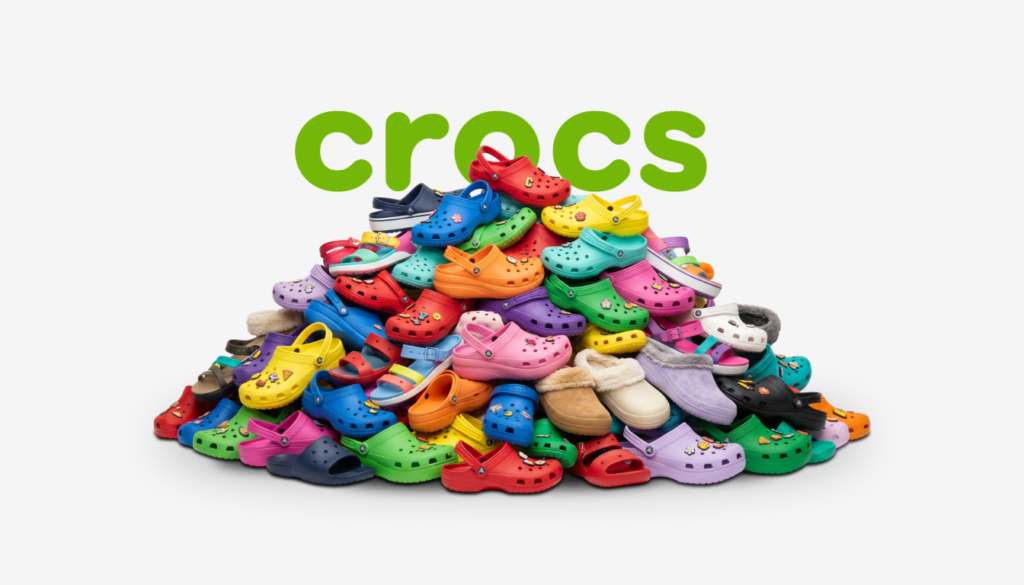
When Terence Reilly was appointed chief brand officer of Crocs, Inc., the first thing he put on the wall of his office was a meme. It read: “Those holes are where your dignity leaks out.” It was the single piece of décor in his workspace. The choice was neither sentimental nor ironic. It was strategic. The meme was a compass — a reminder that the most important question Crocs faced was not how to escape the mockery but how to use it.
Reilly’s insight, developed across a career that has included senior roles at Stanley 1913 and HeyDude before his current position at Crocs, is that being mocked means you have achieved awareness without relevance. And awareness without relevance is a solvable problem, because the awareness is already there. The work is not to build attention from scratch — it is to redirect the attention that already exists toward something more useful. In Crocs’ case, that meant embracing the exact attributes that people were mocking and owning them so completely that the mockery became indistinguishable from affection.
The Post Malone Moment
The tactical breakthrough that proved this theory was the Crocs partnership with Post Malone, which arrived not from a boardroom strategy session but from a junior intern who showed Reilly a photo of the rapper wearing Crocs in a hotel lobby. The observation was casual. The response was decisive: if someone with Post Malone’s cultural standing was already wearing the shoes, the brand’s job was to make that connection official and amplify it before anyone else could.
The Post Malone collaboration generated enormous cultural attention and drove meaningful sales. But what Reilly took from it was not primarily the commercial result — it was the operational lesson embedded in how the opportunity was identified. The signal came from a frontline employee, someone who was deeply embedded in the culture the brand was trying to reach, not from an executive team or a research report. That observation led Reilly to build what he calls “insight surfacing” into the way his teams operate: creating explicit channels through which junior staff and frontline employees can surface observations that would otherwise never reach the people in a position to act on them.
The Crocs playbook describes this as one of its core competitive advantages: institutional responsiveness to cultural signals that traditional planning cycles would identify months too late, if at all.
Failing Fast as a Philosophy, Not a Slogan
Reilly is pointed about the gap between what most organizations say about risk-taking and what they actually practice. Nearly every CMO will tell you that their team embraces failure as a learning tool. Almost none of them actually reward failure in a way that would make that claim true. The organizational structures, board governance, and personal incentive arrangements that govern most large marketing functions systematically punish failure and therefore systematically discourage the kind of bold experiments that produce the occasional extraordinary outcome.
His approach is to make the permission structure explicit and public. He tells teams directly: ” You will figure it out, you will get it done, I trust you to do it. He publicly celebrates both successful and failed experiments, documents what was learned, and rewards the teams behind bold ideas, even when those ideas don’t work. The practical effect is to make failure feel safe enough that the team is willing to try things that a risk-averse organization would never attempt.
The Stanley car-fire TikTok campaign — which generated $50 million in additional revenue and 100 million views during his time as president of Stanley 1913 — is the most famous product of this approach. A video emerged organically showing a Stanley tumbler surviving a car fire with ice still intact inside. Rather than treating it as a liability, Stanley leaned in with the full weight of the brand. The car’s owner was given a new car. The video was amplified. The story became the campaign. It worked because the decision to act was made in hours rather than weeks, which required an organizational culture where that speed was already normal.
What “Collaboration Fatigue” Actually Means
Reilly is also clear-eyed about a dynamic he calls collaboration fatigue — the diminishing returns of brand partnerships in a market that has seen so many of them that the format itself has become predictable. The Crocs collaboration playbook was genuinely innovative when it launched, pairing the brand with artists, musicians, and cultural figures in unexpected ways that sparked genuine cultural conversation. As the format has proliferated across the industry, each individual collaboration generates less attention simply because the model is now familiar.
His response is not to abandon collaboration, but to be more selective and invest more deeply in the brand’s own narrative between collaborations. A brand that can generate cultural attention only through partnerships has outsourced its identity. A brand that has its own clear, distinctive point of view — one strong enough to stand on its own — can use partnerships to amplify that identity rather than substitute for it.
For Crocs, that point of view is comfort, self-expression, and the deliberate rejection of conventional standards of footwear attractiveness. The brand that hung a dignity-meme on the wall to remind itself why people laughed at it has, over the course of a decade, transformed that laughter into one of the most recognizable and commercially durable brand identities in the global footwear market. The holes are still there. So is the dignity.