
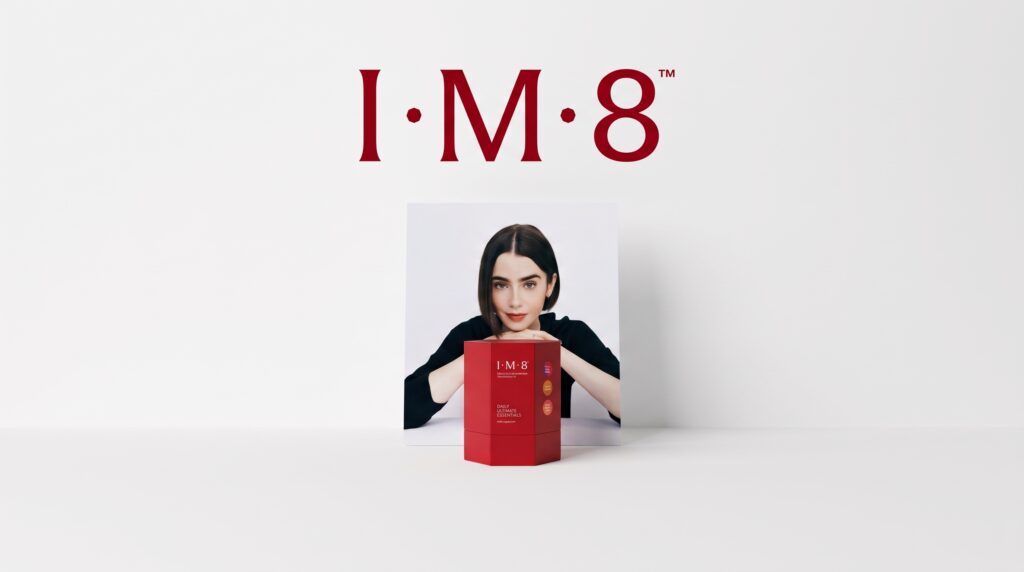
When Lily Collins signed with the wellness brand IM8, she did not simply agree to appear in its advertising. She took a piece of the company. Announced on August 20, the multi-year partnership makes Collins IM8’s first global ambassador drawn from film and television and a shareholder in its parent company, Prenetics, through an undisclosed equity stake. The distinction between being paid to endorse a brand and owning part of it is small on a press release and large on a balance sheet, and it is the reason the deal matters beyond the celebrity headline.
From Ambassador to Owner
IM8 is a premium health and wellness brand co-founded by the entrepreneur Danny Yeung and David Beckham, and Collins is not the first famous name it has turned into a part-owner. Over the past year the podcaster Jay Shetty, the tennis star Aryna Sabalenka, and the Formula 1 driver Ollie Bearman have each signed on as ambassadors and shareholders. The pattern is deliberate. Rather than rent a roster of faces for a season, IM8 is assembling a group of talent with a financial stake in the outcome, converting endorsers into stakeholders whose payday depends on the company growing rather than on the length of a contract.
Why Equity Changes the Incentives
A conventional endorsement rents credibility. The brand pays a flat fee, the celebrity lends a face for a defined term, and the relationship ends when the check clears or the campaign wraps. The incentives are shallow and short, and audiences increasingly sense it. An equity deal rewires those incentives. When the ambassador owns a slice of the business, the association is expected to last, the enthusiasm reads as more sincere because it is financially self-interested in the right direction, and the talent has reason to promote the brand well beyond the terms of any single campaign. This is the template Ryan Reynolds turned into a genre with Aviation Gin and Mint Mobile, and it has spread because it solves advertising’s oldest credibility problem. A star who owns the company is harder to dismiss than a star who was paid to smile.
The Collins Fit
Collins brings a specific set of assets. She is IM8’s first ambassador whose primary audience is female, a notable gap for a brand whose earlier partners skewed toward sports and self-optimization, and she connects with more than 33 million people across social platforms, including over 28 million on Instagram, where she ranks among the most-followed British women in the world. The origin story is the part marketers will envy most. According to the company, the relationship began organically in late 2025, when a physician recommended IM8’s daily supplement while Collins was working on a UK set, and she became a customer before she became a partner. Whether or not that narrative is burnished for the announcement, it supplies the authenticity that endorsement deals usually have to manufacture, a user who liked the product before she was paid to say so.
The Business Behind the Headline
The timing of the announcement doubled as an investor message. Alongside the Collins partnership, Prenetics raised its full-year 2026 revenue guidance to between 220 and 230 million dollars and set initial 2027 guidance at 400 million dollars or more. For a publicly traded company, a celebrity shareholder is not only a marketing asset but a growth signal, a way to attach a recognizable face to an accelerating revenue story and to give the market a reason to believe the trajectory. The endorsement and the earnings guidance are two halves of the same pitch, one aimed at consumers and one aimed at shareholders, and the equity structure is what lets a single announcement speak to both.
The Risks of Equity Deals
Ownership cuts both ways. Equity ties the brand’s fortunes to a person’s reputation more tightly than a fee ever could, and unwinding that link if a partner’s standing sours is far harder than declining to renew a contract. Handing out stakes dilutes existing owners, the value of the equity depends on a company that may or may not hit its guidance, and the model is available mainly to founder-led challengers with shares to spare rather than to incumbents defending a mature business. There is also the danger of proliferation. A brand with a dozen celebrity shareholders can look less like a focused company and more like a cap table in search of a product. Alignment is the promise of the equity model, but alignment assumes the underlying business performs.
What Marketers Should Take
The Collins deal marks how far endorsement has moved from paying for reach toward sharing ownership for alignment. The appeal is obvious, a partner who behaves like an owner rather than a hired face, and the authenticity dividend is real when the relationship predates the contract. The caution is equally clear. Equity is a commitment, not a campaign, and it binds a brand to a person for years in ways a media plan never does. For challenger brands with growth to sell and shares to trade, the math increasingly favors making the star a shareholder. For everyone else, the lesson is narrower but still useful, that the most persuasive endorsement is the one the audience believes the endorser would give for free.