
The End of the Big Moment
There is a particular kind of Nike ad that lives rent-free in the collective memory of anyone who has ever cared about soccer. The “Secret Tournament” in 2002, with its caged matches and Eric Cantona, was broadcast like a fever dream. “Write the Future” in 2010, a three-minute epic that made Wayne Rooney and Didier Drogba feel like mythological figures. For two decades, Nike owned the World Cup not just by sponsoring it, but by creating the defining piece of advertising that would make the tournament remembered. That era is now, deliberately and irrevocably, over.
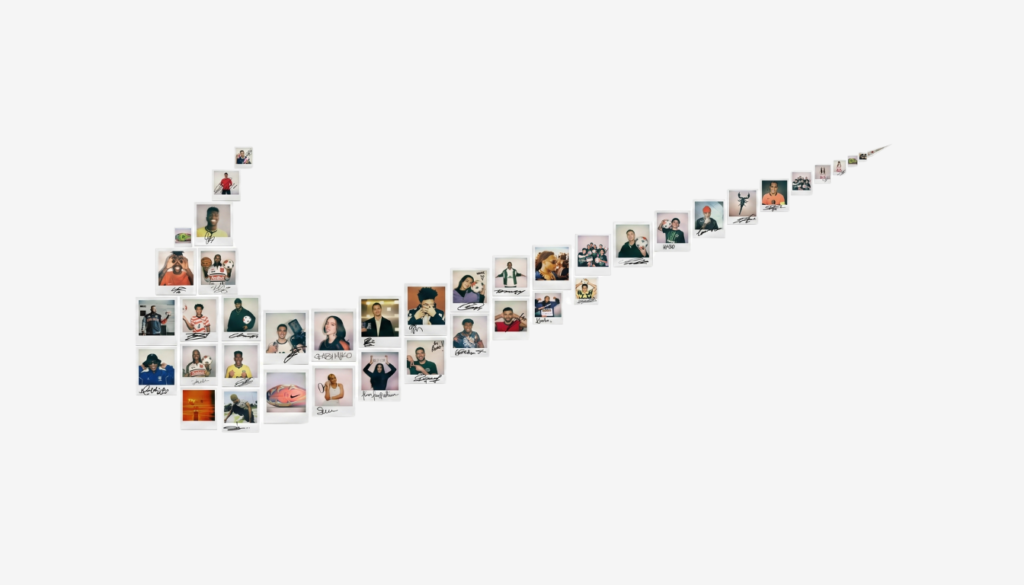
Ahead of the FIFA World Cup 2026 — which kicks off June 11 across the United States, Canada, and Mexico — Nike revealed its campaign not with a cinematic premiere but with a series of Polaroid photographs posted across social media. Lo-fi, analog, and designed for immediate sharing, the images teased a global cast of 42 names: soccer legends Ronaldo and Erling Haaland, pop star Lisa from K-pop group BLACKPINK, rapper Travis Scott, Puerto Rican artist Young Miko, Serena Williams, and Kim Kardashian, among others. Instead of a single film, the brand promised “unexpected collabs and cultural expressions” across 12 consecutive weeks. There would be no hero moment. The campaign itself would be the moment, stretched across an entire summer.
A Brand in the Middle of a Comeback
To understand why Nike made this choice, it is essential to understand where the company stands right now. The Swoosh — for decades the default uniform of athletic aspiration — has spent the last two years in the most turbulent stretch of its modern history. After a strategic overcommitment to its direct-to-consumer digital model under former CEO John Donahoe, the company found itself with inventory problems, weakened wholesale relationships, and a brand that had drifted away from the performance storytelling that made it great. Revenue fell 9% year-over-year to $11.3 billion in one quarter. Digital sales plunged 20 to 26% in late 2025. The stock dropped more than 10% in a single day after earnings last December. By any measure, Nike was in a hole.
Elliott Hill, a Nike veteran who returned as CEO in October 2024, has been explicit about the severity of the reset. He called fiscal year 2026 “a year of taking action” and described the company as being in “the middle innings of its comeback.” His strategic framework, branded the “Sport Offense,” reorganizes the company around athlete-centered storytelling and performance product innovation, uniting Nike, Jordan Brand, and Converse under a single sport-focused logic. The World Cup, arriving on American soil for the first time since 1994, was always going to be a centerpiece of that recovery. Hill said as much directly: “Global football is the next sport to fully transform into the Sport Offense. We’re also utilizing the World Cup as an opportunity to catalyze the football marketplace for quarters to come.”
The stakes are considerable. While football represents only about 4 to 5% of Nike’s total annual revenue — roughly $44.7 billion — its halo effect on the broader brand is disproportionate. When the 2022 Qatar World Cup was held, Nike’s football revenue surged 65% year-over-year in the quarter during which the tournament took place, with spillover benefits in lifestyle sales, app traffic, and brand perception worldwide. The 2026 edition, played on home soil before an enormous domestic audience that has grown increasingly soccer-literate, could be the most commercially significant World Cup Nike has ever faced.
Building a System, Not a Statement
What Nike is doing this summer is not simply a creative refresh — it is a structural rethinking of how a sports marketing campaign should operate in 2026. The old model assumed a concentrated media environment: one defining piece of content, a massive production budget, and the hope that it would detonate across television and eventually the internet, shaping cultural memory. That model worked brilliantly when audiences were captive, and attention was more predictable.
The new model assumes the opposite. Audiences are fragmented, attention is contested, and a single piece of content — no matter how well-made — has a diminishing half-life. Nike’s answer is what industry analysts have begun calling a “distributed campaign architecture”: a rolling sequence of activations, product launches, creator content, and brand collaborations designed to generate multiple entry points into the campaign over time, rather than one single detonation. The 12-week structure is deliberate. There will be no quiet weeks. Every week of the tournament offers a new reason to pay attention to Nike — a new collab, a new product reveal, a new pairing of athlete and artist that feels unexpected enough to generate its own conversation.
The collaborators folded into the campaign extend this logic further into the territory that traditional sports marketing rarely touched. Alongside footballer-centric content, Nike has brought in fashion houses like Jacquemus, streetwear institutions like Patta, and Drake’s Nocta label, extending the campaign’s reach into the overlapping worlds of luxury, street culture, and hip-hop that increasingly define how younger global audiences relate to sportswear brands. Football, in this framing, is not just a sport — it is an entry point into a lifestyle ecosystem.
Nike and Adidas, Two Opposite Bets
The contrast with Adidas makes the strategic divergence between the sport’s two dominant brands unusually legible. Earlier in May, Adidas launched “Backyard Legends,” a five-minute cinematic film starring Timothée Chalamet alongside Lionel Messi, Bad Bunny, and a multi-generational cast of players. It was, by virtually all accounts, beautifully made — a sweeping, emotionally resonant piece of storytelling that felt like a direct heir to the classic World Cup film tradition. The advertising industry noticed immediately, and it has been widely discussed ever since.
Adidas, in other words, played Nike’s old hand — and played it well. The irony is pointed: at the very moment Adidas has embraced the cinematic blockbuster format that made Nike famous, Nike has walked away from it entirely. Each brand is betting that the other has misread the moment. Adidas believes a great film still cuts through. Nike believes that no single film, however great, can sustain the level of engagement that a World Cup-length, multi-touchpoint campaign can generate. For Adidas, the goal is a single galvanizing cultural artifact. For Nike, the goal is omnipresence — to be the ambient sound of the tournament rather than its loudest moment.
The question that will be answered over the next 12 weeks is deceptively simple: which kind of attention matters more? A concentrated burst of earned media and genuine emotional resonance from one extraordinary film, or a sustained drumbeat of cultural touchpoints that keeps a brand in conversation throughout an entire summer? The honest answer is that nobody yet knows, because at this scale and in this media environment, nobody has tried quite this before.
The Risks of the New Playbook
For all its strategic coherence, Nike’s approach carries real risk. The brand’s great World Cup films did not merely generate awareness — they created mythology. “Write the Future” was not just an ad; it was a portrait of what football meant at the level of civilization. It gave fans something to feel collectively, something to argue about, something to remember. The distributed model, almost by design, sacrifices that possibility. When everything is a moment, nothing becomes the moment.
There is also an execution risk that should not be underestimated. A 12-week rolling campaign with 42 cast members across multiple collaborators, product categories, and cultural verticals requires relentless organizational discipline. For a company that Hill himself has described as still working through its turnaround — realigning teams, restoring wholesale relationships, managing inventory — that is a demanding operational bet on top of an already complex recovery. One badly received collab, one week where the content feels incoherent or forced, and the campaign’s cumulative logic begins to fray.
And then there is the Adidas factor. If “Backyard Legends” becomes the film that defines the memory of the 2026 World Cup — the one people reference when they look back at the summer — then Nike will have surrendered the very territory it once owned, at the precise moment it most needed to reclaim it. Losing the advertising story of your rival’s biggest tournament in your own backyard is not a small defeat.
What Nike Is Really Saying
Ultimately, the Polaroid announcement was not just a marketing tactic — it was a declaration of philosophy. By choosing an analog, intimate format to introduce a campaign built on cultural breadth and sustained engagement, Nike was making an argument about what sport means in 2026 and how brands should relate to it. Not as the authors of a single authoritative narrative, but as curators of a living, evolving conversation that fans can enter from almost any cultural direction — football, fashion, music, celebrity, street culture.
Whether that argument wins in the marketplace remains to be seen. What is clear is that Nike has fully committed to it, backed by a CEO who has staked his turnaround story on football, and by a company that understands — perhaps better than anyone — that in sport, the biggest risk is not trying something new. It is letting your rival define the moment while you stand on the sidelines.
The World Cup kicks off on June 11. Twelve weeks of surprises await.