
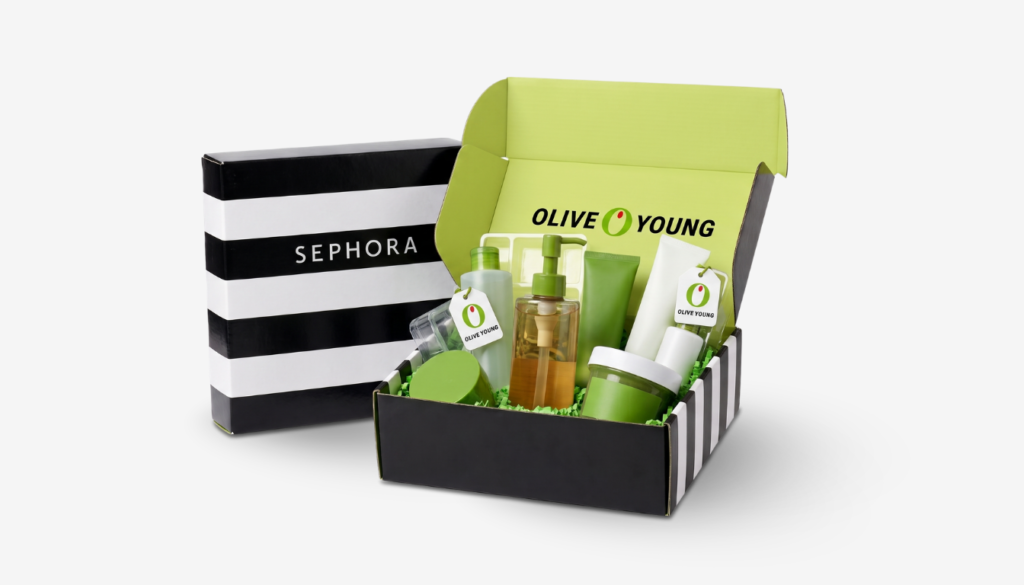
Sephora and CJ Olive Young confirmed on August 4 that 19 Olive Young-curated Korean beauty brands will launch across more than 500 Sephora stores and on Sephora.com beginning August 20, with a dedicated space at the Times Square flagship. The assortment runs to roughly 150 products, weighted toward serums, creams and sun care, with toner pads, cleansers and sheet masks alongside them. Prices start around $4 for skincare and reach $299 for devices. The brands include Abib, Banila Co, Make P:rem, Torriden, Rejuran, Beplain and Cell Fusion C, selected by Olive Young on the basis of performance and trend leadership in the Korean market.
Read as a merchandising announcement, it is a solid assortment expansion. Read carefully, it is something more consequential, and the detail that carries the weight has been skipped in most of the coverage.
The name on the fixture
The section is branded the Olive Young K-Beauty Edit. Olive Young is not supplying products to Sephora. It is occupying shelf space inside Sephora under its own name, in a chain where the retailer’s own judgment has always been the product on sale.
Sephora’s entire proposition is that walking into the store is a filter. Hundreds of brands compete for placement, and the buyer’s decision about which ones make it is what customers pay a premium for. Handing a defined category to an outside merchandiser, with attribution, converts that filter into a franchise. Curation is being sold as a service, and Sephora is the buyer.
Why Sephora needed the deal
The context makes the trade legible. Sephora exited the South Korean market in March 2024, citing competition from established local retailers. Olive Young is the largest of those retailers, with more than 1,380 stores in Korea and 27 years of category experience, and it opened its first two United States stores in Los Angeles only months ago.
The exchange is explicit. Sephora contributes distribution, with more than 3,400 stores across 37 markets. Olive Young contributes the credential Sephora could not build fast enough. Two companies that could not both win in Korea are now splitting the American opportunity between shelf space and shelf logic.
The market that forced it
Korean cosmetics exports reached roughly $10.2 billion in 2025, a fifth consecutive record year, and hit a quarterly record of about $3.1 billion in the first quarter of 2026. The United States has displaced China as the largest destination, with first-quarter shipments to America rising more than 40% year over year to roughly $620 million, close to a fifth of Korea’s total beauty exports. American demand climbed from about $841 million in 2021 to $2.2 billion in 2025.
Those numbers describe a category, not a trend, and they carry a problem for prestige retail. Most of that growth was discovered somewhere other than a Sephora aisle. Independent labels such as Beauty of Joseon, Anua, COSRX and SKIN1004 built demand on TikTok and Instagram and converted it through Amazon and TikTok Shop, moving at a speed that a twice-yearly buying calendar cannot match. K-beauty is the clearest case of a category where the retailer stopped being where discovery happens.
Importing Olive Young’s merchandising is Sephora’s attempt to buy back that position rather than rebuild it over three seasons.
Who pays for the shortcut
Nineteen brands gain national distribution overnight. The hundreds outside the list face a new gatekeeper, and that gatekeeper now applies Korean retail logic rather than American prestige-beauty logic. For an indie K-beauty founder, the route to a Sephora shelf increasingly runs through relevance in Seoul, which changes where a young brand needs to prove itself first.
Sephora carries a subtler cost. Curation authority is a trust asset, and trust attaches to whichever name the customer sees when the recommendation proves right. A shopper who buys a Torriden serum from the Olive Young K-Beauty Edit and loves it has learned something about Olive Young. Sephora provided the aisle. Over enough repetitions, that is how a host becomes a landlord.
The partnership is also structured to travel. Hong Kong, Singapore, Malaysia and Thailand follow later this year, with the Middle East, the United Kingdom and Australia planned for 2027. This is not a seasonal activation. It is a distribution architecture.
The decision underneath
When a category grows faster than an organization’s ability to understand it, there are three responses available. Hire the expertise, acquire it, or partner for it. Sephora chose partnership with attribution, which is faster than building and cheaper than buying, and it remains reversible if the arrangement stops paying.
The question any brand or retailer should ask before making the same call is which categories represent judgment and which represent logistics. Outsourcing the movement of boxes costs nothing strategically. Outsourcing the judgment that customers came for costs the reason they came.
Sephora appears to have decided that K-beauty had already escaped its judgment, and that borrowed authority beats absent authority. Against Amazon’s assortment and speed, and Ulta’s mass reach, that is a defensible read. The measure of whether it worked will not be August sell-through. It will be whether, two years from now, American shoppers looking for Korean skincare think of Sephora as the place to find it, or think of Olive Young as the reason it is worth finding there.