
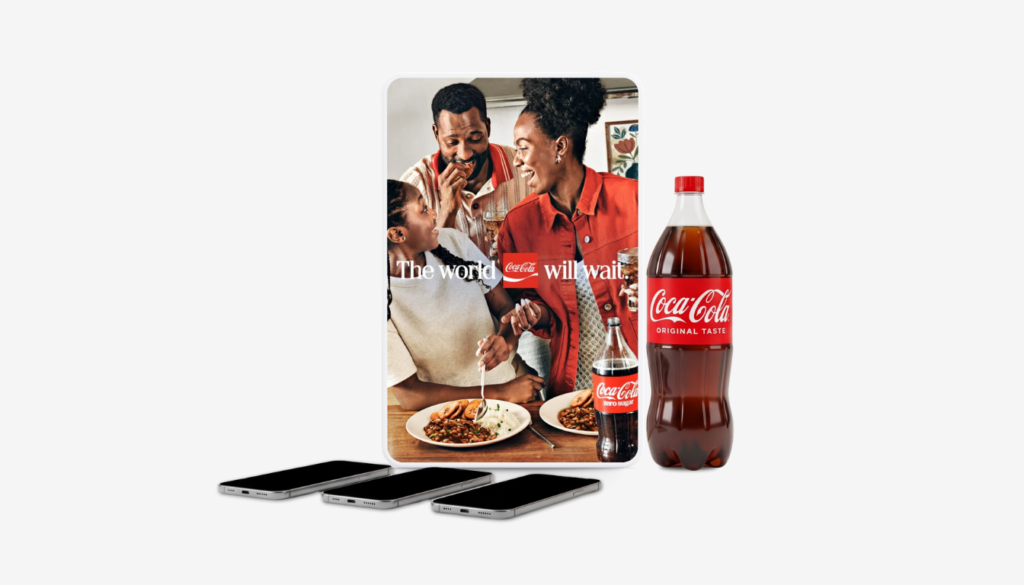
Coca-Cola’s newest global campaign asks for something the company usually competes for, your attention, so you can hand it to someone else. On August 4 the beverage giant launched “The World Will Wait,” an international effort running everywhere except the United States that urges Gen Z and millennials to put their phones down and reclaim the shared meal.
The hero film is domestic and understated. A family sits down to a home-cooked dinner and realizes the father is missing. His son finds him shut in a dark office behind a laptop, signaling without a word that work still has him. Later the father discovers his son’s drawing of the family, his own face blotted out by the job, and it moves him to close the computer and rejoin the table. Out-of-home lines carry the same idea with a lighter touch, among them “Laundry can wait. Fried Chicken & Coca-Cola can’t” and “No one ever said this meal could have been an email.”
Selling Presence in an Attention Recession
The campaign is built on a now-familiar anxiety, that always-on connection has crowded out the in-person kind. Arnab Roy, who leads Coca-Cola’s global category, framed the work around consumers, especially younger ones, who want real connection but feel overwhelmed by the pressures of daily life. Rather than sell refreshment, Coke is selling presence, and casting itself as the drink on the table when people choose each other over their screens. It is a bid to own an emotional territory, the shared meal, that a soft drink can plausibly attach itself to. The work was developed by WPP Open X, led by the Grey agency with support from Ogilvy.
The Tension in a Brand Telling You to Log Off
There is an obvious contradiction. Coca-Cola is one of the most prolific advertisers alive, a fixture of the same feeds it now asks people to close, and the campaign itself leans on social-media influencers, borrowing the gaming term AFK, or away from keyboard, to nudge audiences offline. A brand that profits from attention telling audiences to spend less of it invites the charge of wanting it both ways. The counterargument is that this is exactly the kind of tension that makes purpose-driven work either land or fail: audiences reward it when the sentiment feels earned and punish it when it feels like a pose. Coke is wagering that the message is universal enough to survive the messenger.
A New Front in the Cola Wars
Underneath the sentiment is a competitive motive. Coca-Cola has spent 2026 pressing its case as the drink that belongs with food. An earlier effort, “And a Coke,” enlisted food-service partners including Domino’s, Popeyes and Wendy’s to tie the brand to a range of meals, a direct answer to Pepsi’s “Food Deserves Pepsi” stunts, in which the rival’s agents swap out Coke at barbecues and fast-food counters. The mealtime is the battleground because it drives volume, and “The World Will Wait” extends the same fight onto emotional ground. If Coke can make itself the drink of the meal that matters, it wins an occasion Pepsi has been attacking head-on.
The US Exclusion Is the Tell
The most revealing detail is where the campaign does not run. “The World Will Wait” is global but skips the United States, the market where the food-pairing fight with Pepsi is most direct and where Coke has been deploying its own tactics. Leaving out the US signals that Coke reads its home market as a different competitive problem, one that calls for the blunt, partner-driven approach of “And a Coke” rather than a tender film about family dinners. It is a reminder that a global brand rarely runs one message everywhere, and that the absence of a campaign can say as much about strategy as its presence.
Marketing From a Position of Strength
Coke is making these moves from a strong quarter. In the second quarter of 2026 the company reported net revenue up 7 percent to 13.38 billion dollars, organic revenue up 6 percent and global unit case volume up 5 percent, with Coca-Cola Zero Sugar volume climbing 16 percent. Net income reached 4.43 billion dollars, and the company raised its full-year outlook to comparable earnings-per-share growth of 9 to 10 percent. It also commanded a leading share of voice around the FIFA World Cup, which it activated across more than 180 markets. A brand posting numbers like these can afford a campaign that sells a feeling rather than a discount, and can take the risk of telling its customers to look up from their phones.
What Marketers Should Take From It
The lesson is that anti-attention marketing has become a mainstream posture rather than a fringe one. Brands are increasingly claiming human tensions, presence, rest, connection, and attaching them to a usage occasion they can credibly own. Done with conviction and tied to a real moment, the shared meal, it can lift a product above the price fight. The risks are the ones Coke is now testing in public: the awkwardness of an attention merchant asking for less attention, and the difficulty of making a single sentiment fit every market, which is why the United States was left out. Whether the work builds equity or draws eye-rolls will come down to execution, but the strategic instinct, to sell presence in an age that feels short of it, is one more marketers will copy.