
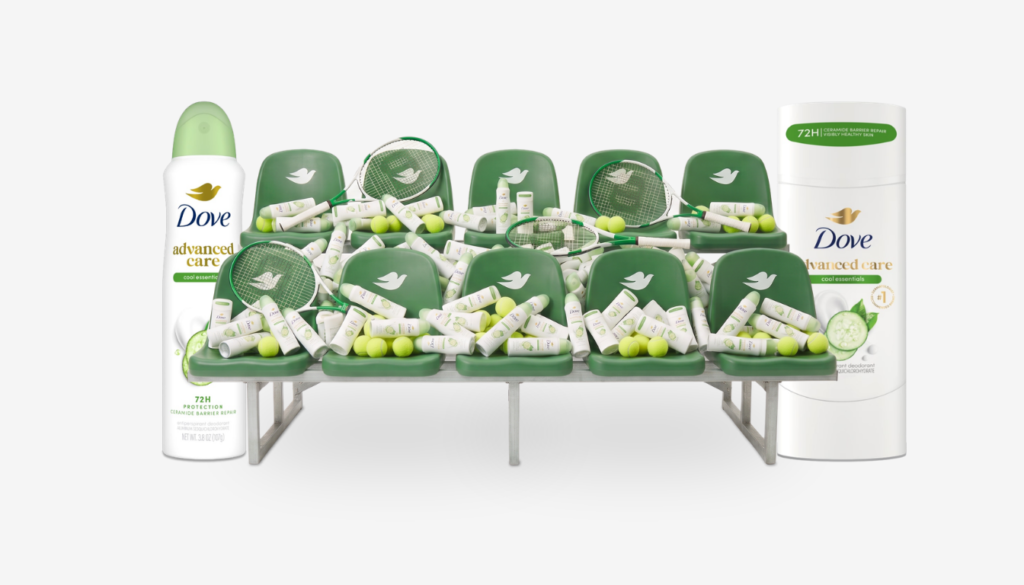
Dove has returned to the US Open, and it has done so with one of the more improbable titles in sports marketing. For the second year running, the Unilever brand is the tournament’s Official Underarm Sponsor, a designation engineered to make people smile before they think. Behind the joke sits a deliberate reading of where the US Open’s cultural weight now lives, and it is not on the court.
The platform, “Don’t Sweat It. Make A Racket.,” celebrates the confidence, style and fan culture that have turned the two-week tournament into one of summer’s defining events. Dove is not sponsoring tennis so much as the crowd that comes to be seen at it.
Sponsoring the Tunnel, Not the Trophy
The US Open has spent recent years becoming a fashion and celebrity destination as much as a Grand Slam, its arrivals and stands photographed like a runway. Dove is leaning directly into that shift. The brand enlisted photographers Tyrell Hampton and Johnny Criollo, of the street-style account Watching New York, to capture fan looks and tournament style, with a tie back to Dove Advanced Care and its promise of no white deodorant marks on a carefully chosen outfit. The move is a study in sponsoring the sub-story: not the match, but the tunnel walk and the tribune, the parts of the event that actually travel on social feeds.
An Absurd Title With a Serious Logic
Official Underarm Sponsor works precisely because it is narrow. Rather than pay to be a general partner of the tournament, a crowded and expensive tier, Dove claimed a category no rival would contest and made the claim funny enough to repeat. The title cuts through, and it hands the brand a natural, ownable connection between a functional product, deodorant, and a fashion moment where sweat is the enemy of a good outfit. Returning for a second year matters too. A one-off stunt is noise; a repeated sponsorship becomes an association, and Dove is building one on purpose.
A Gimmick Built to Travel
The absurd-sponsor device is not new, but it is having a moment because it is engineered for social. A title like Official Underarm Sponsor is a headline, a caption and a joke in one, which is what a distracted feed rewards. It gives editors something to write and fans something to screenshot, and it does the branding without a hard sell. Dove has paired that shareable framing with real utility on the ground, which is what separates a durable platform from a passing pun. The brands that win these moments back the wordplay with an experience worth showing up for.
The Activation Stack
The campaign is more than photography. On the grounds of the USTA Billie Jean King National Tennis Center, Dove is running the Re[set] Club, a refresh lounge where fans can cool down and touch up. It has partnered with the USTA on a social series called Racquet Report, hosted by comedian Carly Aquilino, that interviews fans about their looks and opinions. Nationally, the brand is covering tabs at ten women-owned bars during the tournament’s biggest matches, including the Women’s Finals. Video, out-of-home and community engagement tie the pieces together, so the sponsorship lives on the grounds, on social and in neighborhoods at once, rather than as a logo on a screen.
Why Beauty Keeps Moving Into Sports
Dove’s play sits inside a larger migration. As women’s sports and tennis draw record attention and audiences, beauty and personal-care brands are entering the arena through style and culture rather than performance. The value of a sponsorship is shifting from visibility, a logo courtside, to narrative ownership, a defensible piece of the story fans tell about the event. Dove is not trying to out-spend a watchmaker or a carmaker for center-court signage. It is claiming the conversation about how fans look and feel, which is cheaper, more distinctive and better suited to a product about confidence. The spend behind the effort has not been disclosed, but the logic does not depend on scale.
What Marketers Should Take From It
Three lessons carry beyond deodorant. Own a defensible sliver of a large event instead of renting the whole thing; the underarm framing gives Dove a lane no competitor will fight for. Make the sponsorship title itself the creative, so the association does the work before a single ad runs. And translate a functional benefit into cultural relevance; no white marks becomes a fashion promise the moment the event is framed as a style show. The risk is that the joke wears thin or that fans see through a beauty brand’s sudden interest in tennis. Handled with this much activation, though, Dove has turned an unglamorous product into a fixture of one of the summer’s most watched style moments, a return most center-court logos cannot claim.