
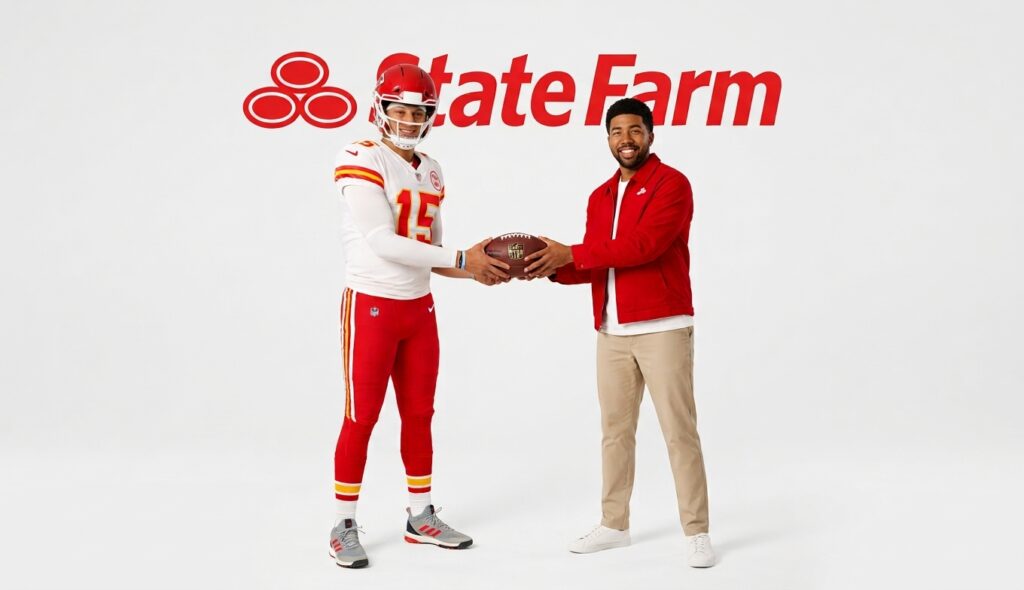
Jake from State Farm is back for football season, but the campaign built around him is less about the mascot than about a word insurers rarely make exciting: personalization. State Farm launched its new football push on Wednesday, filling it with familiar NFL faces and a few emerging ones, and using humor to argue that personalized coverage, not a catchy line, is the product. Patrick Mahomes and head coach Andy Reid of the Kansas City Chiefs anchor the work, joined by newer talent including New York Giants running back Cam Skattebo and Las Vegas Raiders quarterback Fernando Mendoza. The message beneath the comedy is blunt. Having insurance is not the same as having State Farm.
From One Big Ad to Many Tailored Ones
The phrase the campaign leans on, a personalization play, describes a structural choice as much as a creative one. Instead of pouring the budget into a single hero spot that speaks to everyone in the same voice, State Farm built distinct storylines tuned to different audiences and different corners of the football map. That approach mirrors at television scale what digital marketers have done for years, cutting one idea into many variants so each viewer meets a version that feels closer to home. For a national brand that needs to feel local, personalization at the creative level is a way to be everywhere without sounding generic anywhere.
Star Power as Distribution, Not Only Attention
The casting reads as an audience strategy rather than a celebrity flex. Mahomes and Reid unlock the enormous, national following of the Chiefs, the closest thing the current NFL has to a default favorite. Skattebo and Mendoza do something different, reaching younger fans and specific markets, New York and Las Vegas among them, where a rising player carries outsized local weight. Pairing established superstars with emerging names lets one campaign speak to the committed fan who watches every snap and the casual viewer who just drafted a rookie in a fantasy league. In sports marketing, who a brand casts is increasingly a decision about which audiences it can reach, not simply whose fame it can borrow.
When the Media Tactic Matches the Product Claim
The sharpest thing about the campaign is that its form acts out its message. State Farm sells the idea that coverage should be personalized, tailored to the individual customer rather than sold off a rack. A campaign that itself comes in many personalized versions demonstrates that promise instead of merely asserting it. Form mirrors content, and an abstract benefit that is hard to feel becomes tangible through the way the advertising is built. That alignment is what separates a personalization play from a personalization slogan. When the how and the what agree, the audience absorbs the claim without being lectured on it.
The Category’s Sameness Problem
Insurance is one of advertising’s biggest spenders and one of its least differentiated categories. Geico has its gecko, Progressive has Flo, Liberty Mutual has its emu, and State Farm has Jake, each a memory device engineered to make an interchangeable product recognizable. Mascots buy fame, but they do little to explain why one policy beats another. Personalization is State Farm’s attempt to claim substance on top of that fame, to argue that behind the familiar character sits a truly tailored service. In a category where most messaging competes on likeability alone, a claim about the product itself is a way to change the terms of the fight.
What Marketers Should Take
The campaign is a reminder that the structure of the work can carry the argument. Marketers spend most of their energy on what a campaign says and far less on whether the way it is built reinforces that message, yet the two are inseparable. State Farm engineered its casting for reach, matching stars to the audiences it wanted, and it engineered its format to embody the product promise rather than restate it. The risk is that personalization curdles into a gimmick if the storylines turn out to be interchangeable behind their different faces, the same ad wearing different jerseys. Executed with discipline, though, the approach shows how a tired category can find a fresh argument, not by inventing a new mascot, but by making the shape of the campaign prove the point the copy is trying to make.