
A Campaign Built by Hand
Hinge launched All We Need Is Us across Europe this month, the latest chapter of its long-running Designed to be Deleted platform. The work was developed by creative collective Birthday and directed by Justyna Obasi, and it features real couples who met on the app.
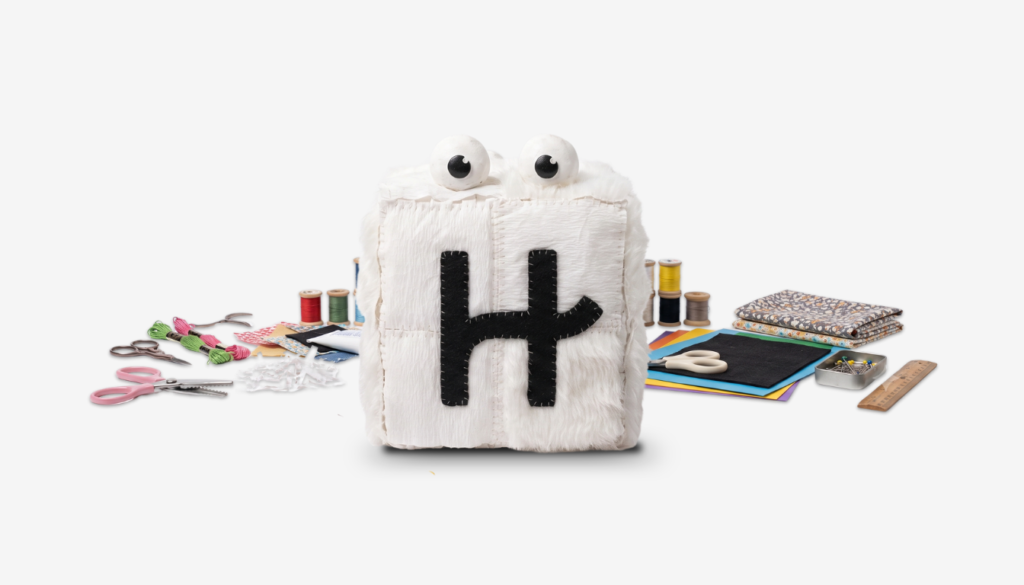
What separates it from the category norm is what it refuses to show. There is no cinematic first kiss, no airport reunion, no candlelit reveal. The spots depict couples cleaning up after a party, weeding a garden and doing nothing in particular. A recurring handcrafted mascot called a Hingie appears in each film and is disposed of in mundane fashion, vacuumed away in one spot once the relationship no longer needs it.
Every element was made by human hands. The mascot was built and puppeteered manually. The end cards were handmade. The mixed-media social assets were physically produced. In a year when a large share of advertising output is at least partly synthetic, that production choice functions as an argument.
“We often think of relationships as being defined by big moments, but they’re usually built in much smaller ones,” said Tamika Young, Hinge’s chief marketing and communications officer. “Making dinner together, running errands, or spending time doing absolutely nothing.”
The Category Problem Hinge Is Solving
Dating apps face a demand crisis that marketing alone cannot fix.
Match Group reported first-quarter revenue of $864 million in 2026, ahead of analyst estimates, while total paying users fell 5% year-over-year to 13.5 million. Tinder’s paying subscribers dropped from 9.6 million in 2024 to 8.8 million by the end of 2025. The industry term for the underlying condition is swipe fatigue, and it describes users exhausted by volume and unconvinced by outcomes.
Hinge is the exception inside that portfolio. Its revenue rose 28% year-over-year in the first quarter of 2026 and its paying users grew 15% to roughly two million. It is on track to become Match Group’s second-largest revenue contributor.
That performance gives the marketing a specific job. Hinge does not need to explain what a dating app is or persuade anyone to try one. It needs to separate itself from a category a generation has decided is not working, without absorbing the fatigue attached to it.
Why Ordinary Is the Stronger Claim
The strategic choice here is to move the sales pitch past the match.
Every dating app advertises the moment of connection, because that is the moment the product delivers. The problem is that the moment of connection is also the moment users have stopped believing in. Showing more of it reads as a promise the category has already broken.
By advertising what happens six months after the match, Hinge sells the outcome instead of the mechanism. The company worked with Gen Z contributors in Germany, France and Sweden during development, grounding the work in the markets where it runs rather than translating a US narrative. Its user base skews heavily toward people seeking serious relationships, which means the everyday imagery is not aspiration. It is a description of the customer the product already attracts.
There is risk in the approach. Restrained work is harder to remember, and a campaign built on understated domestic scenes carries less social velocity than one built on spectacle. Hinge is trading reach for credibility, which is defensible when credibility is the scarce resource in the category.
Craft as a Positioning Tool
The handmade production is the part other brands should study most closely.
Match Group is simultaneously making a substantial push into artificial intelligence. Its chief financial officer described the company as moving toward becoming AI-native, and Hinge itself introduced an AI recommendation engine in late 2025 that the company credits with a 15% increase in matches and contact exchanges.
So the brand deploys AI in the product while advertising human craft in the marketing. That is not a contradiction. It is a division of labor. AI is applied where users want efficiency, in sorting and surfacing profiles. Handmade craft is applied where users want reassurance, in the story the brand tells about itself.
Any brand operating in a category where trust is the constraint can copy that split. The question is not whether to use AI, but which parts of the customer relationship benefit from feeling engineered and which parts benefit from feeling authored. Getting that division backwards, automating the emotional layer while hand-crafting the functional one, is how brands lose credibility.
The Takeaway
Hinge is wagering that in a saturated, low-trust category, believability outperforms aspiration. Its financial results give it room to make that wager, and the production choices make the claim legible without anyone having to say the word authentic out loud.
The broader lesson concerns what a brand advertises when the category itself is in disrepute. The instinct is to promise harder. The stronger play is usually to promise less and prove more.