
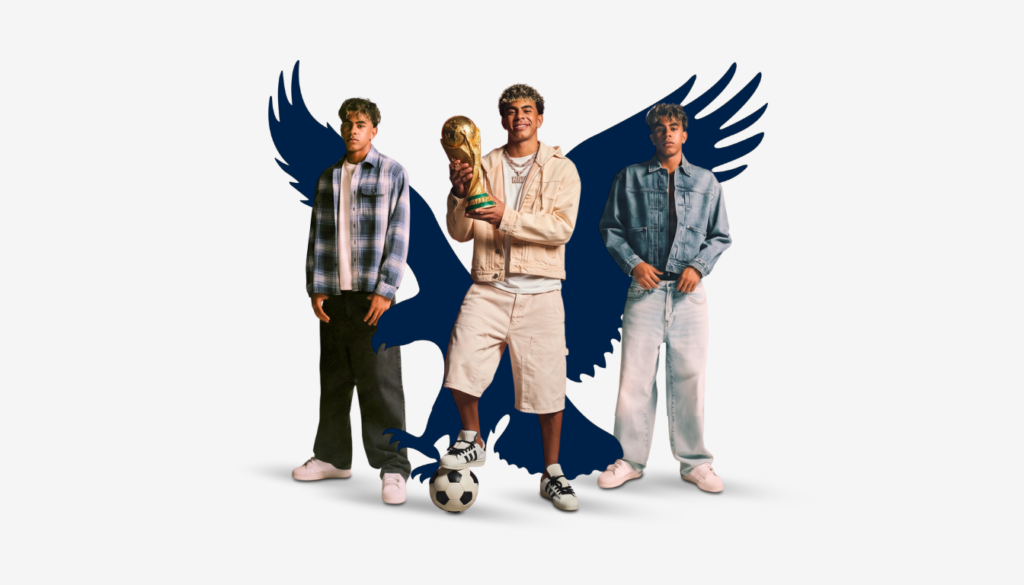
Within a day of Spain winning the 2026 FIFA World Cup, American Eagle made a bold move. The retailer temporarily rebranded itself as Lamine’s Eagles across its social channels, honoring Lamine Yamal, Spain’s 19-year-old star and an American Eagle ambassador since January. It reinvented its logo with his initials and a denim-patchwork soccer ball, renamed a popular jeans model The 19 Jean after his age and jersey number, and took over Times Square with a CGI billboard activation. Now the brand is applying the same speed and fluidity to the season that matters most, a period chief marketing officer Craig Brommers has dubbed the World Cup of denim.
The moment looks like luck, but it was a bet placed months in advance. Understanding why it paid off explains how American Eagle is approaching a Gen Z audience that no longer moves as one.
A January bet that ripened on July 19
American Eagle signed Yamal in January to an unprecedented five-year deal as its first global brand ambassador, a forward wager on talent that had not yet peaked. The World Cup delivered the peak at the ideal moment. Spain beat Argentina in the final on July 19, and Yamal became the youngest player to win both the World Cup and the European Championship. By the final whistle, the retailer had a world champion as its ambassador, and it moved within hours.
The narrative hook is almost too neat. Yamal wore number 19, at 19 years old, and won on July 19. As Brommers put it, Hollywood could not write a better story, and the brand’s internal rallying cry became From Yamal to the mall. That legibility matters because back-to-school is American Eagle’s most important retail season, the window when denim rivals like Levi’s, Gap, and Abercrombie fight hardest for share. A campaign built around a freshly minted World Cup winner gives the season a story that the brand’s core audience of 16-to-24-year-olds grasps instantly.
The capsule turns a moment into a season
The immediate activations captured attention. The sustained commercial expression arrives September 3, when American Eagle launches a co-branded Yamal capsule of roughly 25 men’s and unisex pieces spanning denim, woven bottoms, rugby shirts, and sweaters. The color palette of greens, tans, whites, and burgundy draws on Yamal’s Spanish heritage. Brommers said the player, though busy with training and other sponsors, was involved in the design, and that what interested him was marrying his street-style sensibility with the American heritage of the brand and finding the tension between those two worlds.
That tension is the creative idea, and it is more durable than a rebrand stunt. A viral weekend generates reach. A product line converts that reach into revenue across the highest-stakes weeks of the retail calendar. American Eagle is treating the World Cup less as a campaign and more as a launchpad for its most important selling season.
Reaching a Gen Z that fractured
The most instructive part of American Eagle’s approach is its read on the audience. Not one thing defines culture for Gen Z anymore, and the retailer has built its ambassador roster to reflect that. Yamal anchors global soccer and street style. Earlier in the year, the brand leaned into country music through its partnership with Ella Langley, its Denim Darling, reaching young women through a cultural movement with its own momentum. The strategy assumes the audience is a set of distinct subcultures rather than a single monolith, and it assigns a face to each.
This is a deliberate departure from the one-celebrity playbook. American Eagle uses a customer panel of roughly 2,000 people aged 15 to 25 to identify the passion pillars that drive Gen Z, including sports, social media, and community, then matches talent to each. The bet is that relevance inside a specific subculture beats broad fame that resonates with no one in particular.
The precedent, and the risk
American Eagle has run this play before. Its 2025 Sydney Sweeney campaign became one of the most talked-about efforts of the year, drove business results, and generated fierce criticism over the sexualization of its star and a divisive wordplay. A Travis Kelce collaboration followed. Brommers has said those swings gave the brand permission to keep taking big ones, and the Yamal activation is the latest.
The approach carries real risk. Moving at the speed of culture means occasionally moving into controversy, and a segmented ambassador strategy multiplies the number of bets that can go wrong. Tying a brand’s biggest season to a 19-year-old athlete concentrates exposure in a single personality whose trajectory the brand cannot control. The upside is a brand that stays interesting, which Brommers frames as the only real defense against being boring. The downside is a brand that has to keep raising the stakes to hold attention.
For marketers watching, American Eagle offers a clear case study in reading a fragmented audience and building for speed. The retailer signed its bet before the payoff was visible, prepared the commercial follow-through in advance, and structured its talent around the reality that Gen Z culture no longer has a single center. The World Cup made the bet look prescient. The back-to-school season will show whether the strategy converts.