
A public-service announcement about urine
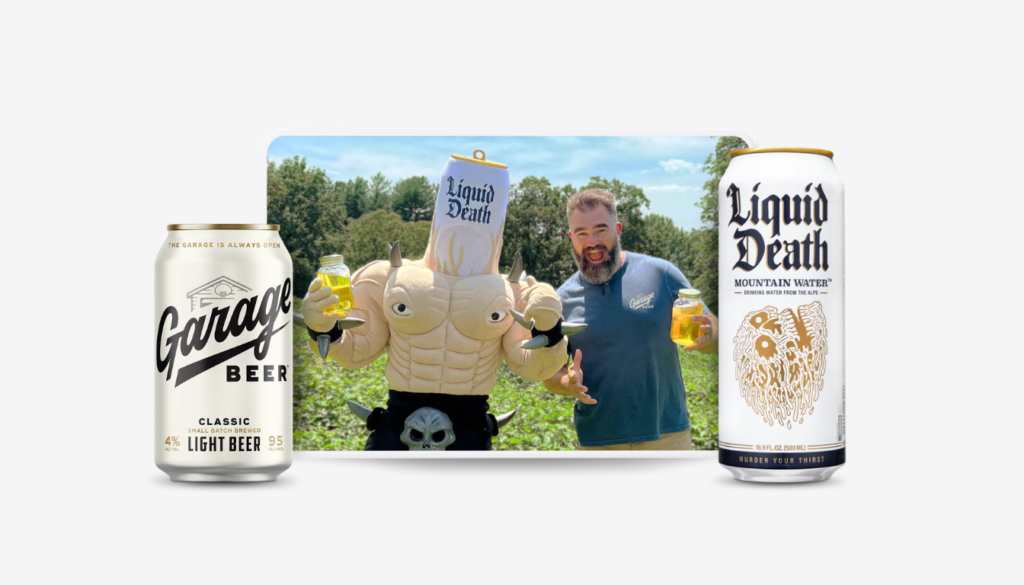
Liquid Death and Garage Beer, two brands that have built their followings on refusing to behave like their categories, have joined forces on a campaign asking Americans to mail their urine to AI data centers. The spot, titled We Want Your Pee, is staged as a public-service announcement and fronted by Garage Beer co-owner and former NFL center Jason Kelce. It opens with Kelce at his toilet, then reveals he is filling a bottle. AI data centers waste millions of gallons of water, he tells the camera, before stepping into a wooded meadow and breaking into song.
We want your pee, please give us your pee, Kelce sings, joined by Murder Man, Liquid Death’s mascot, each clutching a jar. A crowd assembles, everyone holding a receptacle, harmonizing on the promise to pee on computers, together, to save humanity, before marching to a post office to ship their contributions to the nearest data center. The film runs across both brands’ social channels and on connected TV.
Riding the year’s loudest anxiety
The gag lands because the anxiety underneath it is real. As technology companies race to build data centers across the country, local resistance has hardened. A recent Gallup survey found that seven in ten Americans oppose data centers being built in their communities, and municipalities including Tulsa, New Orleans and Birmingham have enacted moratoriums on new construction. Water is central to the objection, since the facilities consume enormous volumes to cool their servers.
Liquid Death and Garage Beer saw an opening to occupy that cultural moment. Garage Beer is a lot like us, an indie beverage brand that’s trying to take on the big guys through humor, Andy Pearson, Liquid Death’s vice president of creative, told Adweek, adding that humor works because it is based on sharing a reality with another human being and laughing at a truth that’s there. Andy Sauer, Garage Beer’s chief executive, framed the intent more plainly: Water is the world’s most valuable resource, and data centers are a hot topic, so we got together to have some fun, while raising a little awareness.
Marketing built to look like content
The more instructive move sits behind the joke. Kelce is again the central character in a Garage Beer production, and that recurrence is deliberate. The brand has assembled a repertory cast of people close to him, so its marketing accumulates the texture of a series rather than a set of disconnected ads. Former teammate Beau Allen has appeared in several videos, including an eleven-minute film set in the Predator universe and the brand’s Super Bowl debut, while Kelce’s wife, Kylie, cameoed in a sixteen-minute Western spoof.
That approach borrows directly from how creators work. With people consuming most of their news, media, and life through their phones, we’ve found the best way to reach them is through short form, and in some cases, longer form videos that tell a story, Sauer said. Most of the time, the story is a little if not very dumb, but it’s also relatable and easy to digest. A recognizable cast and a running comedic voice make the content feel like something audiences choose to watch, not something interrupting what they came for.
The business under the joke
The comedy is a growth strategy in disguise. Garage Beer, majority-owned by Jason and Travis Kelce since 2024, has become one of the fastest-growing beer brands in the country, with reported revenue climbing toward $60 million to $70 million in 2025 from under $20 million a year earlier, and dollar sales up sharply over the 2026 Memorial Day period. Liquid Death, valued at $1.4 billion, has turned canned water into a lifestyle brand and expects revenue near $340 million this year. Both are winning share at a moment when alcohol consumption among American adults has fallen to a record-low 54%, a backdrop that rewards brands able to manufacture attention rather than buy it.
That is the real function of a urine-collection singalong. Neither brand needs the campaign to sell a specific product; they need it to keep manufacturing the cultural relevance that fuels distribution and word of mouth. Shock and absurdity are the media buy.
What marketers can learn
The campaign is a clinic in a few things challenger brands do well. It attaches itself to a live cultural tension without pretending its product solves the problem, which keeps the humor self-aware rather than preachy. It uses a co-branded partnership to double each brand’s reach and borrow the other’s credibility. And it distributes through owned social and connected TV, sidestepping the cost and clutter of traditional media.
The risks are equally clear. Gross-out comedy alienates as easily as it delights, a recurring celebrity face ties a brand’s fortunes to one person’s reputation, and a campaign engineered for virality can overshadow the product it is meant to sell. Liquid Death and Garage Beer are wagering that a shared sense of humor, and a shared enemy in the data center down the road, is worth the gamble. So far, the growth curves suggest it is paying off.