
An Anime Empire Meets a Signature Silhouette
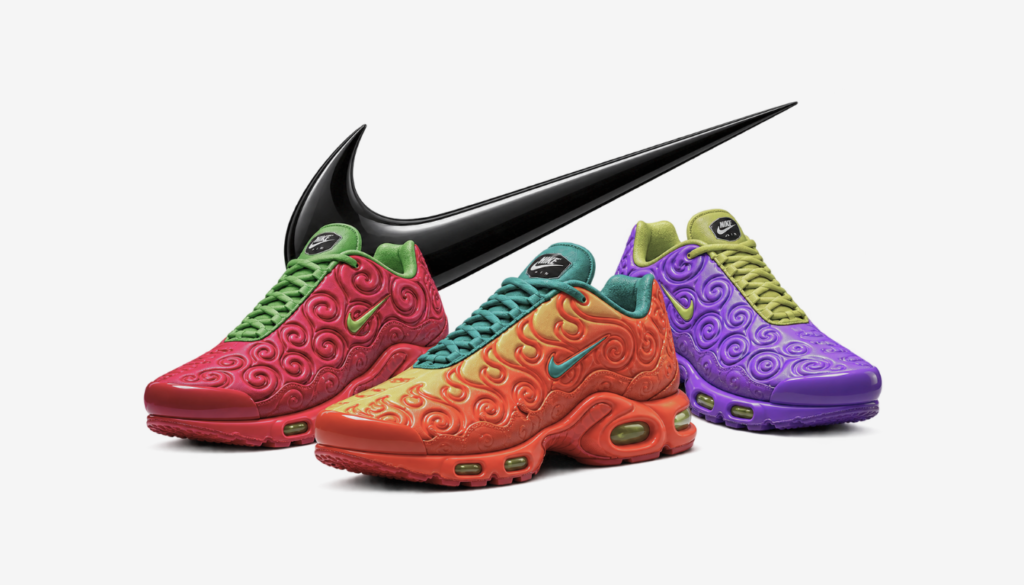
On August 23, Nike unveiled a One Piece collection that pulls one of the world’s largest entertainment franchises onto its shelves, led by three versions of the Air Max Plus inspired by the manga’s Devil Fruits. Rather than restyling an existing shoe, Nike built each pair around a specific power from the story. The Gomu Gomu no Mi, Ope Ope no Mi and Mera Mera no Mi each anchor their own Air Max Plus, with uppers retooled from the ground up rather than recolored, and each carries a $210 price. One Piece is one of the best-selling manga in history, with more than 500 million copies in circulation, and its reach now extends through a long-running anime and a live-action adaptation that widened the audience well beyond its original readers.
The Design Choice Is the Message
Most licensed collaborations resolve into a logo transfer, where a recognizable mark lands on a familiar product and the premium comes from the name alone. Nike took the harder route. The apparel leans hard into the source material, with actual manga panels printed across pieces, a co-branded Nike and One Piece emblem, vintage Nike advertisements redrawn as manga illustrations, and a vest stamped with a Nike-branded Jolly Roger. Reworking the tooling of the Air Max Plus for three separate designs is an expensive way to honor a license, and that expense is the point. It signals that Nike wants the collection judged as design, not merchandise, and that it trusts One Piece fans to notice the difference between a themed sneaker and a repainted one.
A Release Engineered for Scarcity
The rollout is built to concentrate attention. The collection lands first at pop-up and retail experiences beginning September 4 in Tokyo, the natural home for a One Piece launch, before a global release on September 25 through SNKRS. Nike seeded the drop through its .SWOOSH platform with a One Piece Poneglyph teaser, a reference only fans would immediately decode, which rewarded the core audience and turned the announcement into a puzzle worth sharing. Staggering a physical debut in Tokyo ahead of the digital global release stretches the story across weeks and geographies, giving collectors, resellers and media repeated moments to react rather than a single day of noise.
Why Nike Needs Culture Right Now
The timing matters. Nike has spent the past year working through a turnaround under chief executive Elliott Hill, with revenue under pressure and particular weakness in China. In that environment, cultural collaborations do more than generate hype. They give the brand a reason to command full price and a way to reach audiences that a performance-running message cannot. One Piece brings a built-in global fandom that Nike can borrow at a moment when the core business needs the heat, and pairing it with the Air Max Plus, a silhouette with its own deep sneaker-culture equity, doubles the cultural surface area of the launch.
The Collectible as a Content Property
What Nike released is closer to a content property than a product line. The manga panels, the redrawn advertisements and the Jolly Roger vest turn the collection into something fans read as much as wear, and the staggered scarcity turns each piece into a collectible with a story attached. That framing lets Nike operate less like a supplier and more like a studio releasing a limited series, where the value sits in narrative and access rather than availability. It also raises the stakes, because an audience that scrutinizes canon will punish a shallow execution as fast as it rewards a faithful one.
What Marketers Should Take From It
The broader lesson for brand teams is about where the value in a licensing deal actually lives. A logo grants recognition, but recognition is cheap and easy to imitate. Nike is arguing that fandom rewards craft, and that the surest way to convert cultural affinity into demand is to redesign the product so it earns the association. That is a more expensive and slower path than a sticker collaboration, and it carries more risk if the execution misses. For any brand tempted to rent an audience by borrowing a beloved property, the One Piece collection is a reminder that the audience can tell the difference, and that the difference is the whole business.