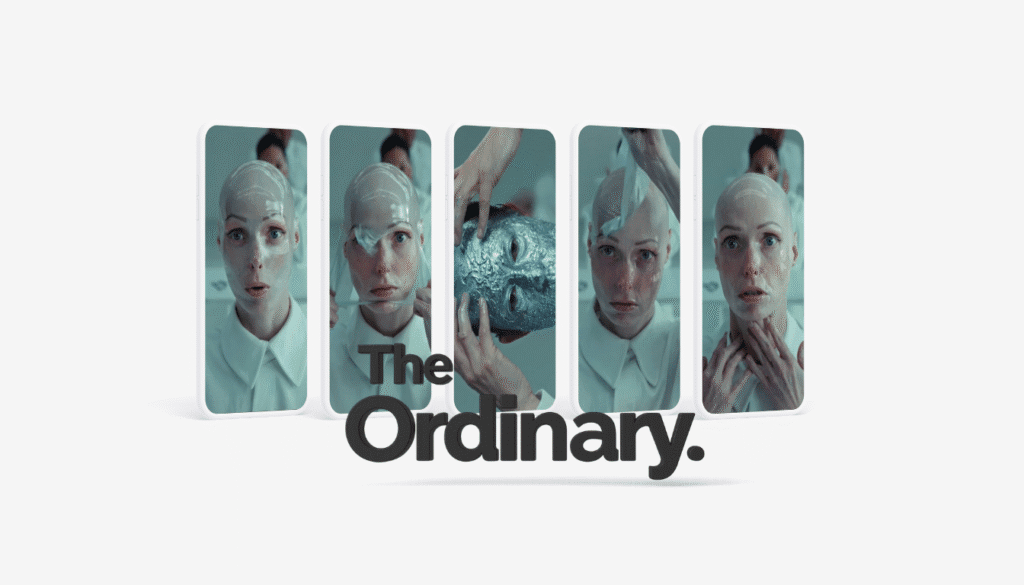
On 14 October 2025, The Ordinary launched its provocative new campaign The Periodic Fable, a global activation that swaps the cosmetic industry’s hallmarks of promise — “eternal youth,” “medical grade,” “fat-freezing,” “poreless” — for fictional “elements” in a mock-scientific table. The effect is to expose how beauty standards are not simply about bodies but built atop persuasive language. The brand, owned by DECIEM, uses the launch to challenge the core of how skin-care is marketed and consumed in 2025.
Rethinking Beauty Standards by Attacking the Claims
Rather than tackling body image head-on, the campaign reframes the problem, questioning how we look and how we are sold looking a certain way. The Ordinary’s shift is clear, turning beauty standards into evidence standards. By highlighting the mechanics of marketing, with the buzzwords, the pseudo-science and the gloss, it invites the consumer to question “do I look like this?” and “did they tell me the truth?”
The strategy follows the brand’s earlier educational platform, combining free myth-busting archives, transparent ingredient discussions, and public commitments to “quality equality.” In that scenario, the periodic-table device is the latest iteration as the brand weaponizes its minimalist, lab-aesthetic identity to stand out not from competitors, but from the industry at large.
Visuals That Disturb to Awaken
Visually, the campaign remains true to The Ordinary’s signature language, leveraging stark monochrome, clean typography and minimal graphic distraction. In addition, the hero film presents a white classroom, students hypnotically enacting viral skin-care routines, such as ice-rolling, massaging, taping, slathering, conforming. Then a projection of the faux periodic table looms large on the wall. Following the scenes, at a moment of fracture one student removes blindfold and nose-plug and approaches the projection. The scene evokes lab discipline and cult ritual simultaneously, appropriate given the brand’s interest in subverting both.
Outdoor and social stills present individual “elements” like “MAGC” (Magic), “ETNY” (Eternal Youth) or “MDGR” (Medical Grade) — each one labelled “Zero Science” beneath. The restraint amplifies impact: you see the word, you feel the promise, you realise the vacuum.
Impact and Cultural Currency
Because the campaign reframes category grammar, it travels easily. Press across the creative, advertising, and beauty industries quickly picked it up. Online, social commentary noted the campaign’s meta-tone, establishing “the industry is its own case study.” In marketing circles, it became an example of “purpose turned craft.”
Commercially, the move supports The Ordinary’s model, including low cost, high transparency, and science-forwardness. By attacking inflated language, the brand aligns consumers’ trust with its value proposition; bringing straightforward actives, no hype, no promises beyond proof. This credibility then becomes a lever for product trial and purchase, making the campaign a truly successful piece.
A Coherent Brand role in Culture
The message behind the campaign is quiet but firm, establishing that the brand won’t just sell products; they help the audience to see how they are sold. In earlier activations, the brand measured the cost of celebrity endorsements; now, it measures the cost of buzzwords. That clarifies a role beyond “skin care brand” into “industry editor.” When a brand becomes a voice about its own category, every campaign becomes a chapter in a broader thesis.
The Ordinary’s play signals two interesting shifts. First, claim-scrutiny is becoming a creative territory in its own right. The language of product is being treated as the subject, not just the medium. Second, beauty purpose is evolving; from body politics (“you must look like that”) to epistemics (“you should know what you’re being told”). This is richer, subtler territory, giving consumers agency, offers transparency, and sidesteps “fix-me” messaging.
In a market saturated with glow-ups, filter-ed realities and influencer-fuelled hype, The Ordinary’s The Periodic Fable offers a jolt of clarity: maybe the real transformation is intellectual.