
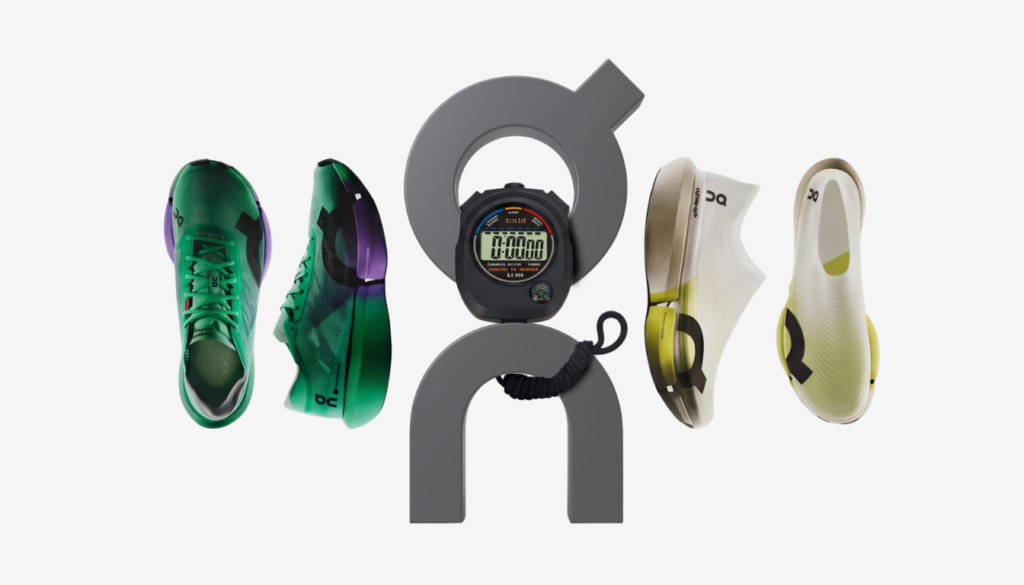
On introduced “Race for the Feeling” on July 30, the first global campaign under a brand platform it calls Run On Clouds. The film, shot in Boulder, Colorado by director Parker Schmidt at CANADA with stills by Joanna Wzorek, follows world champion Hellen Obiri between her daily training routes and the On Athletics Club gym. The idea it sells is compact. At the 22-mile mark of a marathon, fast is not a number you can check, it is something you feel. Obiri supplies the line that anchors the whole thing, describing her course-record run in New York by saying she did not look at her watch because she felt it.
For a company that built its reputation on engineering claims, this is a deliberate turn. Understanding why it happened now requires looking past the film.
The platform arrived at a fashion week
Run On Clouds did not debut at a marathon. On presented it during Paris Men’s Fashion Week in June, weeks before any runner saw the campaign. That sequencing is the most revealing fact available about the strategy, and it went largely unremarked in trade coverage, which focused on the emotional angle and Obiri’s casting.
A running brand that unveils its running platform to a fashion audience is telling the market where it expects growth to come from. The campaign is the second act. The positioning decision came first, and it was made in a room full of buyers and editors rather than coaches and athletes.
The business case sitting behind the creative brief
On’s first quarter of 2026 explains the shift better than any statement from its marketing team. Net sales reached CHF 831.9 million, up 26.4% at constant currency and the first time the company cleared CHF 800 million in a quarter. Gross margin climbed to 64.2% from 59.9%. Management reiterated full-year guidance of at least 23% constant-currency growth, implying reported net sales of at least CHF 3.51 billion.
The composition matters more than the total. Apparel grew 45.1%, or 57.5% at constant currency, far outpacing the company overall. Asia-Pacific grew 61.4% at constant currency and now represents more than a fifth of global sales. On the earnings call, management said the 18 to 24 age group increased its share of the direct-to-consumer customer base by the largest margin since the company began tracking that data, and that the trend accelerated into the second quarter. The launches executives chose to highlight were a Cloudswift relaunch with Kith and a head-to-toe womenswear launch with Zendaya, neither of which is a performance story.
A brand whose fastest-growing category is apparel, whose fastest-growing customer is 22 years old, and whose most visible launches involve a streetwear retailer and an actress is no longer principally selling marginal gains. Run On Clouds is the marketing catching up to the income statement.
What a metrics brand risks when it stops counting
Technical credibility is the asset On spent fifteen years accumulating, and it is expensive to rebuild once spent. The category punishes brands that appear to trade substance for image. Runners notice, and specialty retail notices faster.
On hedged carefully here. The campaign is fronted by a world champion, built around a racing shoe, and tied to LightSpray technology that constitutes an actual manufacturing claim. Feeling is the message; the proof stays in the product. That is the difference between reframing a position and abandoning one.
The precedent the company keeps returning to is tennis, a community On entered from outside and converted into its highest-growth apparel vertical. The wager is that the same maneuver works on an emotion rather than a sport.
Whose territory this actually is
Emotion is ground Nike has occupied for four decades. “Just Do It” is a feeling, not a specification, and the company that owns it generates roughly $51 billion a year against On’s guided CHF 3.51 billion. Competing on the axis where the incumbent is strongest looks like a mistake until you notice that the incumbent has been losing running share to a fragmented group of challengers rather than to any single rival. On and Hoka together hold roughly 19% of the United States premium running market.
The opening exists because the incumbent’s emotional claim has been worn smooth by repetition. A specific feeling, described by a specific athlete at a specific mile marker, is a narrower and more defensible claim than inspiration in general.
Platform, or a campaign wearing a platform’s clothes
On called Run On Clouds a platform and stated explicitly that it is not a rebrand. The distinction deserves scrutiny rather than acceptance. Platforms are cheap to announce and expensive to maintain. The test is not this film. It is whether the next product launch, the next athlete signing and the next retail rollout are built inside the same idea, or whether the brand reverts to specification language the moment it has a technical advantage worth selling.
Most brand platforms fail at exactly that moment. A marketing team commits to feeling, a product team ships something measurably better, and the measurable claim wins the internal argument because it is easier to prove. The Cloudboom communication over the next two quarters will answer the question.
The read for challenger brands
The transferable lesson is about timing. Challengers earn permission with proof, because a new brand has no reservoir of affection to draw on and has to demonstrate that the product works. But proof has a ceiling. It wins the category buyer and stops at the edge of the mass audience, which does not read spec sheets and buys on identity instead.
The moment to shift shows up in the data rather than in a creative meeting. When the fastest-growing categories are the ones people wear rather than compete in, when new customers skew younger than the traditional category buyer, and when the strongest launches come from cultural partners, the brand has already been repositioned by its own customers. Marketing either follows that move or falls out of step with the business it exists to sell.
On appears to have read the signal on schedule. Whether it holds the line is the question the next twelve months will answer.