
From gimmick to infrastructure
For years, AI in advertising was a press-release ingredient, a way to bolt a fashionable word onto work that could have been made without it. That era is ending. Across the industry, agencies and brands are shipping campaigns whose central idea is not decorated by AI but dependent on it. Remove the technology and the campaign does not merely shrink, it disappears. The clearest sign of the shift is that the most interesting recent examples are not conference demos or sizzle reels. They ran in market, they reached real audiences, and they moved measurable numbers, whether adoptions out of a shelter or organic views on a livestream. The question worth asking about any AI campaign is no longer whether the technology was involved, but whether the idea could have existed without it.
Recreating a match that never happened
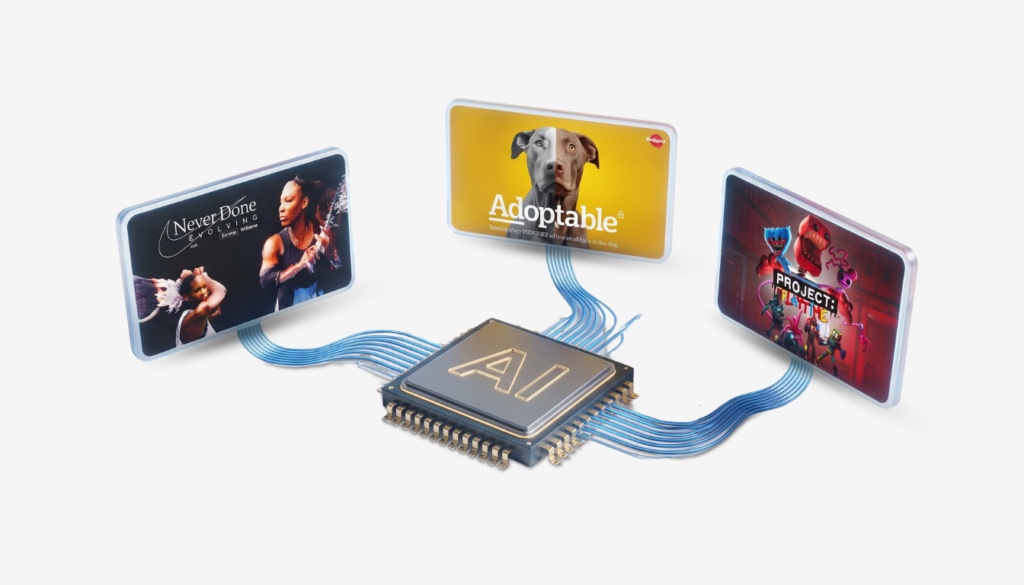
The proof of concept came from Nike. To mark the brand’s 50th anniversary, agency AKQA built Never Done Evolving, a simulated tennis match between two versions of Serena Williams: the 17-year-old who broke through at the 1999 US Open and the champion who won the 2017 Australian Open. Building on a technique called vid2player developed at Stanford, machine learning studied archival footage to model each era’s decision-making, shot selection, reaction time, and recovery, then set the two Serenas against each other across 130,000 simulated games and 5,000 matches. The final match streamed live on YouTube to more than 1.69 million of Nike’s subscribers and drove a 1,082% increase in organic views over the brand’s other content. No archival edit, no body double, and no amount of shoot time could have produced a competitive match between a champion and her younger self. Only a model trained on an entire career could, and that is exactly the point.
Rescuing shelter animals at scale
The more consequential work is less flashy and far more useful. Amazon’s Brand Innovation Lab partnered with PetIQ’s PetArmor brand and Best Friends Animal Society on Protect Playtime, a campaign that pairs an AI matching tool with generative video. A prospective adopter can type a plain-language request, such as a low-energy dog suited to apartment living, and receive tailored recommendations from Best Friends centers across the country. Amazon then used its Nova Reel model to turn static shelter profiles into short, individualized videos that picture each specific animal in a future home. A pilot in Glen Rose, Texas, produced 24 adoptions in a single day, four times the previous record, and the personalized videos ran across Prime Video and Amazon’s streaming inventory. Pedigree pushed the same principle further with Adoptable, made with Nexus Studios, using machine learning to transform ordinary shelter snapshots into polished advertising portraits. Within two weeks of launch, half of the featured dogs had been adopted. Producing bespoke, professional creative for every animal in a shelter system is impossible by hand and trivial for a trained model, and here the payoff is counted in lives rather than impressions.
Reacting at the speed of the game
The 2026 World Cup showed a third category: creative that adapts in real time. FIFA’s restrictions on in-stadium branding left an attention vacuum, and the brands that filled it best used AI-driven dynamic creative that rewrote itself to match live scores and developments on the pitch. Rather than shooting a fixed spot weeks in advance, teams built systems that assembled contextually relevant messages as the tournament unfolded, reaching devoted fans and casual watchers with different creative at the precise moment each was most receptive. The output is not a single advertisement but a responsive engine, and running it by hand would demand an impossible standing army of editors working through the night of every match. The technology did not merely speed the work up. It made a kind of always-on, moment-by-moment relevance possible that no production schedule could ever have delivered.
The line between use and gimmick
What separates these campaigns from the novelty era is a simple test: does the AI enable the idea, or merely advertise itself? Nike’s match, Amazon’s adoptions, and the World Cup’s live creative all pass, because each solves a problem that scale, time, or physics otherwise made unsolvable. Plenty of AI work still fails that test, leaning on the technology as a talking point while delivering something an ordinary crew could have shot for less. The lesson for marketers is not to add AI to the brief for its own sake. It is to reopen the ideas that were once ruled out, the concepts killed in the planning meeting because no one could actually produce them, and to ask whether the technology has now moved them within reach. Increasingly the answer is yes, and the brands that ask the question first will own the ideas everyone else assumed were impossible.