
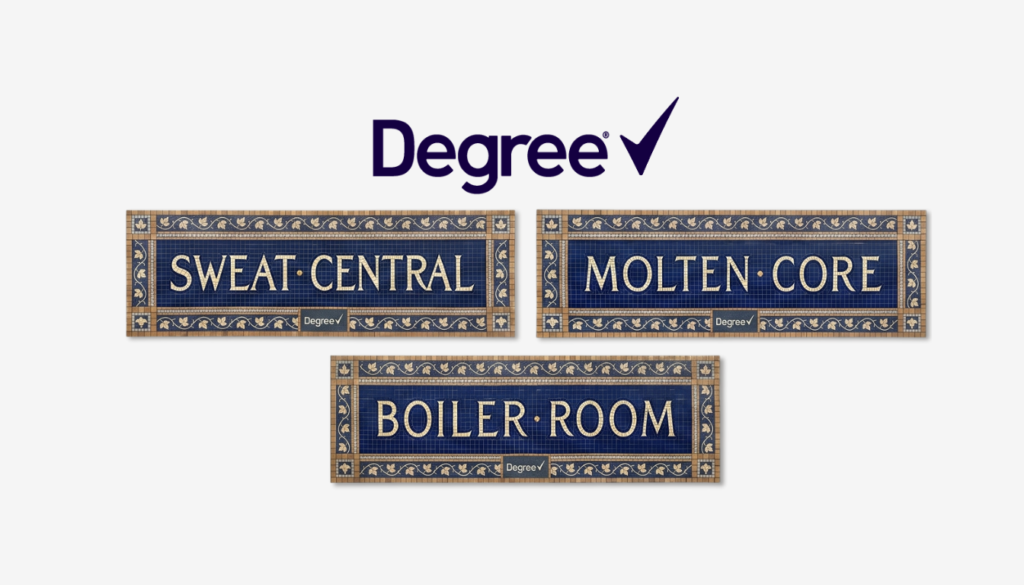
A Stunt Pulled From the Group Chat
Degree spent this summer renaming New York’s most punishing subway stations after what riders already call them. Working with the Metropolitan Transportation Authority, the Unilever deodorant brand rebranded West 4th Street as “Sweat Central,” Union Square as the “Boiler Room” and Herald Square as the “Molten Core,” dressing each stop in Degree out-of-home creative. Turnstile signage declared Degree “The Official Deodorant of the Hottest Commutes.” The campaign, created by WPP Unite, ran through the peak of the season, when the underground becomes one of the least comfortable places in the city.
Social Listening as the Brief
The sharpest part of the campaign is where the idea came from. Degree noticed New Yorkers venting and joking about subway heat on Reddit and other social platforms, and rather than invent a new message it chose to join a conversation already in progress. The brand leans on social listening to shape its marketing, and here it let the audience write the brief. The station nicknames were not conjured in an agency room; they were lifted from the way the city already talks about its own misery, which is why they landed as recognition rather than advertising. The timing helped. A summer of extreme heat, including heat domes settling over the five boroughs, made the exaggeration feel like plain description and pushed the work into a peak sales window for deodorant.
Turning Media Into Utility
Degree did not stop at signage. The takeover included a train wrap and a layer of creator content that carried the stunt beyond the stations and into feeds, building an integrated ecosystem around a single out-of-home idea. The most interesting extension is a limited run of Degree sticks co-branded with the MTA that double as a redeemable free subway fare. That move converts an advertisement into something a rider can use, folding the product into the exact commute the campaign is about and giving people a reason to seek it out rather than scroll past it. An ad becomes a small utility, and a utility becomes a story worth sharing.
The Earned-Media Multiplier
The economics of a stunt like this live in what happens after the install. Renamed stations are built to be photographed, and every rider who posts “Molten Core” becomes a distributor of the campaign at no additional media cost. Degree engineered shareability into the physical world, which is what separates an out-of-home buy that simply occupies space from one that travels. The co-branded fare sticks add a second wave, giving press and creators a fresh reason to cover the campaign weeks after the signs went up. Paid media bought the setup; earned media delivered the reach.
Why It Works in a Low-Interest Category
Deodorant is a low-involvement purchase that rarely earns attention on its own merits. Degree’s answer was to dramatize the precise moment the product exists to solve, the sweat-soaked summer commute, and to do it in the audience’s own language. That combination of relevance and recognition is what gives a commodity category distinctiveness. The business context sharpens the logic. Unilever reported underlying sales growth of 4.8% in the first half of 2026, with its personal care division growing at the same rate, and campaigns like this one are how a mature category defends attention and shelf space against private label and newer challengers.
What Marketers Can Take From It
The Degree campaign is a clean example of three ideas working together. Cultural eavesdropping, in which a brand mines real conversation for a message it could never credibly invent. Location as media, in which the setting of the problem becomes the canvas for the solution. And utility as a call to action, in which the payoff is something the audience can actually use rather than only watch. None of these require a large production budget or a celebrity. They require a brand willing to listen closely, act quickly, and meet its customers exactly where the problem lives. For marketers working in unglamorous categories, that is a more repeatable playbook than chasing spectacle.